

Published: March 5, 2026 | Last Updated: July 3, 2026

Overview
When you watch a western, you often see two worlds in conflict: the lawless frontier and the civilized town. The hero lives between them, more comfortable in the wilderness than at the dinner table. That opposition is a structural pattern that organizes the meaning of the whole film. Structuralism is the approach to film theory that identifies and analyzes those underlying patterns. It grew out of the structural linguistics of Ferdinand de Saussure and the anthropology of Claude Lévi-Strauss, drew on Vladimir Propp’s analysis of narrative, and was brought into film studies by theorists such as Christian Metz.
The central question structuralism asks is not what a film means but how meaning is structured. It looks beneath the surface of a story, an image, or a genre to find the hidden systems of rules, oppositions, and relationships that make meaning possible in the first place.
You encounter structuralism whenever a film studies course asks you to map the binary oppositions in a genre film, apply Vladimir Propp’s narrative functions to a Hollywood story, or analyze how editing creates meaning through sequence. It built the analytical foundation of academic film theory in the 1960s and 1970s, and its concepts run through screen theory in film, psychoanalytic film theory, and contemporary genre analysis.
What Is Structuralism in Film Theory? Definition & Meaning
Structuralism in film theory is an analytical method that reads films by identifying the hidden systems, binary oppositions, and repeating patterns that organize their meaning. Rather than treating a film’s story or images as transparent windows onto reality, structuralism asks what underlying rules produce the meanings a viewer takes away.
Structuralism draws on the linguistic theory of Ferdinand de Saussure, a Swiss linguist; the anthropology of Claude Lévi-Strauss, a French anthropologist; and the narrative analysis of Vladimir Propp, a Russian folklorist. Applied to cinema, it produced the Grande Syntagmatique of Christian Metz, a French film theorist; the auteur structuralism of Peter Wollen, a British film critic; and a genre theory focused on binary oppositions rather than individual films.
Its core assumption is that meaning in film is relational, not individual. An image means something because of its relationship to other images. A character means something because of how they are positioned against other characters. A narrative means something because it follows recognizable deep patterns, even when the surface story looks unique.
Historical Background
Structuralism as a method did not start with film. It began with Ferdinand de Saussure, a Swiss linguist whose lectures were compiled and published after his death as Course in General Linguistics (1916). Saussure proposed that language works as a system of differences: each term gets its meaning from how it differs from everything else in the system, not from any direct match with things in the world (de Saussure [1916] 1959).
The word “cat” does not mean cat because of some inherent connection to the animal. It means cat because it differs from “bat,” “cut,” and “car.” Take away the system of differences, and words stop meaning anything. This idea became the model for structuralism in other fields, including anthropology, literary theory, and eventually film.
Lévi-Strauss and Binary Oppositions
Claude Lévi-Strauss, a French anthropologist whose work in the 1950s and 1960s became foundational for the humanities, took Saussure’s linguistic model and applied it to mythology and culture. In Structural Anthropology (1963), Lévi-Strauss argued that myths across different cultures follow the same underlying logic: they organize their material through binary oppositions, pairs of contrasting terms like raw and cooked, nature and culture, or life and death.
These oppositions are not just surface contrasts. For Lévi-Strauss, they represent the deep contradictions that a culture cannot resolve, and myth is the mechanism by which culture tries to work through or disguise those contradictions. A hero who moves between two opposed worlds is not just a story device; they are a structural solution to a cultural problem (Lévi-Strauss 1963).
Film theorists quickly recognized how well this model fit Hollywood genre cinema, particularly the western, where the opposition between civilization and wilderness is almost always central to the story’s organization.
Propp and the Morphology of Narrative
Vladimir Propp, a Russian folklorist working in the 1920s, published Morphology of the Folktale in 1928. His project was to identify the structural building blocks of Russian folk stories. After analyzing over 100 tales, Propp concluded that they all share 31 narrative functions: a fixed sequence of events that could be combined, skipped, or repeated but never fundamentally reordered (Propp [1928] 1968).
Propp also identified seven character types that recur across stories: the hero, the villain, the dispatcher, the helper, the princess (or prize), the false hero, and the donor. These are structural roles, not psychological portraits. The same character can serve multiple functions, and multiple characters can share one structural role.
When structuralism entered film studies in the 1960s and 1970s, Propp’s framework proved enormously useful. Hollywood genre films follow Proppian patterns with remarkable consistency, and the framework gave analysts a vocabulary for describing narrative structure that did not depend on plot summary.
Structuralism Enters Film Studies
The application of structuralist methods to cinema happened most intensively in France during the 1960s. Christian Metz, a French film theorist, adapted Saussure’s linguistic model in Film Language: A Semiotics of the Cinema (1974). In that book, Metz developed what he called the Grande Syntagmatique: a taxonomy of eight different types of narrative film sequences (Metz 1974). His work belongs to the tradition of film semiotics, but its structural ambition was to identify the grammar underlying all narrative cinema.
In Britain, Peter Wollen, a film critic and theorist, published Signs and Meaning in the Cinema in 1972, which applied structuralist analysis to the western films of John Ford and to auteur cinema more broadly. Wollen, along with Geoffrey Nowell-Smith, a British film scholar who applied structural analysis to the films of Luchino Visconti, helped establish auteur structuralism: an approach that read a director’s entire body of work as a structure of repeated patterns and tensions rather than as the expression of a personal artistic vision (Wollen 1972).
Core Mechanisms: How Structuralism Analyzes Film
The most widely used structuralist tool in film analysis is the binary opposition. The idea comes from Lévi-Strauss: a story organizes its material by setting up pairs of contrasting terms and then working through the tension between them. In film, these oppositions often run through the entire narrative as the story’s organizing principle.
In the western, the key opposition is almost always between civilization and wilderness. The town represents law, family, and social order. The frontier represents freedom, danger, and the absence of rules. The hero moves between these two worlds, and the story works through the conflict between them. Other genres have their own foundational oppositions: in science fiction, it is often technology versus humanity; in horror, it is the ordinary versus the monstrous; in the crime film, it is order versus chaos.
Structuralist analysis does not stop at naming the opposition. It asks how the film positions you relative to each term, which side the narrative rewards, and how the ending resolves or refuses to resolve the conflict. In many westerns, the hero must leave civilization at the end because the same qualities that let him defeat the villain also make him incompatible with settled life. That ending is the structure working through the contradiction between the values the hero represents. This kind of analysis connects to feminist film theory, which applies similar tools to gender oppositions in classical cinema.
Propp’s Functions Applied to Film
Propp’s 31 narrative functions are too numerous to apply mechanically to a feature film, but several of them recur across Hollywood genre cinema with enough regularity to be analytically useful. The core sequence tends to look like this: an initial situation is disrupted by the actions of a villain or by a lack in the hero’s world. The hero is called to action, receives help from a donor figure, confronts the villain, defeats them, and returns. The world is restored, and the hero is recognized or rewarded.
You can trace this sequence in action films, adventure stories, science fiction blockbusters, and superhero films with relatively minor variation. The structuralist point is that the surface content of these stories can differ radically while the underlying narrative structure remains constant. Star Wars (1977) and a 1950s western share a Proppian skeleton, even though almost everything else about them looks different.
Auteur Structuralism: Reading a Director’s System
Classical auteur theory asked what personal vision or worldview a director expressed through their films. Auteur structuralism shifted the question: instead of looking for a personality, it looked for a structure of contradictions. For Peter Wollen, a director’s body of work is best understood as a system in which certain oppositions recur, are never fully resolved, and define what is distinctively interesting about that filmmaker.
In his analysis of John Ford’s westerns, Wollen identified a set of oppositions that run across the films: garden versus wilderness, married versus wandering, settler versus nomad. These oppositions are never neatly reconciled. The hero is always caught between them. That irresolution is the structure, and it repeats across films from Stagecoach (1939) to The Searchers (1956) to The Man Who Shot Liberty Valance (1962) (Wollen 1972).
The Grande Syntagmatique: Film Grammar
Christian Metz’s Grande Syntagmatique approached structuralism from a different angle. Rather than looking at narrative patterns or thematic oppositions, Metz tried to identify the basic units of film syntax: the rules by which shots are combined into sequences, and sequences into narratives.
Metz identified eight types of syntagmatic units, segments that organize images into meaningful groups. An autonomous shot is a single shot forming a complete segment on its own (a cutaway insert or an establishing shot used in isolation). An alternate syntagm cuts between two lines of action happening simultaneously (a chase sequence). An ordinary sequence compresses time to show a scene’s highlights without showing every continuous moment. These are just three of Metz’s eight types, but they illustrate the project: to map the grammar of how films structure time and space (Metz 1974).
The Grande Syntagmatique was ambitious, and later critics found it limiting. But it represented the first systematic attempt to treat film editing as a structured system rather than a set of intuitive choices.
What to Look For: A Structuralist Analysis Checklist
Structuralist analysis works by identifying patterns rather than individual moments. The checklist below is designed to help you build a structural reading of a film, a genre, or a director’s body of work. Apply it systematically, then look for what the patterns reveal about the film’s deeper logic.
- Core binary opposition: What is the film’s central pair of contrasting terms? How does the story set them up and work through the tension between them?
- Supporting oppositions: What subsidiary contrasts reinforce the central opposition? Consider: male/female, past/present, individual/community, inside/outside.
- Structural roles: Which characters fill Propp’s seven roles (hero, villain, dispatcher, helper, princess/prize, false hero, donor)? Does any character occupy more than one role?
- Narrative sequence: Can you identify the major Proppian functions? Where does the disruption occur? Who is the donor? What form does the defeat of the villain take?
- Resolution: Does the ending resolve the central opposition, mediate between the two terms, or leave the tension unresolved?
- Genre patterns: How does this film’s structure relate to the conventions of its genre? Where does it follow the pattern, and where does it deviate?
- Auteur structure: If analyzing a director’s work, what oppositions recur across multiple films? What tensions are never resolved?
Once you have identified the structural patterns, the analytical work begins. Ask why the film organizes its material this way. What does the structure tell you about the assumptions the film makes about its world? What does the resolution (or non-resolution) of the central opposition reveal about the values encoded in the film?
Micro-Analysis: The Searchers (1956)
John Ford’s The Searchers (1956) is the film most frequently cited in structuralist film analysis, and for good reason. It is a western that makes its central binary opposition visible and then refuses to resolve it.
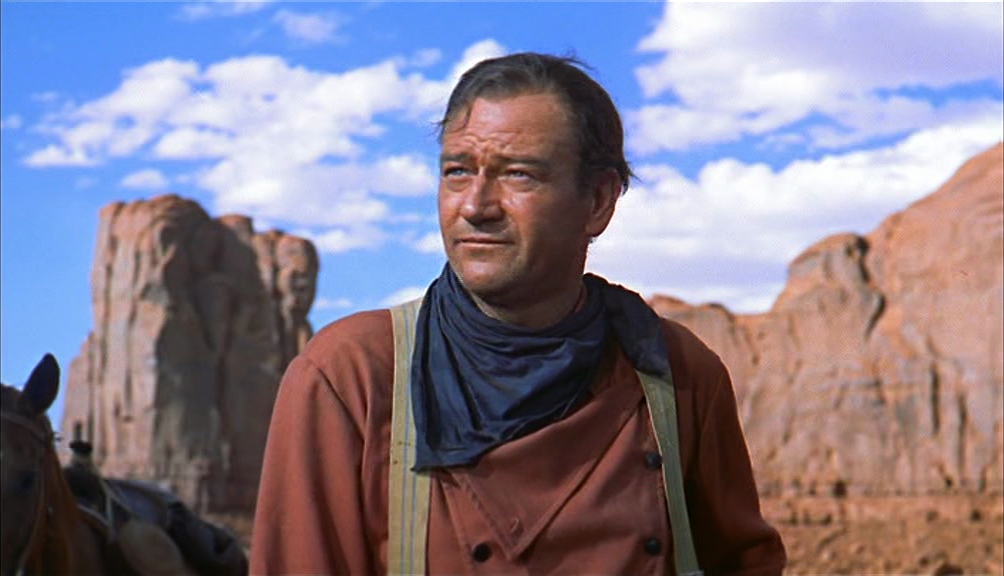
The film follows Ethan Edwards (played by John Wayne), a Civil War veteran who returns to his brother’s Texas homestead and witnesses his family massacred by a Comanche raiding party. Ethan spends years searching for his niece Debbie, who was taken captive as a child. By the time he finds her as a teenager, his stated intention is to kill her because she has become a wife of Chief Scar and, in his view, no longer belongs to his world.
The Opposition: Civilized and Wilderness
Wollen’s analysis identifies the central opposition in Ford’s westerns as civilized versus wilderness. In The Searchers, this maps specifically onto white settlement versus Comanche culture. But Ford’s treatment is more complicated than a simple endorsement of one side.
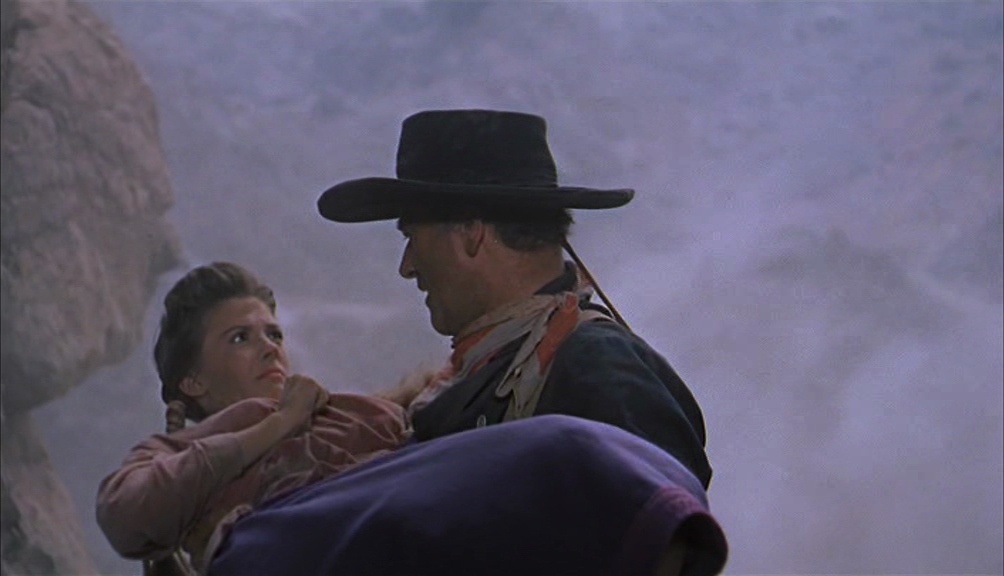
The film maps the opposition onto Ethan himself (Wollen 1972). He is positioned on the side of civilization: he fights for his family, he follows a code, and he is the nominal hero. But his obsessive racial hatred and capacity for violence align him structurally with what the film codes as the opposing term.
The structural result is that Ethan mediates the opposition without resolving it. He can rescue Debbie precisely because he shares the ferocity of the world he is supposed to be fighting. But that same quality means he cannot enter the house at the end of the film. The final image shows Ethan framed in the doorway of the homestead as the family goes inside. The door closes. He walks away alone into the desert.
What the Structure Reveals
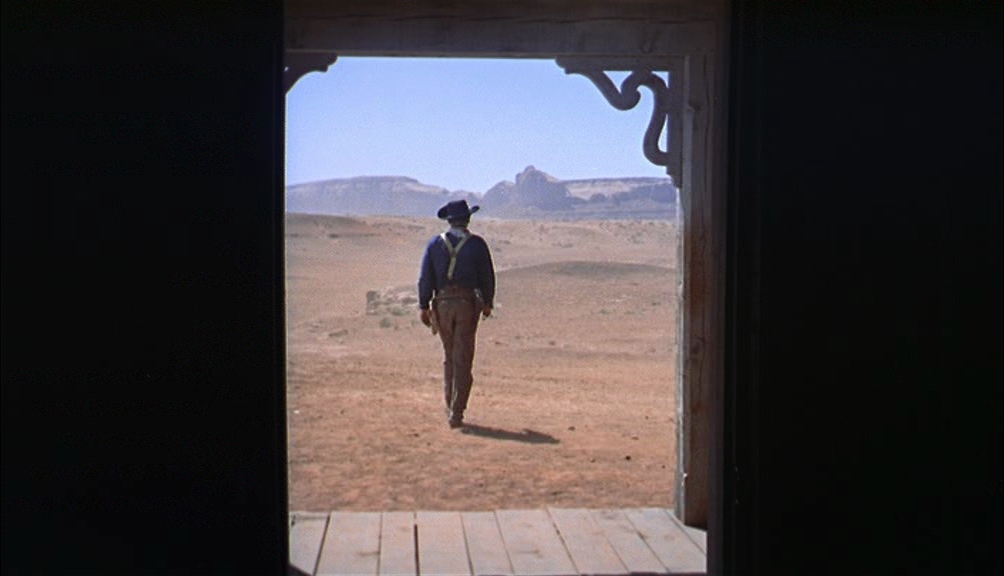
A Proppian reading adds another layer. Ethan fills the role of hero, but he also has qualities of the villain. His initial motivation is rescue, but by the film’s midpoint his stated goal is murder. The structural function of the villain (Scar) has been displaced onto the hero. The film cannot allow Ethan into the house at the end because the structure has revealed that he belongs to the same category as the thing he hunted.
This irresolution is exactly what structuralist critics found most interesting about Ford’s films. The binary oppositions do not collapse into each other; they remain in tension. The structure of the film traces the contradictions in American mythology about the West without offering a clean resolution. That is what structuralism is designed to see.
Additional Film Examples
Below, I’ve picked a couple of other good examples for structural analysis.
Star Wars (1977): Propp in Space

George Lucas’s Star Wars (1977) follows Propp’s narrative morphology so closely that it is frequently used in film studies courses as a teaching example. The initial situation is an ordinary world (Luke on the moisture farm). A villain disrupts it (Darth Vader captures the princess). The hero receives a call to action (the hologram message from Leia). A donor provides a tool with special properties (Obi-Wan Kenobi gives Luke his father’s lightsaber). The hero crosses into a new world (the Millennium Falcon leaves Tatooine). A helper joins the quest (Han Solo). The villain is confronted and defeated. The hero is recognized and rewarded.
See also the monomyth concept for more about this story structure.
Almost every one of Propp’s seven character types is present: Luke is the hero, Vader is the villain, Obi-Wan is the donor, Han Solo is the helper, and Leia is the princess.
See also character archetypes in film.
The structural match is so precise that it raises the question structuralism is designed to ask: what does it mean that this story feels new when its deep structure is ancient?
Stagecoach (1939): Genre as Binary System
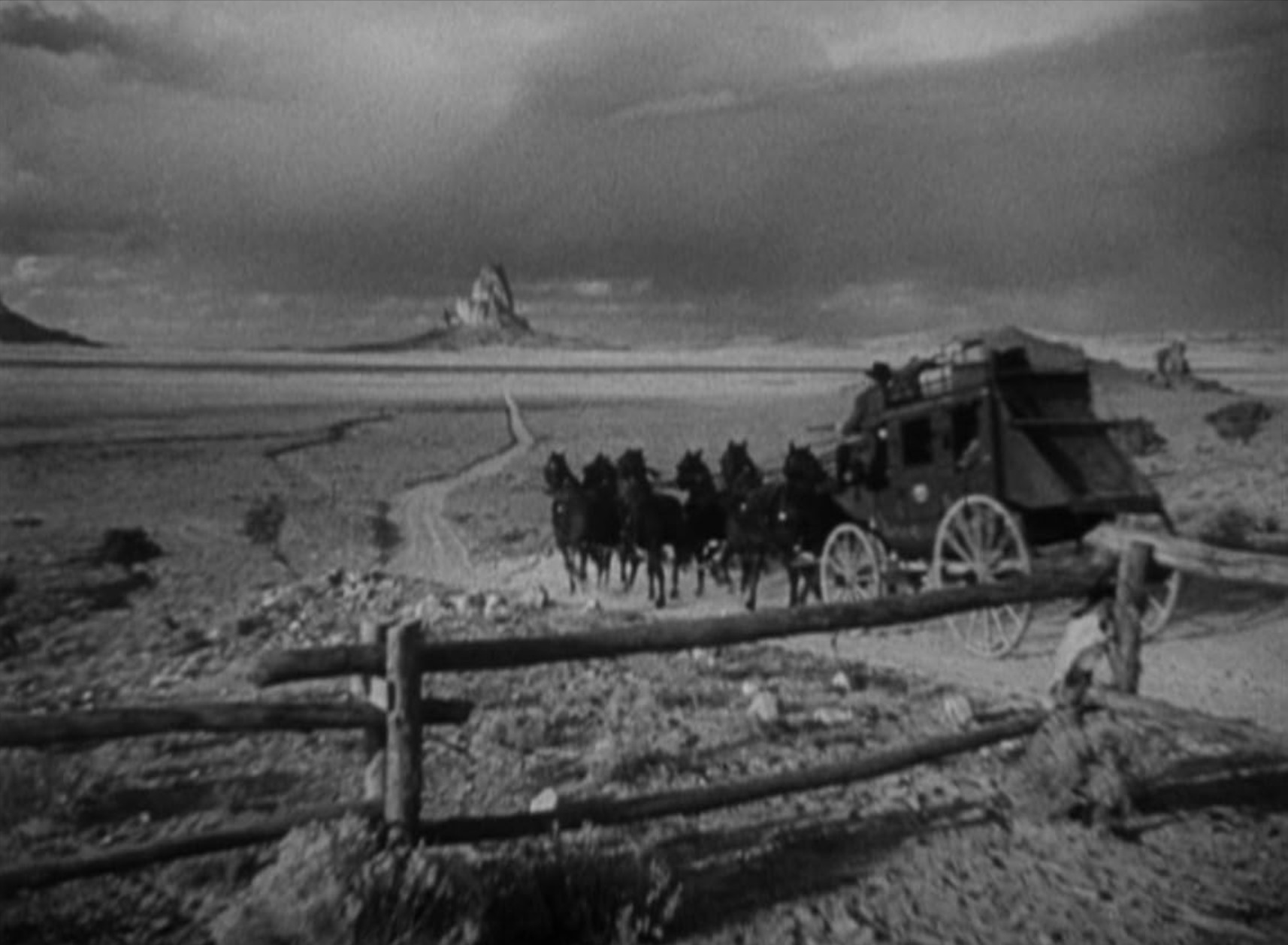
Ford’s Stagecoach (1939) organizes its ensemble of passengers as a set of social types that map onto the civilization-versus-wilderness opposition. The doctor is a drunk (civilization corrupted from within). The banker is a thief (civilization hypocritical). The prostitute has more genuine decency than the respectable women (the social structure inverted). The Ringo Kid, played by John Wayne, is an outlaw who is the moral center of the film.
Structuralist analysis reveals that the film is really about the inadequacy of the social codes that define respectability. The binary opposition between “respectable” and “outlaw” is systematically dismantled by the narrative. The real threat is not external but internal to civilization itself. The structure of the film makes this argument without ever stating it directly.
Rear Window (1954): Paradigmatic Choice in Hitchcock
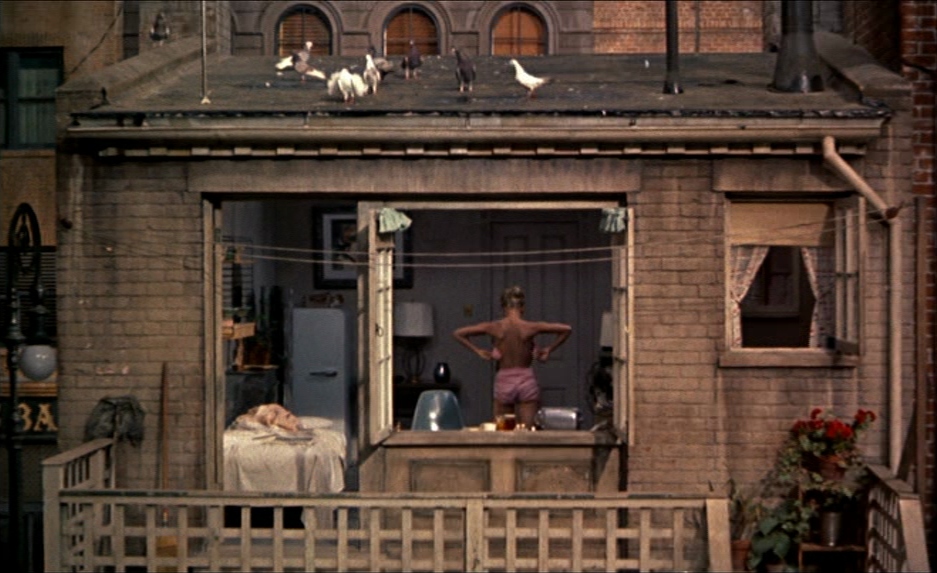
Alfred Hitchcock’s Rear Window (1954) offers a clear example of structuralist analysis at the level of narrative organization. L.B. Jefferies (played by James Stewart) is confined to a wheelchair and passes time watching his neighbors through his apartment window. The film presents him with a set of choices: the different windows he can choose to observe. Each window frames a different kind of life (the dancer, the newlyweds, the childless couple, the songwriter), and each represents a possible future for Jefferies and his girlfriend Lisa.
In structuralist terms, each window occupies a paradigmatic slot: it is one of several alternatives available in the same structural position. Jefferies is not just watching a possible murderer; he is watching the alternatives to his own situation. The structural choice of what to look at is also a choice about what kind of life to want. This connects to debates in spectatorship theory in film about how cinema controls and directs the viewer’s gaze.
Common Misconceptions
Film theoretical discourses often overlap, and it’s easy to get confused. Below are some common misconceptions.
Structuralism Is Not the Same as Semiotics
Structuralism and semiotics in film studies are closely related but not identical. Semiotics is the study of signs and sign systems. Structuralism is a broader method that uses the model of a sign system to analyze cultural phenomena beyond language. Christian Metz’s Grande Syntagmatique is both semiotic (it treats film as a sign system) and structuralist (it looks for the underlying grammar). But not all semiotic film analysis is structuralist, and not all structuralist film analysis is primarily semiotic. The two traditions share their roots in Saussure but developed separately from the 1960s onward.
Structuralism Does Not Say All Films Are the Same
A common objection to structuralism is that if all westerns share the same binary oppositions, then they are all saying the same thing. This misunderstands the method. Structuralism identifies a shared deep structure, but the interest is in how different films handle that structure: which oppositions they foreground, which they suppress, how they stage the mediation between opposed terms, and whether they resolve the central tension or leave it open. The structure is the framework; the analysis is about variation within it.
Auteur Structuralism Is Not Classical Auteur Theory
Classical auteur theory, developed by the French critics associated with Cahiers du cinéma in the 1950s, argued that the best directors impose a personal vision on their films. Auteur structuralism is a critique and revision of that position. Instead of looking for a personality, it looks for a structural system of repeated oppositions and tensions. The director’s signature is a set of contradictions that the films keep circling without resolving. Wollen explicitly separated his method from what he called “auteur theory as a theory of the author-as-origin” (Wollen 1972, 168).
Structuralism Is Not Reductive
Critics sometimes say that structuralism reduces complex films to a diagram of binary oppositions. This is a fair critique of bad structural analysis. Good structural analysis uses the identified pattern as a starting point, then asks what the pattern reveals about the assumptions and cultural contradictions encoded in the film. The binary opposition is a tool, not a conclusion.
Key Debates and Scholarly Criticism
The Problem of the Universal Structure
Lévi-Strauss claimed that binary oppositions are a universal feature of human thought: all cultures organize their myths through the same basic logical operation. Film theorists who applied this claim to Hollywood cinema were making a strong assumption: that the structures they identified were not just conventions of a particular genre or industry but deep patterns of human storytelling.
Critics challenged this on two grounds. First, the universality claim erased historical and cultural difference. If all films follow Proppian patterns, what accounts for the films that do not? Second, the method risked circularity: the analyst looks for binary oppositions, finds them everywhere (because they are looking for them), and concludes that binary opposition is universal. The method appeared to confirm its own premises (Stam, Burgoyne, and Flitterman-Lewis 1992).
The Critique from Post-Structuralism
The most sustained critique of structuralism came from within the structuralist project itself, from thinkers now grouped under the label of post-structuralism in film theory. The French philosopher Jacques Derrida argued that Saussure’s model of meaning as a system of stable differences was incoherent: meaning is never fixed but always deferred along an endless chain of signifiers. There is no final point at which the system settles into stable oppositions.
Roland Barthes, a French literary critic and theorist who had been central to structuralism, moved away from it in later work. In S/Z (1970), he argued that texts are not structured systems to be decoded but plural, open-ended fields in which multiple meanings are produced. For film studies, this meant that the clean structural diagrams of the 1960s gave way to more mobile and contested models of how meaning works (Barthes 1975).
The Limits of Propp’s Model
Propp developed his 31 functions from a specific corpus of Russian folk tales. Critics noted that his model does not generalize cleanly to other narrative traditions. Japanese cinema, African cinema, and art cinema often follow completely different narrative logics. Even within Hollywood, the model breaks down for films that are not organized around a hero’s quest. The analyst who forces every film into Propp’s schema will miss the films that resist it, and those films are often the most analytically interesting.
Quick Contrast: Structuralism and Post-Structuralism
Structuralism and post-structuralism are often treated as a single tradition, but they begin from opposite assumptions. Understanding the difference helps you know which tool to reach for.
Structuralism assumes that meaning is stable and systematic. Underneath the variation of individual films lies a fixed structure that analysis can identify. Binary oppositions, narrative functions, and syntactic categories produce consistent, recoverable meanings. The analyst’s job is to map the structure.
Post-structuralism, by contrast, assumes that meaning is unstable and deferred. Every structure contains internal contradictions that undermine its own logic. Meanings are produced in the act of reading, not encoded in the text. There is no final deep structure to recover: only an ongoing process of interpretation. The analyst’s job is to trace the contradictions, not to stabilize a system.
In practice, many film analyses use elements of both. You can apply Proppian functions to identify a film’s narrative structure and then note where the structure breaks down or contradicts itself. That combination treats structuralism as a starting point and post-structuralism as a method of critique. You can read more about this in our guide to postmodern film theory, which developed alongside the post-structural critique of structuralism.
Why Structuralism Still Matters
Structuralism has been largely superseded in academic film theory by post-structuralism, cultural studies, and other approaches. But its tools remain in active use.
Binary Opposition Analysis: Reading Genre Films
Binary opposition analysis is still the fastest way to identify the assumptions embedded in genre films. When you map the civilization-versus-wilderness opposition in a contemporary western, or the human-versus-machine opposition in a science fiction film, you are doing structural analysis. You are asking what the film takes for granted about the world: what it treats as ordinary and what it treats as threatening. This is also foundational to the kind of genre theory in film that asks how films construct their worlds as credible or artificial.
Narrative Morphology: Propp in Screenwriting and Film Studies
Propp’s functions remain one of the most efficient tools for narrative analysis in screenwriting education and in the study of formalist approaches to film structure. They make the invisible architecture of storytelling visible without requiring any assumptions about what the story means.
Taking Genre Cinema Seriously
Auteur structuralism gave film studies a way to take genre cinema seriously as an object of academic analysis. Before Wollen and Nowell-Smith, the structural patterns in Hollywood westerns or crime films were largely ignored in favor of prestige art cinema. Structuralism demonstrated that popular genre films had a complex logic worth analyzing on its own terms.
Summing Up
Structuralism in film theory asks how underlying patterns of opposition, narrative function, and syntactic structure produce meaning in cinema. It draws on Saussure’s linguistics, Lévi-Strauss’s anthropology, and Propp’s narrative analysis to build a method that looks beneath the surface of individual films and genres.
Its key tools are binary opposition analysis (identifying the contrasting pairs that organize a film’s world), Proppian narrative morphology (identifying the structural roles and functions that recur across stories), and the Grande Syntagmatique (mapping how film editing creates meaningful sequence). Auteur structuralism applied these tools to individual directors’ bodies of work. The method treats each filmmaker’s output as a repeating structure of unresolved tensions.
Structuralism was eventually challenged by post-structuralism, which argued that the stable structures it identified were always more contradictory than the method admitted. But its core tools remain some of the most useful in film analysis. If you want to understand how a film is structured to produce its meanings, structuralism gives you a precise and teachable method for doing that work.
Read Next: Curious how film theory shapes the way we watch movies?
Start with the Film Theory section to break down realism, formalism, structuralism, and more — with examples from iconic films.
If you want studying film theory I recommend starting with The FilmDaft overview of film theory discourses to break down realism, formalism, structuralism, and more — with examples from iconic films.
Then explore the full Film History, Theory & Genre collection to see how movements, styles, and storytelling traditions have evolved.
Whether you’re into Soviet montage or 2000s genre mashups, there’s something here to sharpen your understanding.
Structuralism in Film FAQ
What is structuralism in film theory?
Structuralism is an approach that analyzes films as systems of signs, codes, and binary oppositions. It asks not what a film means but how its meaning is structured, drawing on structural linguistics and anthropology.
Who are the key thinkers behind structuralist film theory?
Ferdinand de Saussure (linguistics and semiotics), Claude Lévi-Strauss (myth and binary oppositions), Vladimir Propp (narrative functions), and Christian Metz, who applied linguistic models directly to cinema.
What are binary oppositions in film?
Paired opposites — such as civilization versus wilderness, light versus dark, or nature versus culture — that organize a film’s meaning. Structuralists map these oppositions to reveal a story’s underlying pattern, like the frontier and the town in a western.
What is the difference between structuralism and semiotics?
Semiotics studies individual signs and how they signify; structuralism looks at the larger systems and oppositions those signs form. They overlap heavily but are not identical.
What is the difference between structuralism and post-structuralism?
Structuralism seeks stable underlying structures and universal patterns, while post-structuralism argues those structures are unstable and that meaning is endlessly deferred.
References
- Barthes, Roland. 1975. “An Introduction to the Structural Analysis of Narrative.” New Literary History 6 (2): 237–272.
- de Saussure, Ferdinand. (1916) 1959. Course in General Linguistics. Translated by Wade Baskin. New York: Philosophical Library.
- Lévi-Strauss, Claude. 1963. Structural Anthropology. Translated by Claire Jacobson and Brooke Grundfest Schoepf. New York: Basic Books.
- Metz, Christian. 1974. Film Language: A Semiotics of the Cinema. Translated by Michael Taylor. New York: Oxford University Press.
- Nowell-Smith, Geoffrey. 1967. Visconti. London: Secker and Warburg.
- Propp, Vladimir. (1928) 1968. Morphology of the Folktale. Translated by Laurence Scott. Austin: University of Texas Press.
- Stam, Robert, Robert Burgoyne, and Sandy Flitterman-Lewis. 1992. New Vocabularies in Film Semiotics: Structuralism, Post-Structuralism and Beyond. London: Routledge.
- Wollen, Peter. 1972. Signs and Meaning in the Cinema. London: Secker and Warburg.
