

Published: March 3, 2026 | Last Updated: July 3, 2026

Overview
Psychoanalytic film theory treats cinema as a machine that produces desire. Instead of asking what a film “means” like a novel, it asks what the film does to you while you watch. It applies the ideas of Sigmund Freud and Jacques Lacan — especially the mirror stage — and was shaped for cinema by Christian Metz and Laura Mulvey. It looks at how films create identification, pleasure, anxiety, and even quiet ideological compliance. The theory draws on Sigmund Freud, the Austrian neurologist who founded psychoanalysis, and Jacques Lacan, the French psychoanalyst and psychiatrist who reworked Freud through structural linguistics.
The field took shape in the 1970s, where French film theory, British Screen journal criticism, and feminist film analysis overlapped. A central claim is that cinema’s formal setup (the dark room, the bright screen, the cut-to-cut logic of editing) can echo unconscious processes such as voyeurism, fetishism, the mirror stage, and suture.
On this view, cinema works as a psychical apparatus. It positions you as a desiring subject and can pull you into ideological positions you might not notice while the film is running.
You will run into psychoanalytic film theory across almost every area of film studies. Its vocabulary (the male gaze, suture, scopophilia, primary identification, and secondary identification) shows up in analyses of genre, gender, and ideology.
Knowing the key concepts helps you read the core texts of 1970s Screen theory. It also helps you understand the Post-Theory critiques that pushed back in the 1990s.
What Is Psychoanalytic Film Theory? Definition and Meaning
Psychoanalytic film theory within film studies is a critical framework that uses ideas from Sigmund Freud and Jacques Lacan to analyze how films position you as a desiring subject. It treats cinema as an apparatus that produces identification, visual pleasure, and ideological compliance through clear formal mechanisms you can point to in the film.
Psychoanalytic film theory sits in a cluster of frameworks (alongside Screen theory, apparatus theory, and feminist film criticism) that treat cinema as ideologically productive, not neutral or “transparent.” The main focus is the subject position a film builds for you, and what kind of desire the film asks you to invest in. Political and aesthetic value often enter later, after the structure is mapped.
The theory covers the formal conditions of film viewing (the apparatus), the mechanisms of spectatorial identification, and the ideological effects both can produce. Its limits matter too. It is not designed to answer empirical questions about real audience behavior, and its universal claims about “the spectator” have been challenged by intersectional and postcolonial critics. In psychoanalytic film analysis, the main evidence is the film’s formal structure itself: editing patterns, point-of-view construction, spatial organization, and the ideological positions those choices build.
Historical Background
Psychoanalytic film theory did not appear out of nowhere. It grew from a specific mix of French intellectual culture in the late 1960s, the British journal Screen in the early 1970s, and a feminist film criticism movement that expanded alongside both. Freud and Lacan were already major influences in literary theory and structural linguistics before film scholars brought those ideas into cinema studies.
Movies as waking dreams
One of the earliest major film-theory turning points is Jean-Louis Baudry’s essay “Ideological Effects of the Basic Cinematographic Apparatus.” It was published in the French journal Cinéthique in 1970 and translated into English in Film Quarterly in 1974. Baudry, a French film theorist and novelist, argued that the physical setup of cinema (camera, projector, screen) carries built-in ideological force.
Baudry compares the setup to Plato’s allegory of the cave: a spectator held in place, watching moving images of a world they cannot reach directly. He argues that film viewing can feel like a waking dream, and this claim became a key starting point for apparatus theory.
Movies as a representation of the past
Christian Metz, a French film theorist whose work on film semiotics helped define the discipline, extends this approach in essays collected in The Imaginary Signifier (published in French in 1977, translated into English in 1982).
Metz uses ideas from Freud and Lacan to explain what makes cinema feel so gripping. His “imaginary signifier” names a central paradox: you see a moving, lifelike image, but the thing the image shows is not there in front of you. What you watch is always already gone. The film is always already past.
Screen Theory
In Britain, the journal Screen became a key home for psychoanalytic film theory in the early 1970s. Writers such as Stephen Heath, a film theorist and literary critic associated with Cambridge, and Colin MacCabe, a film scholar known for work on the “classic realist text,” published essays that used Metz’s ideas alongside Althusserian ideology critique. This body of work is often grouped as Screen theory.
The most widely read text from this period is “Visual Pleasure and Narrative Cinema” (1975) by Laura Mulvey, a British film theorist and filmmaker.
The Male Gaze
Mulvey combines Freud’s ideas about scopophilia and voyeurism with Lacanian thinking about the gaze. Her argument is that Hollywood cinema often builds a masculine viewing position into the film’s structure, meaning the male gaze. Her essay became a foundation for psychoanalytic feminist film theory and remains one of the most cited texts in film studies.
The Female Gaze
By the mid-1980s, a second generation of scholars revisited and complicated the early model. Mary Ann Doane, a feminist film theorist known for work on female spectatorship and desire, published “Film and the Masquerade” in 1982. The essay asks what changes when women watch film, and what kinds of viewing positions are available to them.
Kaja Silverman, in The Acoustic Mirror (1988), shifts attention to the female voice in cinema, which the early gaze model often treated as secondary. E. Ann Kaplan, a feminist media scholar, explores psychoanalytic questions in genre cinema and the maternal melodrama.
How Psychoanalytic Film Theory Works
Psychoanalytic film theory is not one single method. It is a family of approaches that use different Freudian and Lacanian concepts to explain how films position you, and what ideological work that position can do. Four mechanisms are central in the tradition: apparatus theory, Metz’s identification model, Mulvey’s account of the gaze and scopophilia, and suture theory.
Apparatus Theory
Baudry’s apparatus theory starts with the physical setup of film viewing. You sit in a dark space and face the screen. You cannot see the projector behind you. Baudry argues that this repeats the basic structure of Plato’s cave, where prisoners take projected shadows as reality.
Baudry also connects this setup to the structure of a dream. Your body is mostly still. Your movement is limited. Your attention is pulled into images you do not control in the moment.
The key implication is that the film’s “reality effect” can work as an ideological effect. It can happen through the viewing setup itself, not only through what the story says.
Apparatus theory argues that cinema can work below conscious thought. The conditions of viewing can soften the boundary between self and image, which makes it easier for the film to position you inside its world and its logic.
Primary and Secondary Identification
In The Imaginary Signifier, Metz separates two levels of cinematic identification. Primary identification is identification with the camera (more precisely, with the act of looking the camera performs), not with a character.
You “borrow” the camera’s access. You can be everywhere in the story space, see what the film lets you see, and move through the world without being challenged inside the film. Metz links this to Lacan’s mirror stage, where the infant forms an imaginary sense of a unified self by recognizing an image.
Secondary identification is identification with characters, or with a character’s look inside the story. When the editing gives you a character’s optical point of view, you momentarily take up that character’s position.
Secondary identification is what most people mean when they say they “identify” with someone on screen. Metz’s point is that primary identification comes first. You identify with the film’s looking position before you identify with anyone in the story. That matters because it places cinema’s ideological force in form as well as narrative.
The Gaze and Scopophilia
Mulvey asks where cinema aims its visual pleasure. Using Freud’s idea of scopophilia, the drive to look and take pleasure in looking, she argues that Hollywood often organizes images for a masculine viewing position. This is about structure, not biology. The film can invite any spectator to adopt that masculine look through framing and editing.
Mulvey describes two main modes that Hollywood often uses when the female figure becomes a source of anxiety in Freudian terms. One mode is voyeurism: the male protagonist watches, investigates, and punishes, which turns looking into control. The other is fetishism: the female figure becomes spectacle, with visual display used to push away the threat by turning her into a polished image.
In Mulvey’s model, the male gaze works through both modes. Camera angles, cutting patterns, and the direction of looks inside scenes can be organized to deliver these pleasures across a whole narrative.
Suture
Suture theory, developed by Jean-Pierre Oudart and expanded by Stephen Heath in “Notes on Suture” (1977), explains how editing can “stitch” you into the film’s space. The term comes from Lacan’s account of how the subject enters the symbolic order. In film, suture often shows up in the shot/reverse-shot pattern that drives most dialogue scenes.
A shot shows a space (a face, a room, a landscape), but the frame also hides what sits outside it. That cut-off edge can create a sense of lack. Someone might be off-screen. Something might be missing. The reverse shot then fills the gap by showing what the first shot implied, often the character whose look motivates the first view.
That “answer” resolves the lack and locks you into the film’s spatial and narrative logic. Suture theory argues that this matters ideologically because it can hide the film’s construction. Each absence gets patched with a narrative solution, which can make you feel like a participant inside the world instead of someone watching a built system.
What to Look For: A Practical Checklist
To use psychoanalytic film theory well, start with concrete formal observations. Then connect those patterns to concepts like the gaze, suture, and identification. These areas usually give you the strongest evidence in a scene or sequence.
- Camera behavior around the body: Does the camera linger, fragment, or display a character’s body in ways that go beyond basic story function? Do different characters get different kinds of close-ups or tracking moves?
- Point-of-view structure: Whose optical point of view does the editing adopt? Does the film align your look with a specific character’s look? Is that character centered or marginal?
- Shot/reverse-shot patterns: How does the film build off-screen space, and how does it “solve” it? When you sense an absent field, what fills it? Is the suture smooth, or does the film break it on purpose?
- Voyeurism and fetishism: Are there moments where someone watches without being seen? Are there moments where appearance becomes spectacle and pauses the story for display?
- Identification cues: Which character’s knowledge drives what you know? Which character’s desire acts like the engine of the plot?
- Anxiety and disavowal: Do you see patterns that look like anxiety management, such as repetition, fetishistic display, or sadistic investigation?
- The apparatus: Does the film hide its construction, or does it show it? Breaks in the diegesis (direct address, reflexive moments, unmotivated camera moves) can matter as much as smooth classical technique.
After you gather observations, connect them to the theoretical mechanisms. The goal is to show how specific formal choices position you as a desiring subject, and what ideological consequences that position can have. The goal is not to deliver a simple verdict on whether a film is sexist.
Micro-Analysis: Vertigo (1958)
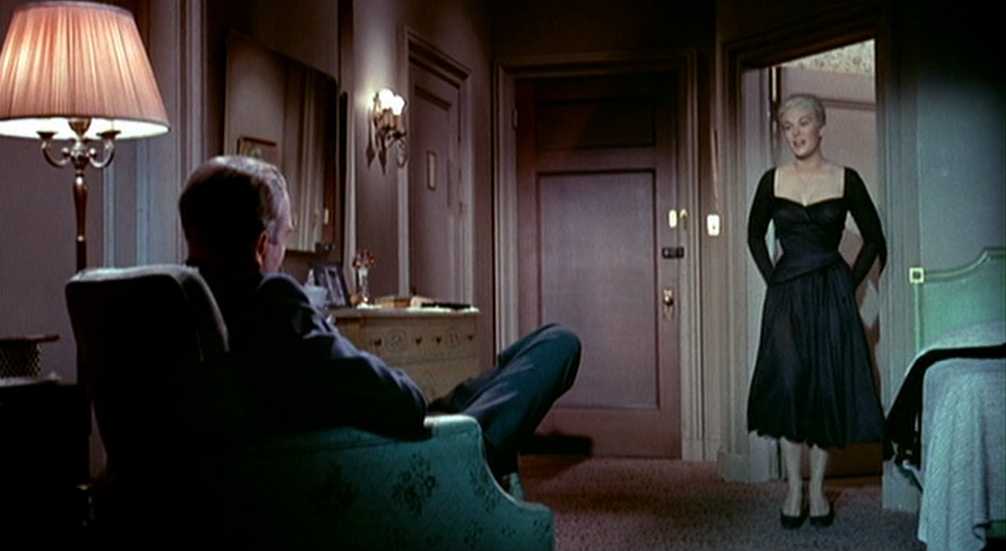
Alfred Hitchcock’s Vertigo (1958, Paramount Pictures) is the go-to example in psychoanalytic film theory. Scholars like Laura Mulvey, Slavoj Žižek, a Slovenian philosopher and cultural theorist, and Todd McGowan have all used it because the film makes desire, fetishism, and the gaze easy to track in the film’s form, not just in the plot.
The key sequence happens in the final third. Retired detective Scottie Ferguson (James Stewart) sees Judy Barton (Kim Novak) on the street and clocks her resemblance to Madeleine, the woman he believes died and whose death he blames himself for. Scottie then starts rebuilding Judy into Madeleine. He buys her clothes that match Madeleine’s wardrobe. He pushes her to dye and style her hair. He demands she copy Madeleine’s look down to the details.
Hitchcock stages the transformation with a blunt visual logic. When Judy walks out of the bathroom “finished,” with blonde hair twisted into Madeleine’s chignon, the camera moves into a 360-degree tracking shot as they embrace. The shot does not just show romance. It shows a fantasy locking into place.
Then Hitchcock takes it further. The hotel room briefly dissolves into the stable at San Juan Bautista, where Madeleine supposedly died. Two women collapse into one image. The film presents that collapse as the payoff of Scottie’s desire. The camera stays close to Scottie’s perspective, so your viewing position fuses with his project.
From a psychoanalytic angle, this is fetishism in Mulvey’s sense. The “real” Judy, a working-class woman from Salinas who carries the truth about Gavin Elster’s murder plot, is a source of anxiety. The film manages that anxiety through transformation, which is the fetishistic move, instead of through investigation, which is the voyeuristic move. Judy becomes an aesthetic surface. Her threatening reality gets pushed away by the construction of a clean visual substitute.
Scottie’s desire is to see Madeleine. Judy only matters as material he can reshape into that image. The film’s gaze structure, tied tightly to Scottie’s look, pulls you into complicity with that disavowal.
Judy does have an inner life in the film, but it is boxed in. She writes a letter that confesses the deception, then does not send it. Her perspective gets one flashback, and then the film moves right back under Scottie’s desire. The letter never reaches him. You learn the truth before he does, but that dramatic irony does not break the film’s main alignment. The film still keeps you riding Scottie’s look and wanting what he wants.
Additional Film Examples
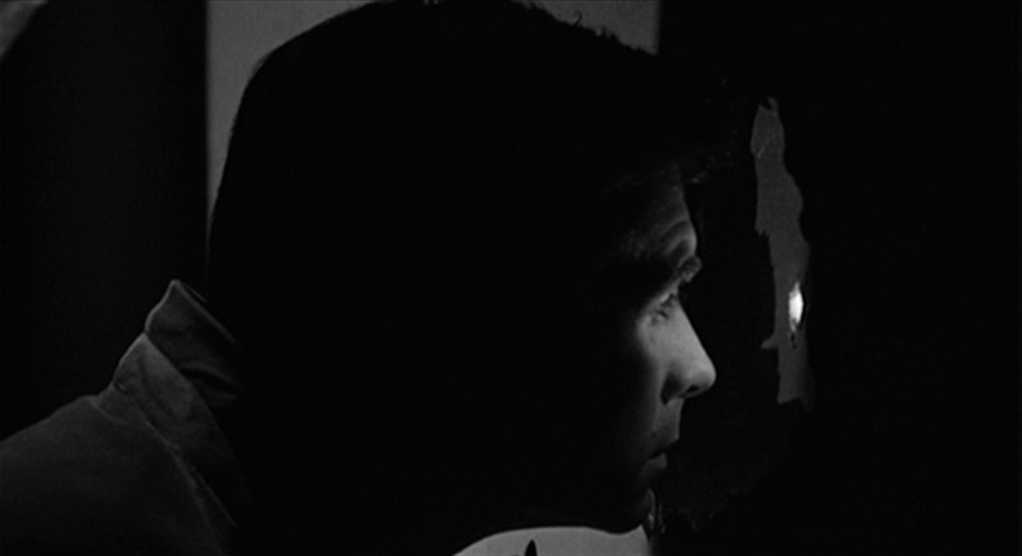
Psycho (Alfred Hitchcock, 1960) offers one of cinema’s most explicit stagings of scopophilia. The voyeur is Norman Bates (Anthony Perkins), who watches Marion Crane (Janet Leigh) undress through a peephole concealed behind a painting in the motel office. Hitchcock implicates the spectator directly: the camera adopts Norman’s point of view, cuts to Norman watching, then returns to his point of view.
The spectator is positioned to share the voyeur’s look before knowing Norman is a murderer. When the shower scene follows, and Marion is killed, the formal logic of the previous sequence has already established a complicity between the spectator’s visual pleasure and the violence that follows. Norman’s voyeurism and the spectator’s pleasurable looking occupy the same formal position.
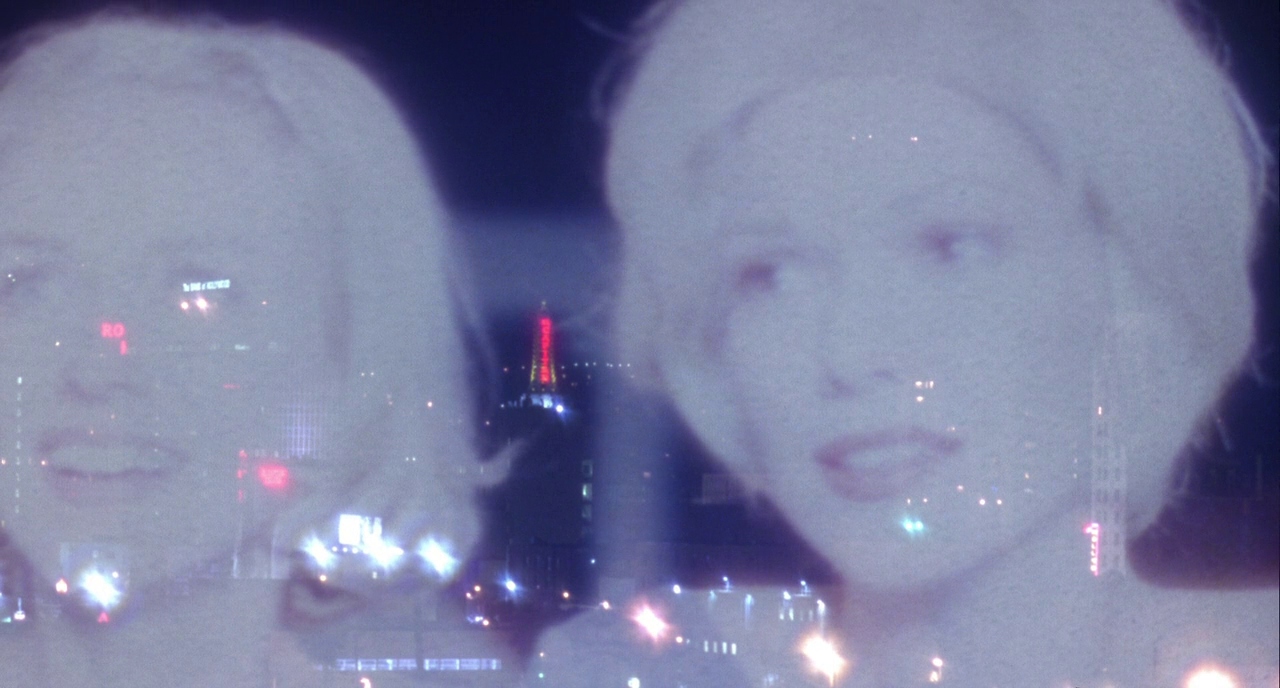
Mulholland Drive (David Lynch, 2001) has generated substantial psychoanalytic analysis, particularly through Todd McGowan’s work in The Real Gaze (2007). McGowan argues that the film dramatizes the Lacanian Real (the dimension of experience that resists symbolization) rather than the Imaginary or Symbolic registers that dominate most narrative cinema.
The first two-thirds of Mulholland Drive present an apparently coherent, if dreamlike, narrative. The film’s structural break in its final act discloses that the earlier narrative was a fantasy formation: a compensatory structure erected around a traumatic Real that the fantasy was designed to conceal. The spectatorial position shifts from inside the fantasy to confronting the desire that produced it.
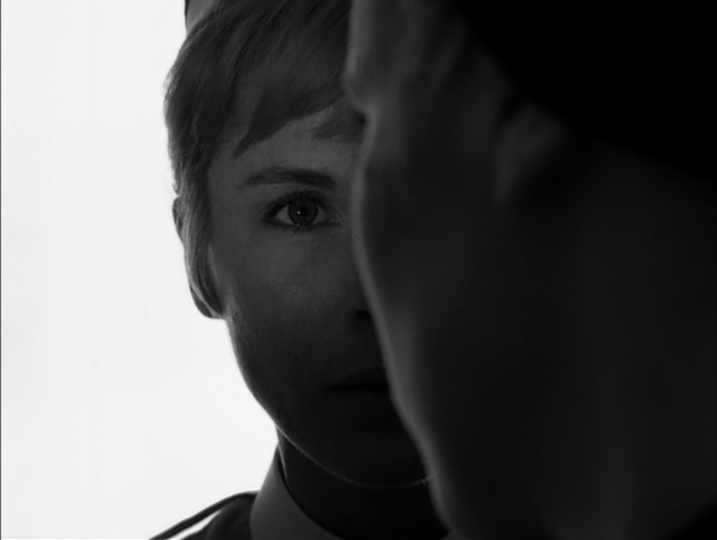
Persona (Ingmar Bergman, 1966) tests the limits of identification by staging its near-dissolution. Nurse Alma (Bibi Andersson) gradually merges her identity with that of the silent actress Elisabet Vogler (Liv Ullmann). Bergman uses formal devices (a deliberate splice in the celluloid, a double-exposure that merges both women’s faces into a single composite image) to make the mechanisms of identification visible rather than invisible.
The viewing position Persona builds stays unstable the whole time. You cannot hold on to one steady identificatory alignment with either woman, because the film keeps messing with the line between them. Their faces, voices, and identities start to bleed together, and the film never fully lets you “lock in” who you are supposed to be with.
Persona lets you test what happens when a film refuses suture, meaning the normal editing and point-of-view tricks that usually smooth over gaps and make identification feel natural.
Common Misconceptions
A common misconception is that psychoanalytic film theory says every viewer reacts to a movie in the exact same way.
That is not what Christian Metz or Laura Mulvey are doing. They describe structural positions that the film builds through its formal organization. They are not running a psychology test on individual viewers. The real question is: how is the film put together so it tends to push you toward certain ways of looking and identifying? That matters more than whether a person consciously feels voyeurism or thinks about the mirror stage while watching. So a psychoanalytic analysis stays focused on the film’s structure, not on any viewer’s private inner life.
Psychoanalytic film theory is not biographical
A second misconception is that psychoanalytic film theory is the same as reading a movie like the director’s diary. Using these ideas does not mean you dig into the director’s unconscious or try to guess their private trauma from a weird image. The focus is on the film’s form. That means editing patterns, how space is organized, point of view, and the viewer positions the film are built through those choices.
So a psychoanalytic reading of Vertigo (1958, Paramount Pictures) does not need any claims about Alfred Hitchcock as a person. It needs clear evidence of how the movie trains you to look, want, and identify.
The male gaze isn’t just about men looking at females
A third misconception is thinking the male gaze just means male characters look at female characters in the story. In Laura Mulvey’s idea, the male gaze is built into the film’s formal apparatus. It is in the framing, editing, and story setup that steer your attention. Hollywood often organizes scenes so your look lines up with a masculine subject position, no matter who you are sitting in the seat. So the gaze is a structure the film creates. It is not a label for what anyone chooses to do.
Psychoanalytic film theory isn’t one unified school with one shared set of claims
In real film studies, it is a messy field with real disagreements. Jean-Louis Baudry focuses on the cinema apparatus, meaning the screen, the camera, and the viewing setup that trains how you see. Christian Metz comes at film through semiotics, meaning how movies work like a language system of signs.
You also get splits between early gaze theory from Laura Mulvey and later Lacanian revisions from Todd McGowan, which rethink how desire and identification work on screen.
And there is a major debate about the viewer. Some Screen theory models treat the spectator as a mostly universal subject. Feminist critics argue that the spectator is situated by gender and power. Postcolonial criticism adds that viewing is also shaped by empire, race, and the history of who gets to be the “default” subject on screen.
Key Debates and Scholarly Criticism
The most sustained institutional critique came from David Bordwell, a film scholar known for major research on film style and narration, and Noël Carroll, an American philosopher of art and film.
In their co-edited book Post-Theory: Reconstructing Film Studies (1996), Bordwell and Carroll argue that a lot of psychoanalytic film theory is unfalsifiable. Their point is simple: if your key ideas cannot be tested against evidence, then the theory can explain almost anything after the fact. Concepts like the unconscious, the subject, and primary identification are hard to check in a concrete way, so the readings can feel consistent while still being disconnected from any observable mechanism of film viewing.
They push for replacing “Grand Theory” with middle-level research. That means tighter questions, clearer terms, and methods from cognitive science and film history. This argument became a major foundation for the Post-Theory movement, which tries to reground film analysis in claims you can actually test or verify.
Political Critiques of the “Universal Spectator”
A second line of criticism targets the spectator that early psychoanalytic film theory often assumes. In the work of Metz and early Mulvey, the spectator can sound like a single “universal” subject, with the same unconscious operations no matter their race, class, sexuality, or nationality.
bell hooks, an American cultural critic and author, challenges this directly in “The Oppositional Gaze” (1992). hooks argues that Black women spectators were historically treated as invisible inside Hollywood’s visual system. Because of that history, their viewing practices often involve critical resistance, not passive identification. hooks’ broader point is that the “universal” spectator in apparatus theory tends to smuggle in a specific default, a white, heterosexual subject, while presenting it as everyone.
Revisions from Within Psychoanalysis
A third line of revision comes from inside psychoanalytic theory itself. Todd McGowan draws on Jacques Lacan’s later work on the Real and objet petit a, and argues in The Real Gaze (2007) that the first wave of psychoanalytic film theory often misread Lacan’s idea of the gaze.
In McGowan’s account, Metz and Mulvey tend to place the gaze on the side of the subject, meaning the spectator “has” the look and the film is the thing being controlled by that look. Lacan’s version flips the pressure. The gaze belongs to the object. What unsettles you is the moment the film feels like it is “looking back,” when an image or object breaks your sense of control and forces you to confront something that does not fit your desire or your explanation.
How Cognitive Film Theory and Psychoanalytic Film Theory Differ
Psychoanalytic film theory and cognitive film theory both care about how you respond to cinema, but they disagree on almost everything else.
Cognitive film theory, linked to David Bordwell, Noël Carroll, and Murray Smith (a philosopher of film known for his work on character engagement), treats you as an active information-processor. That means you watch, notice cues, and build an understanding of the story by using learned schemata and basic cause-and-effect reasoning.
The cognitive model aims for empirical methods and falsifiable claims. Its unit of analysis is the individual viewer making inferences and emotional responses in real time.
Psychoanalytic film theory places you in a different relationship to the film. You are a desiring subject, and your response is shaped by unconscious investments in the film’s images before you ever “think through” what they mean. The method is mostly interpretive. The claims are mainly theoretical, not experimental. The unit of analysis is the link between the film’s formal structure and the unconscious positions that structure builds for you.
A simple way to see the split is the questions each approach asks. Cognitive theory asks: How do you understand what you see? Psychoanalytic theory asks: What do you desire, and how does the film recruit and steer that desire through form?
Murray Smith’s Alignment Model vs Psychoanalytic Identification
In cognitive film theory, Murray Smith separates different kinds of character connection, often framed as perceptual, affective, and epistemic alignment. The idea is that you can track what you see, what you feel, and what you know about a character, and treat those as conscious or near-conscious processes.
Psychoanalytic theory treats identification as more basic and mostly unconscious. At the level of primary identification, what you “identify with” is not a character. It is a looking position, the camera’s perspective, and the film’s access to space, faces, and bodies. Because that identification works below conscious awareness, the ideological effects are not something you can reliably recover by simple introspection like “I felt X, so the film did Y.”
A post-structuralist angle would add one more complication. Even though cognitive film theory and psychoanalytic film theory disagree on method, both often lean on a fairly coherent subject, meaning a stable “you” who processes information or “you” who desires.
Post-structuralism pushes back on that stability. It argues that the moment you enter language, the self becomes split and slippery, because language speaks through you as much as you speak through it. Psychoanalysis adds a similar pressure from the unconscious, which is full of drives, gaps, and contradictions you do not fully control.
So from this view, both frameworks can be criticized for assuming a subject that is more unified than the theory of language and the unconscious actually allows.
Why It Still Matters
Psychoanalytic film theory still has real analytical value because the mechanisms it describes still show up in contemporary cinema. Films still organize looking in uneven ways. Films still use editing to pull you into a specific identificatory position. Films still manage narrative anxiety through voyeurism, fetishistic display, and sadistic investigation.
The viewing setup has changed. We now watch in multiplexes and on home streaming, not only in the classic art-house theater. But the basic “mental setup” that Jean-Louis Baudry describes is not locked to one format. When a movie builds an immersive screen world and asks you to give your attention and body over to it, many of the same pressures can still apply.
Where the Theory Fits Best
The theory works best on films built from classical Hollywood conventions, because that is what it was designed to analyze. That includes continuity editing, shot/reverse-shot patterns, and linear narrative organized around individual desire.
If you move to avant-garde cinema, documentary, or films that deliberately break classical rules, the tools often need adjustment. You can still use them, but you have to be careful about what the film is refusing.
When Films Refuse Suture
A suture analysis becomes especially revealing when a film breaks the usual shot/reverse-shot machine. That is why work by Jean-Luc Godard and Chantal Akerman is useful here. When a film holds on long takes, blocks easy point-of-view, or refuses the “clean” back-and-forth of dialogue coverage, you can see the theory’s assumptions in action. You learn what suture normally does by watching what happens when the film will not let it happen.
Revisions and the Ongoing Legacy
The original framework was also too universal. Feminist, intersectional, and postcolonial critics have heavily revised it. No serious contemporary scholar applies Metz’s or Mulvey’s 1970s model as-is.
But those revisions are part of the legacy, not a reason to throw the project away. Psychoanalytic film theory helped build the core questions that still guide a lot of film studies today: what viewing position does a film assign you, whose desire does the film serve, and how do pleasure and ideology link through images?
Summing Up
Psychoanalytic film theory took shape in the 1970s, where three strands met: French apparatus theory, British Screen journal criticism, and feminist film analysis.
The core claim is that cinema works like a psychical apparatus. In other words, a film does not only tell a story. It also uses form to place you in a position as a desiring subject. That positioning happens through specific, nameable mechanisms: the apparatus (Jean-Louis Baudry), primary and secondary identification (Christian Metz), the male gaze and scopophilia (Laura Mulvey), and suture (Stephen Heath, Jean-Pierre Oudart).
Taken together, these tools explain how cinema can produce ideological effects through more than plot and dialogue. The argument is that ideology can be built into the conditions of viewing themselves, meaning how a film organizes looking, knowledge, absence, and identification through editing and camera position.
The field has also changed a lot since those founding texts. Post-Theory critics push for claims that can be tested and challenged, not just defended inside the theory’s own language. Intersectional and postcolonial critics challenge the idea of one universal spectator, and show how viewing positions shift across race, gender, class, sexuality, and historical context. Lacanian revisionists argue that early film theory often simplified or misread Jacques Lacan, especially on what “the gaze” is and where it sits.
What remains is a toolkit that still works when you apply it carefully: the gaze, suture, identification, and scopophilia. These concepts keep producing useful analyses of how films organize desire, build ideology, and construct the subject through form.
Psychoanalytic Film Theory FAQ
What is psychoanalytic film theory?
An approach that treats cinema as a machine for producing desire and identification, using Freud’s and Lacan’s ideas to explain how films act on the viewer’s unconscious — not just what they mean.
What is the mirror stage, and how does it relate to film?
Lacan’s mirror stage is the moment an infant misrecognises its reflection as a unified, masterful self. Christian Metz compared watching a film to this: the spectator identifies with the image on screen much as the child does with the mirror.
What is the “gaze” in film?
The look structured by the camera and the characters. Laura Mulvey argued that classical cinema builds a male gaze that positions women as objects to be looked at.
Who are the key psychoanalytic film theorists?
Sigmund Freud and Jacques Lacan (foundational), Christian Metz (The Imaginary Signifier), Laura Mulvey (the male gaze), and later Slavoj Žižek.
How is psychoanalytic film theory used to analyse a film?
By reading a film’s images and structures for unconscious desire, voyeurism, identification, and repression — asking who looks, who is looked at, and what fantasies the film satisfies.
References
- Baudry, Jean-Louis. 1974. “Ideological Effects of the Basic Cinematographic Apparatus.” Film Quarterly 28 (2): 39–47.
- Bordwell, David, and Noël Carroll, eds. 1996. Post-Theory: Reconstructing Film Studies. Madison: University of Wisconsin Press.
- Doane, Mary Ann. 1982. “Film and the Masquerade: Theorising the Female Spectator.” Screen 23 (3–4): 74–87.
- Heath, Stephen. 1977. “Notes on Suture.” Screen 18 (4): 48–76.
- Kaplan, E. Ann, ed. 1990. Psychoanalysis and Cinema. New York: Routledge.
- McGowan, Todd. 2007. The Real Gaze: Film Theory After Lacan. Albany: State University of New York Press.
- Metz, Christian. 1982. The Imaginary Signifier: Psychoanalysis and the Cinema. Translated by Celia Britton, Annwyl Williams, Ben Brewster, and Alfred Guzzetti. Bloomington: Indiana University Press.
- Mulvey, Laura. 1975. “Visual Pleasure and Narrative Cinema.” Screen 16 (3): 6–18.
- Silverman, Kaja. 1988. The Acoustic Mirror: The Female Voice in Psychoanalysis and Cinema. Bloomington: Indiana University Press.
- Žižek, Slavoj. 1992. Everything You Always Wanted to Know About Lacan (But Were Afraid to Ask Hitchcock). London: Verso.
