

Published: March 4, 2026 | Last Updated: July 3, 2026

Overview
A close-up of trembling hands. A red dress at a crime scene. A two-note musical motif just before something terrible happens. Each of these is a sign. Semiotics is the study of how signs work and how they make meaning. The field grew from the work of Ferdinand de Saussure and Charles Sanders Peirce, and was brought into film studies by theorists such as Christian Metz, Roland Barthes, and Peter Wollen.
In film studies, semiotics gives you a tool for asking not just what a film shows, but how it produces meaning, and why that meaning lands the way it does.
You will come across semiotics in almost every film studies course. Its vocabulary turns up in screen theory, psychoanalytic film theory, and cultural analysis. If you want to understand where much of the film theory from the 1960s to the 1980s came from, this is where it starts.
What Is Semiotics in Film? Definition & Meaning
Semiotics in film is the study of how movies make meaning through signs: images, sounds, and editing choices that communicate through shared cultural codes. It treats cinema not as a window on reality, but as a system of choices, each one carrying meaning for the viewer.
The field draws on two main traditions. Ferdinand de Saussure, a Swiss linguist, gave semiotics its core vocabulary: the sign, the signifier, and the signified. Charles Sanders Peirce, an American philosopher, added the icon-index-symbol framework. From the 1960s onward, theorists including Christian Metz and Roland Barthes applied these ideas directly to cinema.
The key claim is simple: meaning in film is made, not found. A film encodes the world through a series of choices, and viewers decode it using knowledge they bring from their culture. Semiotics maps both sides of that exchange.
Historical Background: How Semiotics Entered Film Studies
Semiotics has two founding figures who never collaborated and barely overlapped.
Saussure and Peirce
The first is Ferdinand de Saussure, a Swiss linguist who lectured in Geneva in the early 1900s. His ideas were compiled by students and published after his death as Course in General Linguistics in 1916. His key insight was this: signs get their meaning not from the things they refer to, but from how they differ from other signs in the same system. The word “cat” means what it does because it is not “bat,” “hat,” or “rat.” He called the science he was proposing “semiology” (de Saussure [1916] 1959).
The second is Charles Sanders Peirce, an American philosopher working at roughly the same time. Peirce took a broader view. He wanted a theory that could cover all kinds of signs, not just language. He came up with a three-part model: icon, index, and symbol. It has proved especially useful for film, because cinema works with all three types at once.
Christian Metz and the Ambition of Film Language
The person who brought semiotics into film studies properly was Christian Metz, a French theorist working in the 1960s and 1970s. His goal was bold: treat cinema as a language and analyse it with the same rigour that linguists applied to speech.
In Film Language: A Semiotics of the Cinema (1974), he introduced the Grande Syntagmatique: a catalogue of eight types of narrative segment that he argued formed something like a grammar of film. Nobody had attempted this kind of systematic breakdown within a structural linguistic framework before (Metz 1974).
His specific models did not last. Later scholars picked them apart. But the project changed what film studies could do: analysts now had a structured vocabulary for asking how films organise images into meaningful sequences.
Roland Barthes and the Layer of Myth
Around the same time, the French critic Roland Barthes was working on a related problem: what do images actually show, and what do they mean?
In his essay “Rhetoric of the Image” (first published in French in 1964; translated into English in 1977), he argued that every image works on two levels at once. The first is denotation: what is literally there. The second is connotation: what the image means culturally. A photograph of a beach at sunset literally shows sand, water, and light. But it also carries meanings of leisure, romance, and escape. You bring those meanings to the image; they are not in the image itself.
Barthes had explored this idea earlier in Mythologies (1957), where he called it myth. Myth, for Barthes, is what happens when cultural ideas get presented as if they were natural and obvious. Film is one of the main ways this happens (Barthes 1957).
Peter Wollen and the Turn to Peirce
In 1969, the British critic Peter Wollen published Signs and Meaning in the Cinema (revised in a second edition in 1972). His argument was direct: Saussure’s model was too narrow for film.
Saussure had focused on language as an abstract system of verbal signs. Peirce’s theory, by contrast, was designed to cover all kinds of signs: images, physical traces, and conventional symbols. Wollen argued that Peirce’s icon-index-symbol framework was a better fit for cinema, which works with all three types at once (Wollen 1972).
How Semiotics Analyzes Film: Sign, Signifier, Signified
A sign, for Saussure, has two parts.
The first is the signifier: the physical form. In Saussure’s original model, this was a mental sound-pattern. Film semiotics, following Metz, extends it to include the visual image on screen: the word “fire,” or the image of flames.
The second is the signified: the concept the signifier calls up. Fire, heat, danger. Together they form the sign.
Here is the key thing: the connection between signifier and signified is arbitrary. There is no natural reason why the sound “fire” should mean fire. It means fire because speakers of English agree it does. The same applies to film. A red dress has no built-in meaning. It picks up meanings through repeated cultural use. A viewer who does not share that cultural background may read the same dress completely differently.
Icon, Index, Symbol
Peirce sorted signs into three types, and all three show up in film.
An icon resembles what it stands for. A photograph of a face looks like that face.
An index has a real physical or causal connection to what it points at. Smoke is an index of fire because fire produces smoke. A footprint is an index of the person who made it. You can read more about how this works in film in our guide to indexicality in cinema.
A symbol has no natural connection to what it represents. The link is purely by convention. A red traffic light means stop because we all agree it does. There is nothing naturally “stop” about red.
Film uses all three at once. A shot of a gun is iconic (it looks like a gun), indexical (it was produced by a real camera pointed at a real object), and symbolic (it carries cultural meanings about violence, power, or threat). Part of doing a semiotic reading is asking which type of sign is doing the most work in a given scene.
Denotation and Connotation
Every image in film operates on two levels at once.
Denotation is what you literally see: a man in a dark suit sitting behind a large desk. Connotation is what that image means culturally: authority, power, threat, control. You add the second layer automatically, using knowledge you bring from your culture.
Barthes’s insight was that these two levels are never truly separate. The image looks self-evident: it looks like it is just showing you a man at a desk. But the meaning is already built into the choices: the suit, the desk, the framing. Those are all coded (Barthes 1977).
See also positive and negative connotations in film.
Codes: The Grammar Behind the Image
A code is a shared system of conventions that lets meaning travel from a film to a viewer. You know what a shot means because you have learned the code, and so has the director.
Technical codes are the conventions of camera craft. A high angle looks down on a subject and makes them appear vulnerable or powerless. A low angle looks up at a subject and makes them appear dominant or threatening.
Cultural codes are the things you bring from outside the film. White signals purity in many Western contexts, but it signals mourning in many East Asian ones. A ticking clock means time is running out.
Cinematographic codes are conventions specific to the medium. The eyeline match, for instance, tells you that a character in one shot is looking at whatever appears in the next shot: another character, an object, or a space.
No code works alone. In any given scene, several codes are running at once, and the meaning comes from how they combine (Stam, Burgoyne, and Flitterman-Lewis 1992).
Paradigm and Syntagm
Two more concepts from Saussure are essential to film semiotics.
A paradigm is the set of choices available at any given moment. When a director shoots a scene in close-up rather than wide shot, those two options are in a paradigmatic relationship: both were available, and choosing one rules out the other. The meaning of a choice depends partly on what was not chosen.
A syntagm is what you get when you put chosen elements in sequence: the actual order of shots in the finished film. A close-up followed by a wide shot creates a different effect from a wide shot followed by a close-up. This is the principle behind the Kuleshov effect in film editing: viewers build meaning from juxtaposition, not from single images in isolation. The combination does the work (Metz 1974).
What to Look For: A Semiotic Film Analysis Checklist
Use this checklist whenever you are doing a semiotic reading of a scene. Work through each category, then ask how they combine. That is where the analysis really begins.
- Signs in the frame: What objects, colors, clothing, or spatial arrangements carry cultural meaning? Are they iconic, indexical, or symbolic?
- Codes at work: Which technical codes (camera angle, distance, lighting) are active? Which cultural codes does the scene assume you bring with you?
- Denotation versus connotation: What does the shot literally show? What does it culturally mean? Where do those two levels diverge?
- Paradigmatic choices: What alternatives existed for this moment? What does the director’s choice communicate that a different choice would not?
- Syntagmatic sequence: What comes before and after this shot or scene? How does the sequence alter meaning?
- Sound as sign: What does the music, dialogue, or silence signify beyond its surface function? Is the score acting as an index (signalling something present or approaching) or a symbol (representing a character or theme through pure convention?
- Myths at work: What ideas does the film present as obvious or inevitable that are actually cultural constructions?
Once you have gone through each category, the real work begins. Do not just list the signs. Show how they work together and how the combination produces a meaning that none of them could produce on their own.
Micro-Analysis: The Opening Scene of The Godfather
The opening scene of Francis Ford Coppola’s The Godfather (1972) is one of the most studied sequences in cinema. It runs roughly three minutes and sets up the film’s entire sign system in that time.
What You See and Hear
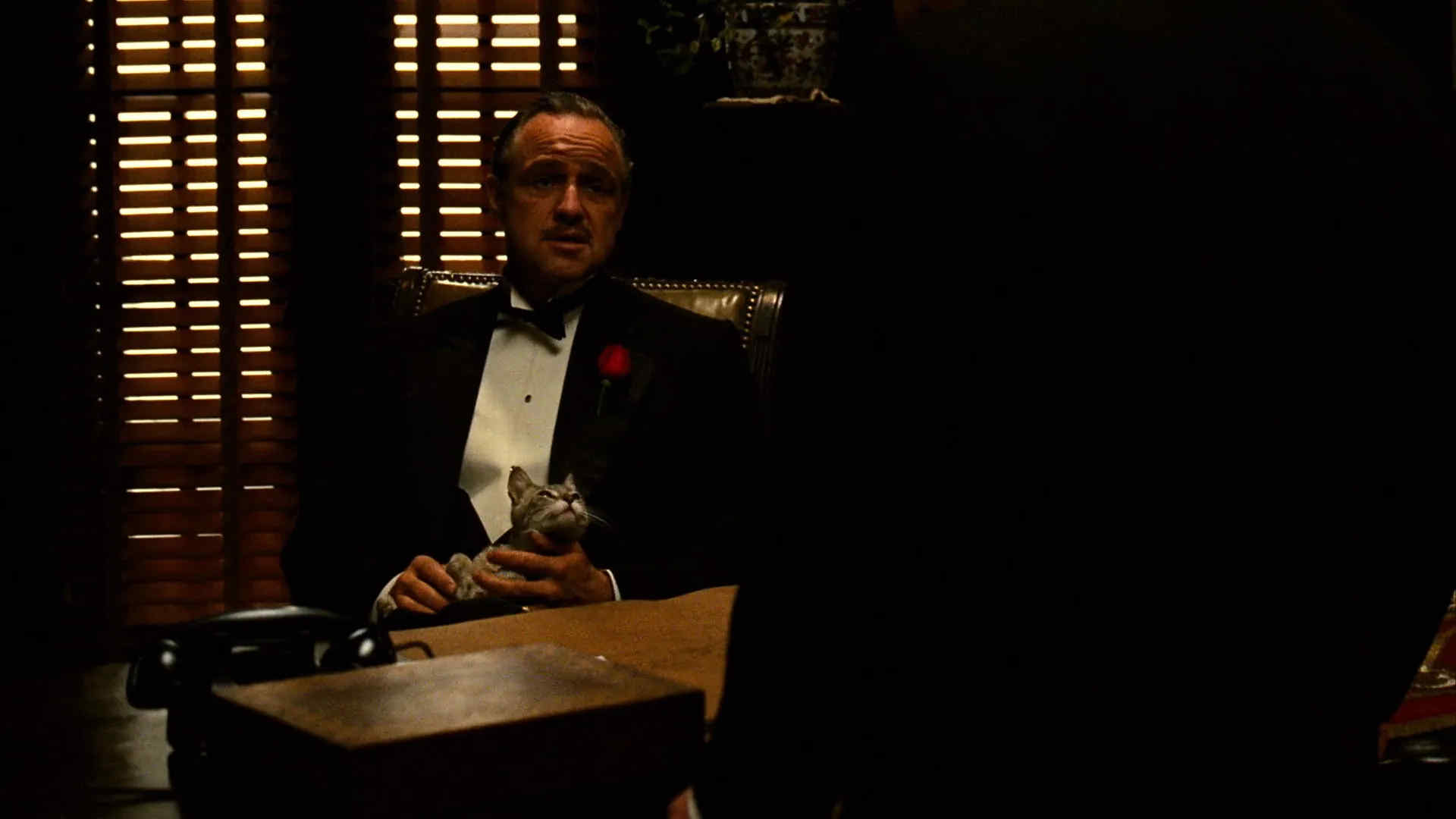
The film starts in total darkness. A voice says, “I believe in America.” The camera holds tight on the face of Amerigo Bonasera, an undertaker, asking a favour. As he speaks, the camera slowly pulls back to show Don Vito Corleone sitting in shadow, a cat on his lap. The room is almost completely dark. Through the window behind Corleone, you can see a bright outdoor wedding — but from inside the study, it feels out of reach.
Corleone barely speaks. He listens, strokes the cat, and eventually answers in a quiet rasp. The scene is almost silent apart from Bonasera’s voice and the faint sound of the wedding outside. The man asking for help stands; Corleone sits. That physical arrangement of the room is itself a sign.
The Sign System at Work
Start with the darkness. In Western cinema, shadow reads as secrecy, threat, and crime. Corleone sits inside it, only half-visible. The wedding outside reads as normal life, light, and family. The shot puts both worlds in the same frame but keeps them apart. The light is there, but Corleone’s world cannot reach it — and neither can you.
Then there is the cat. Iconically, a cat is a domestic animal. It suggests calm and refinement. But Corleone is holding it, while people come to ask favours, they are afraid to refuse. That combination produces a specific connotation: civilised menace. The calmer and more elegant the surface, the more controlled the danger underneath. It is worth noting that the cat was unplanned: Marlon Brando found it wandering on set. That does not change what it means on screen. In semiotics, meaning comes from the finished combination of elements, not from what anyone intended.
The room’s layout is also working as a sign. Corleone sits; the people asking favours stand. He is framed slightly from below; Bonasera from above. This is a technical code that signals authority without a word of dialogue. And the wedding visible through the window is itself a paradigmatic choice: Coppola could have opened on the street or inside the celebration. Instead, he opened in the study, with the wedding visible but inaccessible. That choice tells you that this world runs parallel to ordinary life, just beneath it.
More Film Examples
Let’s look at a couple of more examples.
Jaws (1975): The Indexical Sign in Sound
Think about the famous two-note leitmotif. The first time you hear it, it means nothing: it is just a sound. But the film teaches you. Every time those two notes play, the shark follows. By the third or fourth repetition, your body responds before the shark appears.
In semiotic terms, the theme starts out as a symbol: a sound with no natural connection to anything dangerous. But through repetition, it picks up an indexical quality: it starts pointing forward to the shark’s arrival. The notes become a signal, not just a sound. By the end of the film, the score works as a conditioned warning built through learned association.
2001: A Space Odyssey (1968): The Symbolic Match Cut
Stanley Kubrick’s 2001: A Space Odyssey (1968) has one of the most famous edits in film history.
A prehistoric ape-man throws a bone into the air. The film then match-cuts (it’s the first one in the video below) to a spacecraft in orbit. The bone and the spacecraft sit in the same place in the frame, so your eye links them right away.
At the simplest level, this is syntagmatic. Two shots are placed one after the other, so the cut creates meaning through sequence.
But the cut does something more. Because the images match in screen position, the bone and the spacecraft feel like they can swap places. The bone can stand in for the spacecraft, and the spacecraft can stand in for the bone. In semiotics, that swap is called paradigmatic equivalence: the edit puts both objects into the same structural slot, so you read them as the same kind of tool, just at different stages of history. Together, they make an argument about human development that no single image could make alone.
Parasite (2019): Social Hierarchy as Spatial Code
Bong Joon-ho’s Parasite (2019) builds its whole sign system around one idea: height means status.

The Kim family lives below street level. The wealthy Park family lives on an elevated hillside. Stairs appear constantly. Every time a character climbs, they are gaining access. Every time they descend, they are losing it.
This is not an index in the Peircean sense. There is no physical or causal connection between stairs and social rank. It is a cultural code: a shared convention that connects elevation with power and aspiration. The film banks on you already having that code in your head.
What makes Parasite worth a close semiotic reading is that it does not just use the code. By the end of the film, it inverts it.
Common Misconceptions About Film Semiotics
Students often hit the same stumbling blocks when they first encounter semiotics. Here are the three most common.
Semiotics Does Not Search for Authorial Intent
A lot of students approach semiotics as a hunt for symbols that the director deliberately buried in the film. But that is not what semiotic analysis does. It describes how signs work through shared cultural codes. Meaning comes from the finished film, not from what was intended.
Remember Brando’s cat in The Godfather. It was unplanned. Coppola did not put it there on purpose. But it functions as a sign in the finished film regardless. Intention is beside the point.
Semiotics Is Broader Than Literary Symbolism
When teachers ask students to find symbols in a film, they usually mean deliberate allegorical images: a cross, a serpent, a rose. Semiotics is broader than that. It covers all sign types: technical signs (camera angles, lighting) and the cultural assumptions a viewer brings to the cinema. It is not just about finding symbols. It is about tracing how meaning is made at every level of the film.
Cinema Is Not Literally a Language
Film semiotics talks constantly about language: grammar, vocabulary, and codes. But film is not literally a language. Even Metz admitted this.
Spoken language has what linguists call double articulation. Words break down into phonemes: the smallest sound units that distinguish one word from another but mean nothing on their own. The /p/ in “pat” and the /b/ in “bat” are phonemes. Film has no equivalent. There is no smallest meaningless unit that combines into meaningful sequences the same way (Metz 1974).
The language analogy is a useful tool for analysis. It is not a description of what film actually is.
Key Debates and Scholarly Criticism
No academic discourse exists without discussions and criticism. Below are some of the most common regarding semiotics and film theory.
Is Cinema Really a Language?
Metz argued that cinema functions “like a language” because it arranges images into meaningful sequences through shared conventions. This became the founding claim of film semiotics, and also its most contested one.
Wollen pushed back first. Peirce’s broader framework handles cinema better than Saussure’s linguistic model, he argued, because it can account for images and physical traces as well as conventional signs (Wollen 1972).
The comparison also has practical problems. Cinema has no shared word list: no vocabulary that all films draw on. It has no fixed rules for how units combine. Nothing in film is grammatically obligatory the way sentence structure is in language.
Umberto Eco, whose A Theory of Semiotics (1976) extended Peirce’s framework into cultural analysis, argued that cinematic codes are far less stable and far more context-dependent than the linguistic model suggests (Eco 1976).
The Post-Structuralist Challenge
By the late 1970s, the post-structuralist approach to film was asking a harder question: if signs get their meaning from difference and relation, what stops that meaning from shifting indefinitely?
Jacques Derrida, the philosopher behind deconstruction (the practice of questioning the hidden assumptions built into texts and ideas), argued that the link between signifier and signified is never truly fixed. Meaning is always deferred, always being revised. Applied to semiotics, this was a serious challenge. If meanings are not stable, what is a semiotic reading actually uncovering? Critics argued that analysts were producing their own interpretations, not revealing what films contain (Stam, Burgoyne, and Flitterman-Lewis 1992).
David Bordwell and the Cognitivist Critique
The sharpest attack came from David Bordwell, an American film scholar and one of the founders of cognitive film theory. In Making Meaning (1989), he took aim at what he called “symptomatic” readings: the practice of finding ideological meanings hidden beneath the surface of a film.
His argument was simple: you cannot test these readings. They cannot be proved or disproved. That means, Bordwell said, that the method tells you more about the critic’s theoretical assumptions than about anything the film is actually doing.
His alternative was a cognitive approach: instead of asking what a film secretly means, ask how viewers mentally process it. What schemas and perceptual cues guide their understanding (Bordwell 1989)?
Semiotics Versus Formalism: A Quick Contrast
Both formalism in film and semiotics take technique seriously. Both pay close attention to editing, framing, and sound. But they ask different questions.
What Formalism Asks
Formalism asks: how does this film achieve its effects as a work of art? Its focus is on aesthetic organisation: cuts, angles, the rhythm of editing, and the experience they produce.
The tradition includes Rudolf Arnheim, a German-American art theorist who analysed film as a perceptual medium, and Sergei Eisenstein, the Soviet director who theorised montage editing. Eisenstein rejected the formalist label while sharing many of its analytical concerns, but the questions formalism asks are essentially his questions.
What Semiotics Asks Instead
Semiotics asks a different question: how does this film communicate? It is less interested in aesthetic effects and more interested in meaning.
Take the same tense scene. A formalist reading would track the rhythm of cutting and the use of close-ups to explain how suspense is built. A semiotic reading of the same scene would ask what cultural codes those cuts activate and what meanings they construct for a viewer with a particular set of cultural assumptions.
The two approaches are not in competition. Many analysts use both: formalism to describe what a film does, and semiotics to explain what it means.
Why Semiotics Still Matters
Semiotics had its moment of maximum influence in the 1970s. It provided the theoretical framework for feminist film theory and early psychoanalytic film theory. Since then the field has expanded: cognitive science, affect theory, cultural studies, and digital media studies have all added new tools to the mix.
A Toolkit That Outlasted Its Moment
But the vocabulary stuck. Sign, code, denotation, connotation, paradigm, syntagm: these terms give you precise tools for describing how films produce meaning. You can use them regardless of your broader theoretical commitments.
In practice, semiotics is now usually one tool among several. A reading of a genre film might use semiotic analysis to describe how genre codes work, then bring in cultural theory to ask why those codes circulate, and cognitive theory to ask how viewers process them. Semiotics tends to provide the descriptive foundation that other arguments build on.
Where Semiotics Runs Into Limits
The clearest weakness is the assumption that films communicate to a single, generalised viewer. Someone watching a Hollywood film in Seoul reads it differently from someone watching it in Lagos or London. Reception studies and audience research have made this plain.
Stuart Hall’s work on encoding and decoding showed that viewers actively interpret what they receive, and that meaning can shift significantly between sender and audience. Janice Radway’s research showed similar variation in practice.
Semiotics, in its classic form, cannot easily account for this. It describes the sign system as if everyone reads it the same way. One important note: apparatus theory in film makes the same assumption. It theorises a universal spectator shaped by the cinematic apparatus, so it does not solve this problem either.
Summing Up
Semiotics gives you a set of tools for describing how films make meaning. It treats cinema as a system of signs running through shared codes, and asks how images, sounds, and editing choices combine to communicate.
The toolkit has two sources. Saussure gave film studies the sign, the signifier, the signified, the code, and the paradigm-syntagm distinction. Peirce gave it the icon-index-symbol framework. Metz applied both to cinema with systematic rigour. Barthes connected them to ideology and myth. Wollen used Peirce to push the model beyond the limits of the language analogy.
The field has moved on since its 1970s peak. Critics have challenged it, revised it, and partly displaced it. But the vocabulary it produced is still in use at every level of film studies. If you want to ask how films mean, rather than just what they show, you still need it.
Read Next: Curious how film theory shapes the way we watch movies?
Start with the Film Theory section to break down realism, formalism, structuralism, and more — with examples from iconic films.
If you want studying film theory I recommend starting with The FilmDaft overview of film theory discourses to break down realism, formalism, structuralism, and more — with examples from iconic films.
Then explore the full Film History, Theory & Genre collection to see how movements, styles, and storytelling traditions have evolved.
Whether you’re into Soviet montage or 2000s genre mashups, there’s something here to sharpen your understanding.
Semiotics in Film FAQ
What is semiotics in film?
Semiotics is the study of how films create meaning through signs — images, sounds, and symbols. It treats cinema as a system of signs and codes, asking not just what a film shows but how it produces meaning.
What is the difference between signifier and signified?
From Ferdinand de Saussure: the signifier is the form of a sign (a word, image, or sound), and the signified is the concept it points to. Meaning arises from the relationship between the two.
What are icon, index, and symbol?
Charles Sanders Peirce’s three sign types: an icon resembles what it represents (a photograph), an index has a causal link to it (smoke as a sign of fire), and a symbol is linked only by convention (a flag). Film uses all three at once.
What did Christian Metz contribute to film semiotics?
Metz applied semiotics to cinema systematically, asking whether film is a “language” and developing the grande syntagmatique, a taxonomy of how sequences organize narrative meaning on screen.
What is the difference between semiotics and semiology?
They largely name the same field. “Semiology” follows Saussure’s European tradition and “semiotics” follows Peirce’s, but today “semiotics” is the more common umbrella term.
References
- Barthes, Roland. 1957. Mythologies. Paris: Éditions du Seuil.
- Barthes, Roland. 1977. “Rhetoric of the Image.” In Image-Music-Text, translated by Stephen Heath. London: Fontana Press.
- Bordwell, David. 1989. Making Meaning: Inference and Rhetoric in the Interpretation of Cinema. Cambridge, MA: Harvard University Press.
- de Saussure, Ferdinand. (1916) 1959. Course in General Linguistics. Translated by Wade Baskin. New York: McGraw-Hill.
- Eco, Umberto. 1976. A Theory of Semiotics. Bloomington: Indiana University Press.
- Metz, Christian. 1974. Film Language: A Semiotics of the Cinema. Translated by Michael Taylor. New York: Oxford University Press.
- Stam, Robert, Robert Burgoyne, and Sandy Flitterman-Lewis. 1992. New Vocabularies in Film Semiotics: Structuralism, Post-Structuralism and Beyond. London: Routledge.
- Wollen, Peter. 1972. Signs and Meaning in the Cinema. Bloomington: Indiana University Press.
