

Published: March 3, 2026 | Last Updated: July 3, 2026

Overview
Post-structuralism in film studies is built around one central question: can a film ever have a single, fixed meaning? The answer, according to post-structuralism, is no.
Meaning in film is always shifting. It depends on what the film leaves out, on who is watching, and on the cultural codes the film is embedded in. No filmmaker fully controls it. The approach emerged from French thinkers of the late 1960s — Jacques Derrida, Roland Barthes, and Michel Foucault — and reached film studies through Screen theory in the 1970s and 1980s.
You will come across this framework in film theory courses that deal with language, ideology, and interpretation. It grew out of French intellectual work from the late 1960s onward, including writing by Jacques Derrida, a French philosopher; Roland Barthes, a French literary and cultural critic; and Michel Foucault, a French historian of ideas. These thinkers reached English-language film studies through the journals and scholars connected to Screen Theory in the 1970s and 1980s.
If you are coming from structuralism in film, post-structuralism is the natural next step. It takes structuralism’s tools and turns them against structuralism’s own assumptions.
What Is Post-Structuralism in Film Studies? Definition and Meaning
Post-structuralism in film studies is a critical framework that examines how films build meaning, why that meaning is never fully stable, and how you can analyze a film by finding the gaps and contradictions it tries to hold together.
It sits alongside related frameworks including semiotics in film, psychoanalytic film theory, and structuralism. Where semiotics asks how films create meaning through signs and codes, post-structuralism argues that those codes are never stable. The apparent clarity of any film’s message is maintained by excluding other possible meanings, and those exclusions leave traces you can find and analyze.
The approach works on any film, but it is most revealing when applied to films that seem very confident about what they mean. Look for moments of excess, contradiction, or undecidability: places where the film’s overt message gets complicated by things the film itself generates but cannot fully control.
Historical Background
Post-structuralism did not arrive in film studies all at once. It grew out of a broader intellectual shift in France during the late 1960s, when several thinkers started exposing the limits of structuralism as a scientific method for understanding language and culture.
Structuralism and Its Limits
Structuralism, developed by Ferdinand de Saussure, a Swiss linguist whose lecture notes were published after his death and introduced the modern theory of the sign, held that cultural phenomena could be analyzed through underlying systems of opposites and differences. Claude Levi-Strauss, a French social anthropologist, extended this method to myth and culture. In film studies, this meant that films could be mapped like languages, with identifiable codes, grammars, and structures you could analyze systematically.
Christian Metz, a French film theorist, made the most ambitious attempt at this project with his Grande Syntagmatique, a detailed taxonomy of narrative editing patterns in cinema. The goal was scientific: find the system, explain the text.
The Post-Structuralist Turn
By the late 1960s, several thinkers began pointing out what structuralism had papered over. In 1966, Derrida gave a landmark lecture titled “Structure, Sign, and Play in the Discourse of the Human Sciences” at Johns Hopkins University. His argument was simple but radical: any system depends on a central concept that the system cannot itself explain. The center is outside the rules it is supposed to organize.
In 1967, Barthes published “The Death of the Author.” Once a text is out in the world, he argued, the author’s original intention has no special authority over how meaning is made. Reading produces meaning. The author does not control it. Foucault’s 1969 essay “What Is an Author?” pushed this further: authorship is not a personal identity but a role within institutions. Publishers, critics, and legal systems manage and classify texts by attributing them to authors. That attribution is a function, not a fact about origin.
Arrival in Film Studies
These ideas reached film studies through several channels. The British journal Screen, which became central to what scholars now call Screen Theory, began absorbing Althusserian ideology critique, Lacanian psychoanalysis, and post-structuralist textual theory in the early 1970s.
Colin MacCabe, a British film theorist, introduced the concept of the classic realist text and argued that mainstream cinema uses formal techniques to stop you noticing that it is constructed. Stephen Heath, a British film scholar, developed the concept of suture theory in film, the process by which editing stitches you into a coherent viewpoint even across cuts that would otherwise feel disjointed.
Laura Mulvey, a British film theorist and filmmaker, drew on Lacan and Freud to argue in her 1975 essay “Visual Pleasure and Narrative Cinema” that Hollywood film systematically positions you as a male viewer and the object of the camera’s gaze as female.
By the 1980s, post-structuralism had become one of the dominant approaches in Anglophone film studies. But its influence was never uniform, and it attracted serious criticism. David Bordwell, an American film scholar, and Noel Carroll, an American philosopher of art, developed cognitivism partly as a direct pushback, arguing that post-structuralist film theory made unfalsifiable claims that could not be tested against actual films or actual viewers.
Core Mechanism: How the Theory Works
Post-structuralism in film studies works through three connected moves. It questions whether you, as a viewer, are a stable, unified subject. It shows that film texts are inherently unstable through a method called deconstruction. And it asks how films manage their own contradictions to produce the impression that they mean something fixed and clear.
The Critique of the Unified Subject
One of post-structuralism’s most significant contributions to film theory is its critique of the unified subject. The idea it challenges is simple: that there is a stable, coherent “you” who watches a film and takes in its meaning from the outside.
Post-structuralism says this is wrong. Drawing on Jacques Lacan’s revision of Freudian psychoanalysis, and on Derrida’s argument that there is no fixed point of origin outside a system of meaning, the theory argues that the subject, the “I” that watches a film, is not stable or self-contained. It is produced by the very systems of meaning it appears to stand outside.
In film analysis, this changes the question. Instead of asking what you bring to a film, you ask how the film builds a viewing position for you.
When you feel emotionally engaged, identify with a character, or experience a story as real and coherent, post-structuralism argues that those responses have been produced by the film’s formal choices: framing, cutting, sound, and narrative structure. The film constructs you as its viewer. You do not simply arrive and watch.
Textual Instability and Deconstruction
Deconstruction is a method developed by Jacques Derrida for exposing how a text’s apparent meaning depends on binary oppositions that it ultimately cannot hold stable. It was not originally developed for cinema, but it became one of the most productive tools in post-structuralist film analysis.
The method works like this. You identify the binary oppositions that organize a film’s meaning: presence/absence, male/female, original/copy, insider/outsider. Then you show how the film’s apparent preference for one term over the other is undermined by elements within the film itself.
A film can appear to endorse masculine agency while generating moments that quietly undercut it. It can assert romantic unity while its formal structure keeps introducing division. Read closely, and you often find that a film’s surface message is shadowed by a suppressed alternative the film cannot entirely contain.
This approach does not produce a single correct reading. It demonstrates that no reading is final. The instability is not a flaw in particular films. For post-structuralism, it is built into how any sign system works.
The Author Function and Intertextuality
Post-structuralism fundamentally rethinks the role of the director. Both Barthes’s “death of the author” and Foucault’s author-function challenge auteur theory, which was the dominant critical framework for cinema before post-structuralism arrived. Auteur theory treated the director as the primary source of a film’s meaning, the controlling intelligence whose vision guaranteed interpretive coherence.
Post-structuralism reframes this. Attributing a text to an author, Barthes argued, is a way of shutting down interpretation: it decides in advance that the text means what its creator intended and nothing more. Foucault refined this by noting that the author is not simply a real person. It is a role within institutions of criticism, law, and culture, a way of classifying and managing texts. The director as auteur is not an origin of meaning, but a construction that criticism has found useful.
Julia Kristeva, a Bulgarian-French literary critic and psychoanalyst, developed the concept of intertextuality, which holds that every text is built from fragments of prior texts. She developed this idea in dialogue with Barthes in the late 1960s.
Every film quotes, echoes, parodies, and transforms films, genres, and cultural forms that came before it. This means a film’s meaning cannot be traced back to a single authorial source. It is produced through the interplay of multiple, often contradictory cultural voices that the film activates, whether or not any director planned those connections.
What to Look For: A Checklist
Post-structuralist analysis requires close attention to how a film manages, and fails to manage, the instability of its own meanings. The following checklist gives you a starting framework for working through a scene or a complete film. Collect these observations first, then look for how they connect.
- Identify the film’s central binary oppositions. What two terms does it organize meaning around? Male/female, real/fake, sanity/madness, original/copy, inside/outside?
- Look for moments where the dominant term begins to look unstable: where the film generates material that undermines its own hierarchy without resolving it.
- Trace how the film constructs your position as a viewer. What does the camera and editing ask you to accept as normal, centered, or real?
- Notice where excess appears: performances, visual details, or sound elements that go beyond what the scene strictly needs.
- Ask what has been left out to make the film’s central meanings feel coherent. What is excluded to produce the impression of unity?
- Look for intertextual references. Which prior films, genres, or cultural forms does this film quote, parody, or revise?
- Consider the author function. Does the film encourage you to read it as the expression of a unified directorial vision? What happens when you resist that invitation?
Once you have assembled these observations, ask how the contradictions you found are handled formally. Does the editing cover over the instability you identified? Does the score reassure where the image raises doubt? Do character arcs resolve tensions the visual logic had left open?
The gap between what a film explicitly says and what its formal structure quietly complicates is where post-structuralist analysis does its sharpest work.
Micro-Analysis: Mulholland Drive (2001)

David Lynch’s Mulholland Drive (2001) is one of the films most often analyzed through a post-structuralist lens, and for good reason. The film systematically dismantles the binary oppositions through which Hollywood cinema normally organizes identity, desire, and reality.
The First Half: Oppositions in Place
The first half sets up a familiar structure. Betty (Naomi Watts) is the innocent newcomer; Rita (Laura Harring) is the amnesiac victim. Hollywood is the site of dreams; its criminal underside is what the main story works against. Identity appears stable on one side and lost on the other. You read along with these oppositions and fill in what the amnesia narrative withholds.
The Second Half: Collapse and Undecidability
The second half reverses the structure entirely. Betty becomes Diane, a failed actress consumed by jealousy and guilt. Rita becomes Camilla, Diane’s former lover, who has rejected her. The innocent/corrupt opposition does not simply flip: it dissolves.
There is no stable anchor to return to. You cannot read the first half as a dream generated by the second half without producing new contradictions. The second half cannot stand as the “real” story without the first half’s logic, making it incoherent. Neither half grounds the other.
In deconstructive terms, this produces what Derrida called undecidability: the state in which a text cannot be resolved into a single stable reading. The blue key, the blue box, the Club Silencio sequence, and the film’s final shot all function as markers of excess that point outside whatever frame you have assembled. Lynch withholds the editing patterns, causal connections, and narrative closure that Hollywood cinema normally uses to cover over exactly this kind of instability.
Club Silencio: Presence as Copy
The Club Silencio sequence makes this explicit. The announcer states, repeatedly, that there is no band and that everything is recorded. The singer Rebekah Del Rio then performs a Spanish-language version of Roy Orbison’s “Crying” with overwhelming emotional effect, before collapsing while her voice continues playing.
The voice continues without the body that seemed to produce it. Presence turns out to be a recording. The emotional response you already felt does not stop when the illusion is revealed. The sequence puts post-structuralism’s central claim directly on screen: presence is always mediated, and the apparent origin is always already a copy.
Additional Film Examples
Post-structuralist analysis is not limited to films with conspicuously unstable narratives. The following examples show how the framework applies across different periods and styles.
Blade Runner (1982)
Ridley Scott’s Blade Runner (1982) organizes itself around the opposition between human and replicant, original and copy. The post-structuralist interest lies in how this opposition progressively loses coherence.
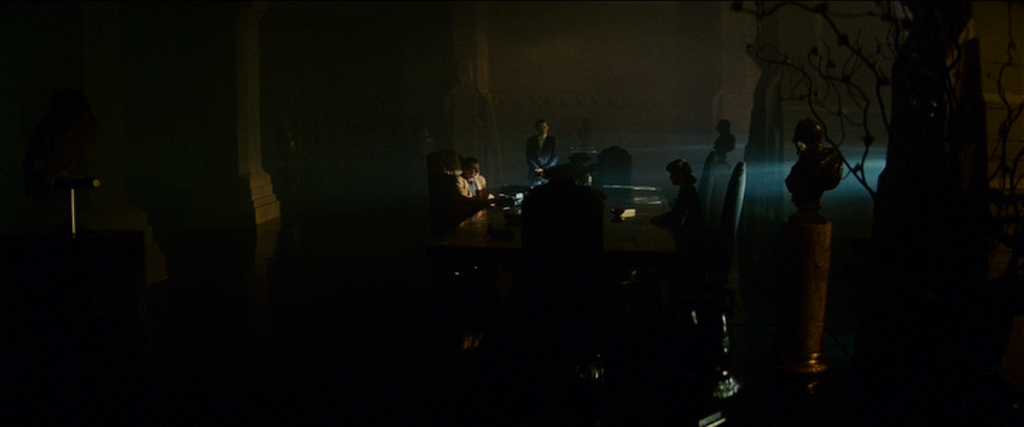
The Voigt-Kampff test, designed to reliably identify non-human subjects, fails in practice. Rachael (Sean Young) believes she is human on the basis of implanted memories. Deckard (Harrison Ford) may or may not be a replicant. By the end, the distinction the film needed to resolve its narrative is exactly the distinction the film deconstructs most thoroughly. That failure is not a weakness. It is the film’s central argument about identity and authenticity.
Rashomon (1950)
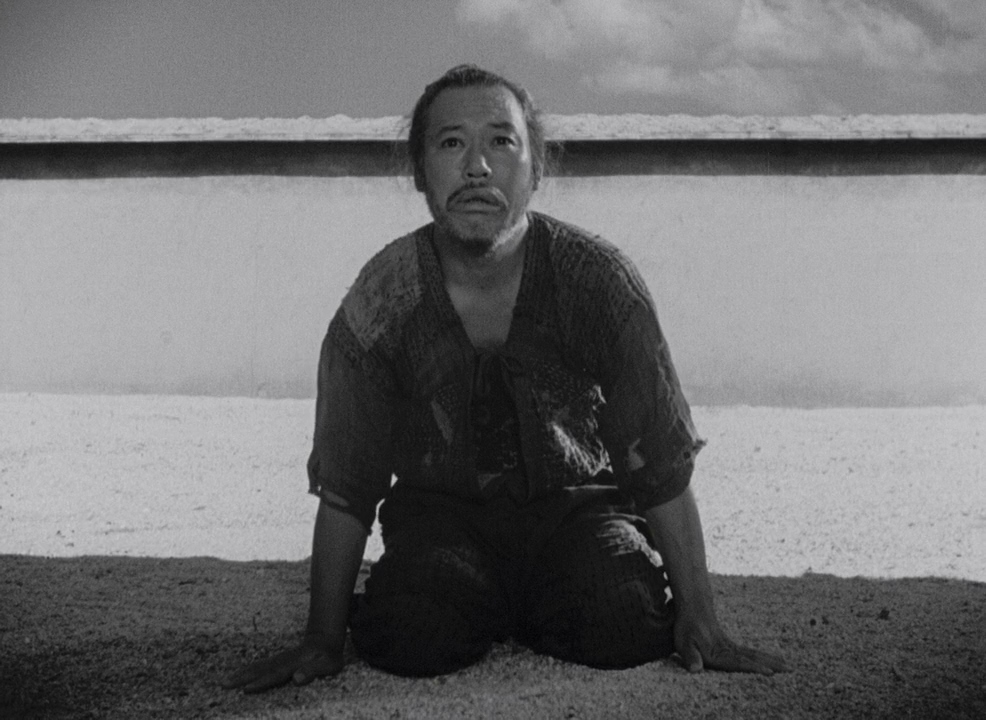
Akira Kurosawa’s Rashomon (1950) predates post-structuralist theory but demonstrates several of its central concerns with particular clarity. The film presents four irreconcilable accounts of the same violent event. No external framework resolves the contradiction. The woodcutter’s final account, generally assumed to be the most reliable, is itself motivated by concealment.
Post-structuralist analysis focuses not on which account is true but on what the film reveals about testimony, language, and truth claims. Testimony is always produced from a position. Language always positions the speaker. The desire for a single authoritative account of events is precisely what the film refuses to satisfy.
Eternal Sunshine of the Spotless Mind (2004)

Michel Gondry’s Eternal Sunshine of the Spotless Mind (2004) treats personal identity as something built from stored traces rather than any stable core. Joel (Jim Carrey) and Clementine (Kate Winslet) are not subjects who happen to have memories: they are, to a significant degree, constituted by them. When those memories are erased, the subjects who held them are altered or partially destroyed.
The film extends this into its formal structure. Sequences run backward. Locations overlap. Memory reconstructions become indistinguishable from present experience. You find it difficult to establish when events are “really” happening because the film consistently refuses to give you reliable markers of time. The instability of identity and the instability of the narrative are the same instability.
Common Misconceptions
Post-structuralism is frequently misunderstood, both by students encountering it for the first time and by critics who reject it without engaging its actual claims.
“A Film Can Mean Anything”
The most common misconception is that post-structuralism means a film can mean anything. This confuses textual instability with interpretive arbitrariness. Post-structuralism does not say that any interpretation is equally valid. It says that no interpretation is final or fully grounded, that meanings are produced by systems of difference, and that the hierarchies within those systems are historically contingent rather than simply given. That is a precise claim about how meaning works, not a license for free-for-all readings. Some interpretations remain better supported than others. The difference is that “better supported” cannot mean “closest to what the director intended.”
“It’s the Same as Postmodernism”
A second misconception treats post-structuralism as the same thing as postmodern film theory. The two frameworks overlap and share key thinkers, but they ask different questions. Post-structuralism is a theory of language and meaning: it is concerned with how signs function and how subjects are positioned by discourse. Postmodern film theory is more concerned with historical periodization, with how contemporary culture’s relationship to simulation, pastiche, and historical narrative differs from earlier eras. Post-structuralism is not a description of a particular era. It is an account of how signification works in any era.
“It’s Politically Disengaged”
A third misconception holds that post-structuralism is politically disengaged, that by questioning the stability of meaning it undermines the possibility of political analysis. Several scholars have addressed this directly. Gayatri Chakravorty Spivak, a literary scholar and translator who introduced Derrida’s Of Grammatology to English-speaking readers, developed post-structuralist concepts in explicitly political directions in her work on postcolonial theory. Stuart Hall, the Jamaican-British cultural theorist, drew on post-structuralist premises about meaning and ideology while maintaining a rigorous commitment to political analysis. Unstable meaning is a condition political critique can use, not a reason for withdrawal.
Key Debates and Scholarly Criticism
Post-structuralist film theory has generated several sustained lines of criticism. Understanding them clarifies both what the framework claims and where its real limits are.
The Grand Theory Debate
The most rigorous challenge came from what David Bordwell and Noel Carroll, in their 1996 anthology Post-Theory: Reconstructing Film Studies, called Grand Theory. Their argument was that post-structuralist film theory, combined with Lacanian psychoanalysis and Althusserian ideology critique, had produced claims about spectatorship and ideology that could not be tested against actual films or actual viewing behavior. You could not confirm them with evidence. You could not refute them either.
Their alternative was “middle-level” research programs that generate empirically testable hypotheses about specific aspects of cinema. This debate remains unresolved. Post-structuralists argue that cognitivism’s empirical approach assumes the stable, unified subject that post-structuralism has shown to be a construction. Cognitivists respond that post-structuralism generates impressive analyses that evidence cannot touch.
Political Effectiveness
A second line of criticism concerns political effectiveness. The Screen Theory project in the 1970s developed post-structuralism as part of a political program: identifying cinema’s ideological mechanisms was supposed to be a precondition for radical filmmaking and critical viewing. By the 1980s, several scholars argued that this model of spectatorship was too rigid. Miriam Hansen, an American film historian whose work on silent cinema and the public sphere drew on Frankfurt School theory, argued that Screen Theory paid insufficient attention to how viewing contexts and audience reception varied historically. This critique helped generate reception studies and cultural studies approaches to cinema.
The Subject Problem
D.N. Rodowick, a film theorist whose 1988 book The Crisis of Political Modernism examined the tensions within post-structuralist film theory, identified a further problem: the theory had never resolved the tension between its account of the subject (that it is produced by discourse and never unified) and its political ambitions (which seemed to require a subject capable of recognizing and resisting ideological positioning). If the subject is always structured by the very discourses it encounters, where does resistance come from?
Quick Contrast: Post-Structuralism and Structuralism
Post-structuralism and structuralism in film share key terminology and many of the same foundational thinkers. The distinction matters for analysis.
What Structuralism Looks For
Structuralism asks: what is the underlying system that generates this film’s meaning? It treats that system as stable and mappable. Christian Metz’s work on film grammar, Vladimir Propp’s morphology of the folktale applied to narrative, and Claude Levi-Strauss’s binary oppositions in myth all belong to structuralism. The analyst’s job is to reveal the hidden structure that the surface text expresses.
What Post-Structuralism Looks For
Post-structuralism asks: how does the film produce the illusion that its meaning is stable and grounded? Its central claim is that the structure structuralism sought to identify is not stable. It is held together by acts of exclusion that leave traces inside the text itself. The analyst’s job is not to reveal a hidden structure but to show where the text contradicts, exceeds, or undercuts its own organizing logic.
In practical terms: a structuralist analysis of a Western film would identify the oppositions, such as civilization/wilderness, law/violence, and settler/outlaw, and map how the narrative resolves them. A post-structuralist analysis would ask where those oppositions break down. Where does the film generate figures or moments that refuse to stay on the correct side of the binary? What does the editing, score, and framing do to contain that refusal?
Why It Still Matters
Post-structuralism is most useful today as a set of sharp tools, not as one complete theory that explains every film. You can use it to ask clear questions, even if you do not buy the whole framework.
Where It Still Works
How does a film make meaning by leaving other meanings out? Where does it force one reading to feel obvious by excluding alternatives? How does it build a viewing position for you through framing, editing, and story structure?
It also helps you push back on simple auteur readings. Instead of treating the director as the single source of meaning, you can track how meaning comes from systems the film is built inside: genre rules, cultural codes, and language itself.
Students interested in feminist film theory and spectatorship theory in film will find post-structuralism embedded in both frameworks. Its analysis of how films construct subject positions remains relevant to work on gender, race, and sexuality in cinema.
Where It Falls Short
The theory has real limits. Its focus on the text rather than on production, distribution, and reception means it struggles to account for how platform algorithms, financing structures, and audience demographics produce meanings before a film even reaches you. Digital cinema also raises new questions: the relationship between a photographic image and the real world does not hold in the same way when images are generated rather than recorded.
Use post-structuralism selectively. Its sharpest questions, about exclusion, about viewing positions, about the limits of auteur readings, remain worth asking of any film.
Summing Up
Post-structuralism in film studies examines how films produce, manage, and ultimately cannot stabilize meaning. Drawing on Jacques Derrida, Roland Barthes, Michel Foucault, and Julia Kristeva, it argues that cinematic meanings are differential rather than fixed, that the author cannot guarantee interpretation, and that films construct the subject positions they appear merely to address.
The framework arrived in film studies through the Screen Theory debates of the 1970s and became a major force in Anglophone film scholarship through the 1980s and early 1990s. It generated close textual work on films as formally challenging as Mulholland Drive and as historically resonant as Rashomon. It also generated sustained criticism for its approach to spectatorship and its difficulties with the theory of political agency.
For students of film theory, post-structuralism is best understood as a set of questions rather than a doctrine. Where is this film’s meaning unstable? What has been excluded to produce the impression of coherence? How does the film’s formal structure build a viewing position for you? Those questions remain worth asking of any film, regardless of whether the full theoretical apparatus that generated them still persuades you.
Read Next: Curious how film theory shapes the way we watch movies?
Start with the Film Theory section to break down realism, formalism, structuralism, and more — with examples from iconic films.
If you want studying film theory I recommend starting with The FilmDaft overview of film theory discourses to break down realism, formalism, structuralism, and more — with examples from iconic films.
Then explore the full Film History, Theory & Genre collection to see how movements, styles, and storytelling traditions have evolved.
Whether you’re into Soviet montage or 2000s genre mashups, there’s something here to sharpen your understanding.
Post-Structuralism FAQ
What is post-structuralism in film theory?
Post-structuralism is an approach that argues films have no single, fixed meaning. Building on but breaking from structuralism, it holds that meaning is unstable — shifting with context, with what a film leaves out, and with who is watching.
How is post-structuralism different from structuralism?
Structuralism looks for stable underlying structures and universal patterns, while post-structuralism argues those structures are unstable and that meaning is never fixed or fully controllable.
What is deconstruction?
Jacques Derrida’s method of showing how a text’s binary oppositions (good/evil, nature/culture) are unstable and depend on each other, so no meaning is ever final. His 1966 lecture “Structure, Sign, and Play” is a founding moment.
What is “The Death of the Author”?
Roland Barthes’s 1967 essay arguing that once a work exists, the author’s intention has no special authority — readers and viewers produce meaning, not the creator.
Who are the key post-structuralist thinkers?
Jacques Derrida (deconstruction), Roland Barthes (the death of the author), and Michel Foucault (discourse and power), whose ideas reshaped how film scholars read meaning.
References
- Barthes, Roland. 1977. “The Death of the Author.” In Image–Music–Text, translated by Stephen Heath, 142–148. New York: Hill and Wang.
- Bordwell, David, and Noel Carroll, eds. 1996. Post-Theory: Reconstructing Film Studies. Madison: University of Wisconsin Press.
- Derrida, Jacques. 1976. Of Grammatology. Translated by Gayatri Chakravorty Spivak. Baltimore: Johns Hopkins University Press.
- Foucault, Michel. 1979. “What Is an Author?” In Textual Strategies: Perspectives in Post-Structuralist Criticism, edited by Josue V. Harari, 141–160. Ithaca: Cornell University Press.
- Heath, Stephen. 1981. Questions of Cinema. Bloomington: Indiana University Press.
- Kristeva, Julia. 1980. Desire in Language: A Semiotic Approach to Literature and Art. Translated by Thomas Gora, Alice Jardine, and Leon S. Roudiez. New York: Columbia University Press.
- Rodowick, D.N. 1988. The Crisis of Political Modernism: Criticism and Ideology in Contemporary Film Theory. Urbana: University of Illinois Press.
- Stam, Robert. 2000. Film Theory: An Introduction. Malden: Blackwell.
