

Published: March 2, 2026 | Last Updated: July 3, 2026

Overview
Feminist film theory examines how cinema constructs, reinforces, and sometimes challenges gender. It asks a deceptively direct question: whose perspective does film privilege, and what does that privilege do? Its landmark figures include Laura Mulvey, who named the “male gaze” in 1975, alongside Claire Johnston, Teresa de Lauretis, and bell hooks. Since its formal emergence in the early 1970s, feminist film theory has become one of the most influential frameworks in academic film studies, changing how scholars read visual style, narrative structure, spectatorship, and representation.
You encounter feminist film theory in virtually every area of film studies. Its central concepts (the male gaze, scopophilia, visual pleasure, the female spectator) appear in undergraduate syllabi, journal articles, and critical reviews. Understanding the theory means understanding not just a set of arguments about gender, but a broader methodology for reading films as ideological systems.
What Is Feminist Film Theory? Definition and Meaning
Feminist film theory is a critical framework that examines how cinema constructs, reproduces, and challenges gendered power relations through formal mechanisms including the gaze, narrative structure, and spectatorship.
Feminist film theory belongs to a cluster of critical frameworks (alongside psychoanalytic theory and semiotics) that treat cinema as an ideological institution rather than simply a storytelling medium. Where psychoanalytic theory asks how cinema positions the subject as a desiring viewer, and semiotics asks how films produce meaning through codes and signs, feminist film theory asks specifically how gender structures both processes. It draws on Freudian and Lacanian psychoanalysis, structuralist semiotics, and Marxist ideology critique, and was later extended through cultural studies and postcolonial thought.
Its object is not simply the content of films (whether female characters are well-written or positively portrayed) but the formal and ideological mechanisms through which cinema produces gendered meaning. Feminist film theory treats cinema as an institution with a systematic visual grammar: a grammar that can be described, analyzed, and challenged.
The theory’s scope extends from Hollywood genre cinema to art cinema, from studio-era films to contemporary digital media. Its limits are equally important to understand: early feminist film theory was often criticized for centering the experience of white, Western, heterosexual women, a limitation that later intersectional and postcolonial feminist critics addressed directly.
Historical Background
Feminist film theory did not emerge in isolation. It developed in dialogue with the broader feminist political movements of the late 1960s and early 1970s, particularly second-wave feminism in the United States and Britain. Journals and collectives began producing feminist film criticism in the early 1970s, with publications such as Women and Film (founded 1972 in Los Angeles) and the British journal Screen providing key venues for theoretical debate.
Visual Pleasure and Narrative Cinema (1975) by Laura Mulvey,
The single most influential early text is “Visual Pleasure and Narrative Cinema” (1975) by Laura Mulvey, a British film theorist and filmmaker. Mulvey drew on Freudian psychoanalysis and Lacanian theory to argue that mainstream Hollywood cinema structured visual pleasure around a masculine, heterosexual gaze. The spectator, she argued, was implicitly positioned as male and derived voyeuristic and fetishistic pleasure from the display of the female body. This essay shaped feminist debates about spectatorship and visual pleasure for at least a decade.
Feminism as film theory during the 1970s: The call for a counter-cinema
The theoretical climate of the 1970s was saturated with structuralism and semiotics, and feminist film scholars engaged with both. Claire Johnston, a Scottish film theorist and critic, argued in “Women’s Cinema as Counter-Cinema” (1973) that even films made by women directors within the Hollywood system were shaped by patriarchal ideology embedded in cinematographic conventions. Johnston called for a counter-cinema that would expose and disrupt those conventions through reflexivity and direct address, an argument that connected feminist film theory to avant-garde filmmaking practice.
Feminist theory in the 1980s and 1990s: femininity as a mask
Through the 1980s and 1990s, the field underwent significant revision. E. Ann Kaplan, a feminist film scholar known for her work on psychoanalysis and cinema, Mary Ann Doane, whose research focused on female spectatorship and the female voice, and Kaja Silverman extended and complicated Mulvey’s psychoanalytic framework.
Doane, in particular, examined the instability of female spectatorship, asking how women as viewers could engage with a cinema that seemed to position them only as objects. Adapting Joan Riviere’s (1929) concept of femininity-as-masquerade, Doane argued that a woman could put on femininity as a mask (creating critical distance from the very image she was supposed to embody) and that this instability opened space for resistant viewing.
The oppositional gaze and queer spectatorship
The field was fundamentally reshaped by intersectional critics in the late 1980s and 1990s. Bell Hooks, a prominent American cultural critic and author, challenged the assumption that “the female spectator” was white by default in essays collected in Black Looks: Race and Representation (1992). She introduced the concept of the “oppositional gaze”: the act of looking back, refusing to accept the terms of mainstream cinema’s representational logic.
Patricia White, Judith Mayne, and others extended feminist film theory to questions of sexuality and queer spectatorship. By the late 1990s, postcolonial feminist scholars such as E. Ann Kaplan, in Looking for the Other (1997), had introduced questions of global and colonial power into the framework.
How Feminist Film Theory Works
Feminist film theory does not operate as a single, unified method. It is better understood as a family of related analytical approaches, each centered on a different aspect of cinema’s gendered operations. What unites them is attention to the relationship between cinematic form and patriarchal ideology.
Analysis of the gaze
The most foundational mechanism is the analysis of the gaze. Mulvey argued that Hollywood cinema structures three distinct looks: the look of the camera during filming, the look of characters within the narrative, and the look of the spectator in the theater.
In mainstream Hollywood, all three looks tend to align along a masculine axis. The camera lingers on the female body; male characters direct their gaze at women as objects of desire; and the spectator is structurally positioned to share that visual pleasure. This alignment is not accidental, but produced through specific formal choices: framing, lighting, editing rhythm, and the use of close-ups.
Narrative structure
A second mechanism is narrative structure. Feminist film theorists have analyzed how classical Hollywood narrative typically assigns agency to male protagonists while positioning female characters as catalysts, rewards, or obstacles. This is inscribed in how narratives are organized, how shot-reverse-shot patterns distribute visual authority (the character whose look we follow determines whose subjectivity the film endorses), and how genre conventions present gender roles as fixed rather than constructed.
Analysis of representation and ideology
A third mechanism, developed more fully in intersectional approaches, is the analysis of representation and ideology. This asks not only how female characters are positioned by the gaze, but what images of femininity, race, sexuality, and class a film produces and legitimizes.
This approach draws less from psychoanalysis and more from cultural studies and ideology critique, examining films as sites where social meanings are produced and contested.
Together, these mechanisms allow feminist film theorists to move from close reading of specific scenes to broader arguments about how cinema functions as a social institution.
What to Look For: A Practical Checklist
When applying feminist film theory to a film, it helps to work systematically from scene-level observations before building larger arguments. The following areas are the most analytically productive to examine. Each one connects a formal observation to a theoretical question.
- Camera behavior around female characters: Does the camera linger, fragment, or objectify the female body? Are close-ups used differently for male and female characters?
- The structure of looking within scenes: Who looks at whom? Does the editing align the spectator with a male character’s point of view?
- Narrative function of female characters: Are female characters agents of their own story, or do they exist primarily in relation to male protagonists?
- Fetishism and spectacle: Are moments of female display inserted into the narrative in ways that interrupt story momentum (what Mulvey calls the tension between spectacle and narrative)?
- Voice and speech: Are female characters given complex interiority through dialogue, or are they more often spoken about than speaking?
- Intersectionality: How do race, class, sexuality, and ability intersect with gender in the film’s representational logic?
- Counter-cinema strategies (if applicable): Does the film disrupt dominant conventions through reflexivity, direct address, or non-classical editing?
Once you have made systematic observations under these headings, the analytical task is to connect formal patterns to ideological function. The goal is not to produce a verdict on whether a film is “feminist” or “sexist,” but to explain precisely how its formal choices construct gendered positions for characters and spectators.
Micro-Analysis: Vertigo (1958)
Alfred Hitchcock’s Vertigo (1958) is one of the most frequently cited examples in feminist film theory, partly because its concern with vision and transformation makes the mechanisms of the male gaze unusually visible. The film’s extended transformation sequence, in which Scottie (James Stewart) redesigns Judy (Kim Novak) to resemble the dead Madeleine, is worth examining closely.
The sequence begins after Scottie encounters Judy in the street and recognizes her resemblance to Madeleine. He takes her to dinner, buys her clothes that match Madeleine’s wardrobe, and requests that she change her hair.
Throughout these scenes, the camera consistently adopts Scottie’s perspective: the viewer sees Judy through his evaluating gaze, and the editing places his scrutiny at the center of each scene. Judy’s discomfort registers in her performance, but the reverse-shot logic of the sequence does not grant her look equal weight. Her gaze is reactive, not structuring. When Judy finally emerges from the bathroom transformed (wearing Madeleine’s grey suit, her hair newly styled), the sequence reaches its formal climax.
Here, Hitchcock stages the gaze with unusual explicitness. The camera executes a 360-degree tracking shot (or arc shot) that circles Scottie and Judy as they embrace, transforming the hotel room into the Spanish stable where Madeleine supposedly died. Scottie is literally remaking a woman into a dead image: a process that condenses the two forms of visual pleasure Mulvey identifies: voyeurism (the pleasure of looking at a spectacle from a distance) and fetishism (the replacement of a threatening figure with a reassuring substitute). Madeleine’s “death” represents a threat to Scottie’s mastery of vision and narrative control, and Judy’s transformation into Madeleine is the fetishistic resolution of that threat.
Judy’s interiority is present in the film (she writes a letter confessing the deception), but it is structurally contained: the letter is never sent, and her perspective is subordinated to the mechanics of Scottie’s obsession. The film is structured so that the viewer shares Scottie’s visual pleasure in the transformation, drawing the spectator into the process of objectification that the film depicts. This is why Mulvey treats Vertigo not as an aberration but as a paradigm case: it does not merely represent the male gaze as a character trait; it reproduces the male gaze as a spectatorial structure.
Additional Film Examples
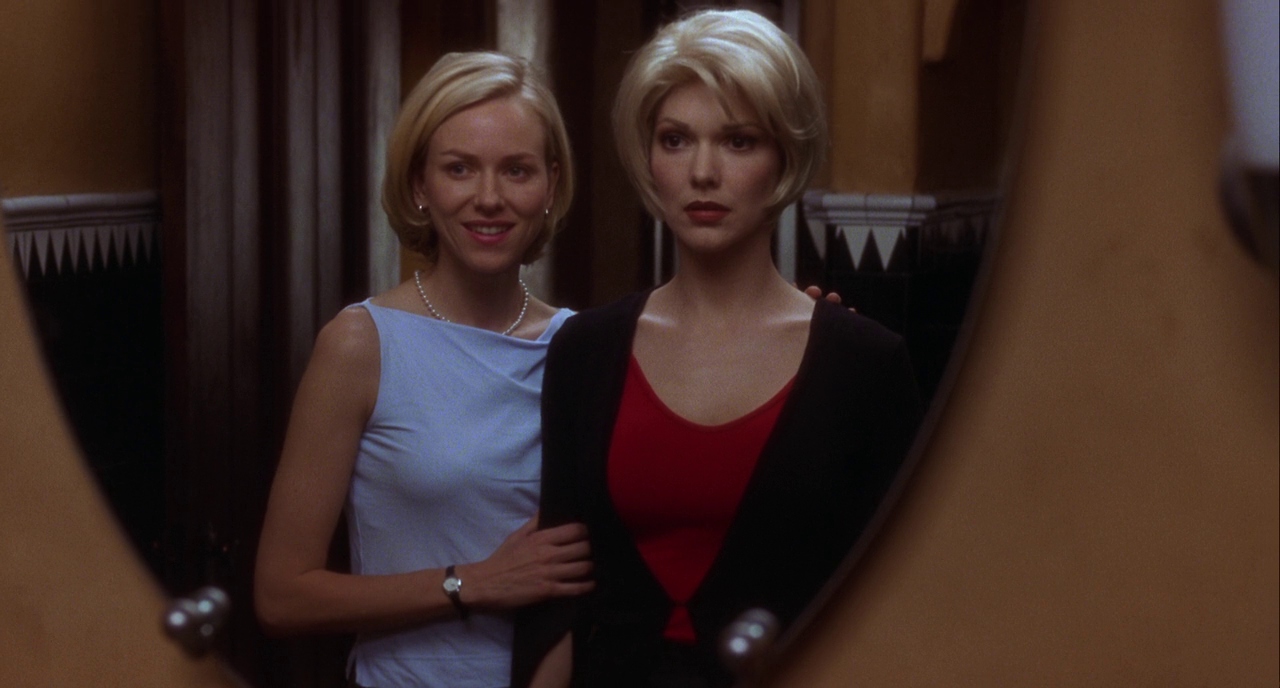
Mulholland Drive (David Lynch, 2001) has generated substantial feminist analysis, particularly for its disruption of classical narrative and its refusal to offer stable female characters as objects of a coherent gaze. The film’s non-linear structure and its treatment of female desire and identity as unstable and multiply-determined make it a productive case for examining the limits of Mulvey’s original model. The female spectator is not simply absent here. The film’s visual logic is disorienting precisely because it refuses the alignment of gaze, desire, and narrative closure that Mulvey identified in classical Hollywood cinema.
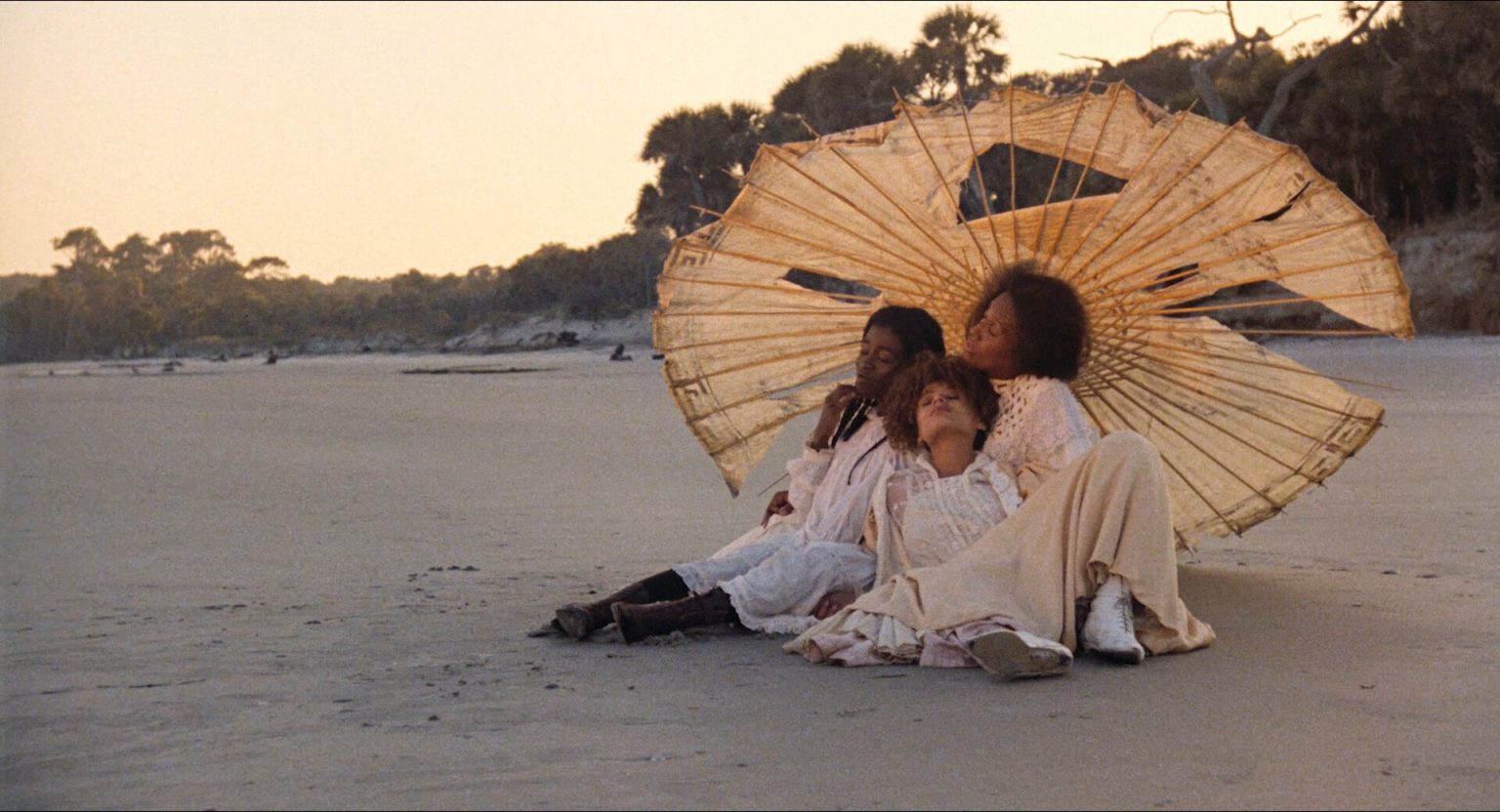
Daughters of the Dust (Julie Dash, 1991) offers a key example in the tradition of feminist counter-cinema. Dash’s film centers Gullah women of the Sea Islands at the turn of the twentieth century and refuses the conventions of the Hollywood gaze at every formal level: its temporal structure is non-linear, its narration is communal rather than anchored in a single protagonist, and its cinematography treats the female body as a subject of contemplation rather than an object of desire. bell hooks identified the film as a paradigm case of a cinema that refuses both mainstream Hollywood’s representational terms and the narrow critical frame that dominated early feminist film theory.
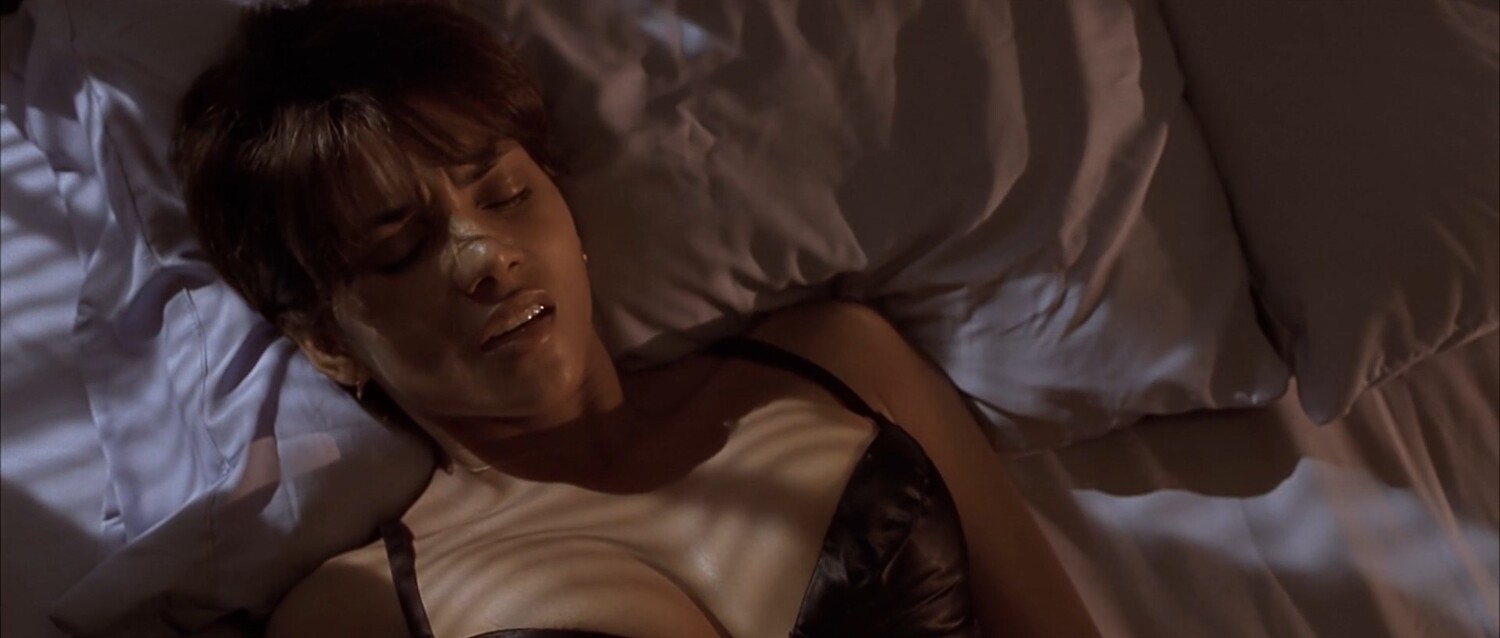
Monster’s Ball (Marc Forster, 2001) offers a more troubling example, frequently cited in intersectional feminist criticism. Halle Berry’s performance earned the Academy Award for Best Actress. Still, critics, including hooks, argued that the film reproduced racialized visual pleasure by presenting the Black female body as an object of white male desire, while framing this as a narrative of healing and reconciliation. The example illustrates how a film can challenge one axis of domination (gender, through a complex female performance) while reinforcing another (race, through its cinematographic and narrative logic).
Common Misconceptions
One of the most persistent misconceptions about feminist film theory is that it is primarily a form of content analysis: that its central question is whether female characters are “good role models” or whether a film passes the Bechdel Test. At the theoretical level, feminist film theory is concerned with formal and ideological mechanisms, not with counting female speaking roles. A film can feature a strong female protagonist and still produce a masculine gaze through its cinematography; conversely, a film can foreground female objectification in ways that are ideologically complex and aesthetically significant.
Not all Hollywood movies are viewed as sexist
A second misconception is that feminist film theory treats all films (or all Hollywood films) as straightforwardly sexist. The tradition has consistently engaged with the tension between ideology and subversion. Mulvey herself acknowledged that films like Vertigo expose the mechanisms of the male gaze in ways that can produce critical distance in attentive viewers. The analytical claim is not “this film is bad” but “here is precisely how this film’s formal structure operates ideologically.”
The male gaze doesn’t require male characters
A third misconception, common in introductory discussions, is that “the male gaze” refers simply to male characters looking at women within a story. Mulvey’s concept operates at the level of cinematic apparatus (the camera, editing, and spectatorship) and not merely at the level of narrative content. A film can have no male characters and still reproduce a masculine gaze through its cinematographic choices.
Feminist film theory is dead
A fourth misconception is that feminist film theory is a historical relic, superseded by more recent frameworks. While the original psychoanalytic model has been substantially revised, the core insight (that cinema’s formal mechanisms are not gender-neutral) remains analytically productive in contemporary film studies, and intersectional and postcolonial feminist scholars have extended the framework considerably since the 1990s.
Key Debates and Scholarly Criticism
Mulvey’s original framework attracted significant criticism almost immediately after its publication. David Rodowick, a film theorist whose 1982 essay examined the instabilities in Mulvey’s account, argued that her framework was too rigid in its alignment of masculinity with activity and femininity with passivity, failing to account for the multiple and unstable identifications that actual viewers make during film viewing. Rodowick suggested that cinema’s address is more contradictory than Mulvey allowed, and that the spectator’s gender does not automatically determine their identificatory position.
The oppositional gaze and racial homogeneity in feminism
The most sustained critique came from scholars attentive to race and postcolonial politics. Bell Hooks’s argument in “The Oppositional Gaze” (1992) was that Mulvey’s model, and much of mainstream feminist film theory, assumed a white female spectator and a white male gaze, rendering Black female spectatorship theoretically invisible.
Hooks documented how Black female viewers historically developed an “oppositional gaze”: a practice of resistant, critical looking that refused the terms of Hollywood’s representational logic. This was not simply a corrective footnote to Mulvey; it was a structural critique of the racial assumptions embedded in the psychoanalytic framework itself. Where Rodowick challenged the rigidity of gendered identification, Hooks challenged the racial homogeneity of the entire theoretical apparatus.
Feminist film theory vs cognitive science
A different line of criticism came from cognitive film theorists. Noël Carroll, an American philosopher of art and film, and David Bordwell, known for his extensive work on film style and narration, are associated with the Post-Theory movement of the 1990s.
They argued that psychoanalytic feminist film theory made empirical claims about spectator psychology that were unsupported by cognitive science. They challenged the notion of a unified “subject position” produced by cinema, arguing that actual viewers engage with films through learned cognitive schemas rather than through the subject-positioning effects described by Lacanian theory.
This debate between psychoanalytic and cognitive approaches to spectatorship remains one of the central methodological fault lines in film studies.
Contrast with Postcolonial Film Theory
Feminist film theory and postcolonial film theory share a concern with power, representation, and the politics of the gaze, but they differ in their central question, unit of analysis, and theoretical sources.
Feminist film theory’s central question is how cinema constructs gendered subject positions, for characters and for spectators. Its primary unit of analysis is the relationship between the gaze, the female body, and spectatorial pleasure, and its key theoretical sources are psychoanalysis (Freud, Lacan) and ideology critique (Althusser).
Postcolonial film theory’s central question is how cinema manages the relationship between colonizer and colonized, representing non-Western peoples and spaces through Western epistemological frames. Its primary theoretical sources are postcolonial thought (Fanon, Bhabha, Spivak) and cultural studies. While intersectional feminist theory has drawn substantially from postcolonial frameworks, the two remain analytically distinct, and conflating them risks losing precision in both feminist and postcolonial analysis.
Why It Still Matters
Feminist film theory retains genuine analytical value because the mechanisms it describes (the objectifying gaze, the gendered alignment of narrative agency, the spectatorial positions produced by cinematographic convention) have not disappeared from contemporary cinema. They have evolved, been contested, and in some cases subverted, but they remain operative in ways that feminist analysis continues to make visible.
The theory works best when applied to films produced within or in explicit dialogue with classical Hollywood conventions, where the structural patterns Mulvey and others identified are most legible. It is less immediately applicable to films from traditions with different visual economies: slow cinema, Third Cinema, and much of global art cinema, though intersectional and postcolonial feminist theorists have developed frameworks for those contexts.
The theory’s original psychoanalytic foundation has been substantially challenged, and no serious contemporary film scholar applies Mulvey’s 1975 framework without modification. But that ongoing revision is precisely what demonstrates the framework’s vitality. Feminist film theory remains one of the most generative analytical traditions in the discipline, not because it has all the answers, but because it continues to ask the right questions about whose vision cinema serves and at whose expense.
Summing Up
Feminist film theory emerged in the early 1970s at the intersection of psychoanalysis, semiotics, and feminist politics. Its foundational contribution was to show that cinema’s formal mechanisms (the gaze, narrative structure, spectatorship) are not gender-neutral but are organized around patriarchal structures of visual pleasure. Laura Mulvey’s concept of the male gaze provided the theory’s most influential early formulation, and subsequent scholars, including Mary Ann Doane, Bell Hooks, and E. Ann Kaplan, extended, complicated, and in some cases fundamentally revised that framework.
The field has moved substantially since Mulvey’s foundational essay, incorporating intersectional, postcolonial, and cognitive perspectives that have enriched and complicated the original framework. What remains constant is the commitment to treating cinema as a formal system with ideological consequences: a system that can be read, analyzed, and held to account.
Read Next: Curious how film theory shapes the way we watch movies?
Start with the Film Theory section to break down realism, formalism, structuralism, and more — with examples from iconic films.
If you want studying film theory I recommend starting with The FilmDaft overview of film theory discourses to break down realism, formalism, structuralism, and more — with examples from iconic films.
Then explore the full Film History, Theory & Genre collection to see how movements, styles, and storytelling traditions have evolved.
Whether you’re into Soviet montage or 2000s genre mashups, there’s something here to sharpen your understanding.
Feminist Film Theory FAQ
What is feminist film theory?
An approach that examines how cinema represents gender — how films position women, reinforce or challenge patriarchy, and shape who the camera invites us to look at and identify with.
What is the male gaze?
Laura Mulvey’s concept, from her 1975 essay “Visual Pleasure and Narrative Cinema,” that mainstream cinema is built around a masculine viewpoint that turns women into objects of desire. See our full guide to the male gaze.
What is the oppositional gaze?
bell hooks’s response to Mulvey: the critical, resistant way marginalised viewers — she wrote about Black women — watch films without accepting the position the film assigns them.
What is the Bechdel test?
A simple measure of women’s representation: a film passes if two named women talk to each other about something other than a man. It highlights how often films sideline women.
Who are the key feminist film theorists?
Laura Mulvey, Claire Johnston, Teresa de Lauretis, and bell hooks, among others.
References
- Doane, Mary Ann. 1982. “Film and the Masquerade: Theorising the Female Spectator.” Screen 23 (3–4): 74–87.
- Hooks, Bell. 1992. Black Looks: Race and Representation. Boston: South End Press.
- Johnston, Claire. 1973. “Women’s Cinema as Counter-Cinema.” In Notes on Women’s Cinema, edited by Claire Johnston, 24–31. London: Society for Education in Film and Television.
- Kaplan, E. Ann. 1983. Women and Film: Both Sides of the Camera. New York: Methuen.
- Kaplan, E. Ann. 1997. Looking for the Other: Feminism, Film, and the Imperial Gaze. New York: Routledge.
- Mulvey, Laura. 1975. “Visual Pleasure and Narrative Cinema.” Screen 16 (3): 6–18.
- Mulvey, Laura. 1981. “Afterthoughts on ‘Visual Pleasure and Narrative Cinema’ Inspired by King Vidor’s Duel in the Sun.” Framework 15–17: 12–15.
- Rodowick, David N. 1982. “The Difficulty of Difference.” Wide Angle 5 (1): 4–15.
- Silverman, Kaja. 1988. The Acoustic Mirror: The Female Voice in Psychoanalysis and Cinema. Bloomington: Indiana University Press.
