

Published: March 5, 2026 | Last Updated: July 3, 2026

Overview
In the 1960s, filmmakers across Latin America, Africa, and Asia began asking a question that Hollywood had never seriously posed: whose interests does cinema serve? The answer they developed gave rise to one of the most ambitious film movements of the twentieth century. Third Cinema is a theory and practice of filmmaking that uses the camera as a tool for political liberation, committed to the struggle of colonized and oppressed peoples. The term was coined by Argentine filmmakers Fernando Solanas and Octavio Getino in their 1969 manifesto Hacia un tercer cine (“Towards a Third Cinema”), members of the Grupo Cine Liberación.
The movement emerged from the wave of anti-colonial revolutions sweeping the globe after World War II. It rejected two existing models of filmmaking: the commercially driven entertainment industry of Hollywood (called First Cinema) and the European art film tradition, which prioritized the director’s personal vision above all else (called Second Cinema). Third Cinema demanded something different: film made collectively, with and for the people it depicts, designed to provoke political awareness and inspire real-world action.
You will encounter Third Cinema in film studies courses on world cinema, political film, and postcolonial theory in film. Unlike most film theories, it came with its own manifesto, published in 1969 by Argentine filmmakers Fernando Solanas and Octavio Getino. That document remains one of the most important political texts in the history of cinema.
What Is Third Cinema? Definition and Meaning
Third Cinema is a political film movement and theoretical framework that emerged in Latin America, Africa, and Asia in the 1960s and 1970s. The movement argues that cinema should serve the liberation of oppressed peoples rather than the entertainment of paying audiences or the artistic ambitions of individual directors.
The term was coined by Argentine filmmakers Fernando Solanas and Octavio Getino in their 1969 manifesto “Towards a Third Cinema.” They described three types of cinema: First Cinema, meaning Hollywood and its commercial imitators around the world; Second Cinema, meaning the European art film tradition and its focus on the director as individual artist; and Third Cinema, a new kind of filmmaking rooted in anti-imperialism (opposition to the economic and political domination of weaker nations by stronger ones), collective production, and direct political engagement.
As a theory, Third Cinema gives film scholars a framework for analyzing films that prioritize political function over formal sophistication or commercial appeal. It asks what the film is doing in the world, not just what it looks like on screen.
Historical Background
Third Cinema did not emerge from a film school. It came out of revolution.
In the late 1950s and 1960s, much of Latin America, Africa, and Asia was living through the end of colonial rule. European powers were withdrawing from their empires, but economic and cultural domination continued in new forms. Hollywood films flooded local cinemas across the global south, and local audiences were often watching stories that had nothing to do with their lives, told from the perspective of the colonizer.
The Manifesto That Started It
In 1969, Fernando Solanas and Octavio Getino, Argentine filmmakers and political activists, published “Towards a Third Cinema,” a manifesto that called on filmmakers to abandon commercial and art-house models and take up the camera as a political weapon. Solanas and Getino had already completed their landmark film La hora de los hornos (Hour of the Furnaces, 1968), a four-hour documentary about neocolonialism (the continued economic and cultural dominance of wealthy nations over countries that have formally gained independence) in Argentina. They screened it illegally in homes and union halls. At regular intervals, they stopped the film to encourage audience discussion. People attended these screenings to watch and argue. The film served as a starting point for political conversation.
Their manifesto drew on the political theory of Frantz Fanon, a Martinican psychiatrist and revolutionary theorist whose 1961 book The Wretched of the Earth described colonialism as a psychological as well as a material condition. Fanon argued that decolonization (the process of breaking free from colonial rule and its psychological effects) required a total transformation of culture and consciousness. Solanas and Getino applied this argument to cinema: if the culture of the colonizer enters through Hollywood films, then the decolonizing response must include an alternative cinema.
Spread Across the Global South
The ideas in the manifesto spread quickly. In Cuba, filmmakers working within the revolutionary government’s film institute (ICAIC) developed their own version of committed political cinema. In Senegal, Ousmane Sembène, widely regarded as the father of African cinema, began making films in Wolof and French that depicted the experience of ordinary West Africans rather than the colonial myths they had grown up watching. In Brazil, the Cinema Novo movement, led by figures like Glauber Rocha, a Brazilian director who was one of the movement’s chief theorists, combined Neorealist technique with explicitly political content.
The Ethiopian-born film scholar Teshome H. Gabriel, who taught at UCLA, later mapped these developments into a systematic theory. Gabriel argued that Third World cinema moved through three historical phases: assimilation, where filmmakers adopted Western forms wholesale; remembrance, where filmmakers began recovering cultural memory and indigenous storytelling; and combative, where cinema directly confronted colonial and neocolonial power (Gabriel 1982, 2–30). By the 1970s, Third Cinema had become an international conversation, debated in film journals, screened at political film festivals, and studied in newly formed film departments across the world.
Core Mechanism: How Third Cinema Works as a Framework
Third Cinema is both a set of filmmaking practices and a tool for film analysis. To understand how it works, you need to understand the three-cinema model and what happens when films refuse the conventions of the first two categories.
The Three-Cinema Model
Solanas and Getino’s framework asks a simple question: who controls the film, and who does it serve? First Cinema, meaning the Hollywood studio system and its commercial equivalents worldwide, is controlled by capital. It serves the entertainment industry. Its goal is profit, and its formal conventions (clear narrative, sympathetic protagonists, resolved conflicts) exist to maximize audience comfort and ticket sales. It packages ideology as entertainment and hides the assumptions built into every story choice.
Second Cinema is more complex. It refers to European art cinema and the auteur theory in film, where directors like Ingmar Bergman, a Swedish filmmaker known for existential dramas, Jean-Luc Godard, a French-Swiss director central to the French New Wave, and Federico Fellini, an Italian director known for surrealist and autobiographical films, are treated as artists whose films express their personal vision. Second Cinema often critiques commercial culture and explores difficult themes. But Solanas and Getino argued that it remains caught within the same system of individualism and institutional funding. The art-house director is still an individual selling films to audiences in a market economy, still dependent on festivals and critics who belong to the cultural establishment.
Third Cinema breaks from both models. It is collective in production, political in purpose, and flexible in form. It works with non-professional actors, minimal equipment, and whatever space is available for a screening. It is designed to start conversations rather than resolve them neatly.
Formal Techniques
Third Cinema developed a distinctive visual language that reflects its political commitments. Because many Third Cinema productions had little money and needed to move fast, they adopted techniques already associated with truth-telling: handheld camera, which gives a sense of presence and physical instability; location shooting in real urban and rural environments; non-professional actors, who often played versions of themselves or people from their own communities; and documentary footage mixed with fictional scenes, which blurred the line between historical record and dramatic representation.
Each technique carries a specific political argument. The handheld camera signals that this film was made in the world, not in a studio. The non-professional actor insists that the people depicted here are real, rather than performed by someone who doesn’t know their lives. The documentary footage anchors the film in recorded history. Together, these choices replace the smooth, controlled look of Hollywood with something rougher and more immediate.
Third Cinema also experiments with structure. Films in this tradition often break the fourth wall, address the audience directly, include title cards with political arguments, or insert passages of documentary analysis into fictional narratives. The goal is to keep the viewer thinking rather than pulling them into a comfortable story-world where they forget they are watching a film. This connects to broader debates in Screen theory about how cinema shapes what viewers accept as normal or true (what film theorists call ideology).
What to Look For When Analyzing Third Cinema
When you approach a film through the lens of Third Cinema, you are looking for evidence of political commitment at the level of form, not just content. A film can have a political message and still be made entirely within the conventions of First Cinema. Third Cinema analysis asks how the film is made, not just what it says.
- Production context: Who made the film, and under what conditions? Was it produced independently, by a state film institute, or by a collective? Who financed it?
- Mode of address: Does the film speak to its audience as passive consumers, or does it invite active engagement, discussion, or reflection?
- Formal disruptions: Does the film break narrative illusion? Does it use title cards, direct address, or documentary inserts to interrupt the fictional world?
- Visual texture: Is the image smooth and controlled, or rough and unstable? Handheld camera, grainy film stock, and location sound all carry meaning.
- Casting and performance: Are the actors professional performers, or do they come from the communities depicted in the film?
- Distribution and exhibition: How was the film shown? In cinemas, in community spaces, in secret screenings?
- Political alignment: Does the film take a clear position on a political struggle, and does that position serve the interests of an oppressed group?
Once you have noted these features, connect them. Do the formal choices support or contradict the film’s political claims? A film that argues for collective liberation but centers a single heroic individual has a tension worth examining. Third Cinema analysis is most productive when you use formal evidence to test political claims rather than simply listing them.
Micro-Analysis: The Battle of Algiers (1966)
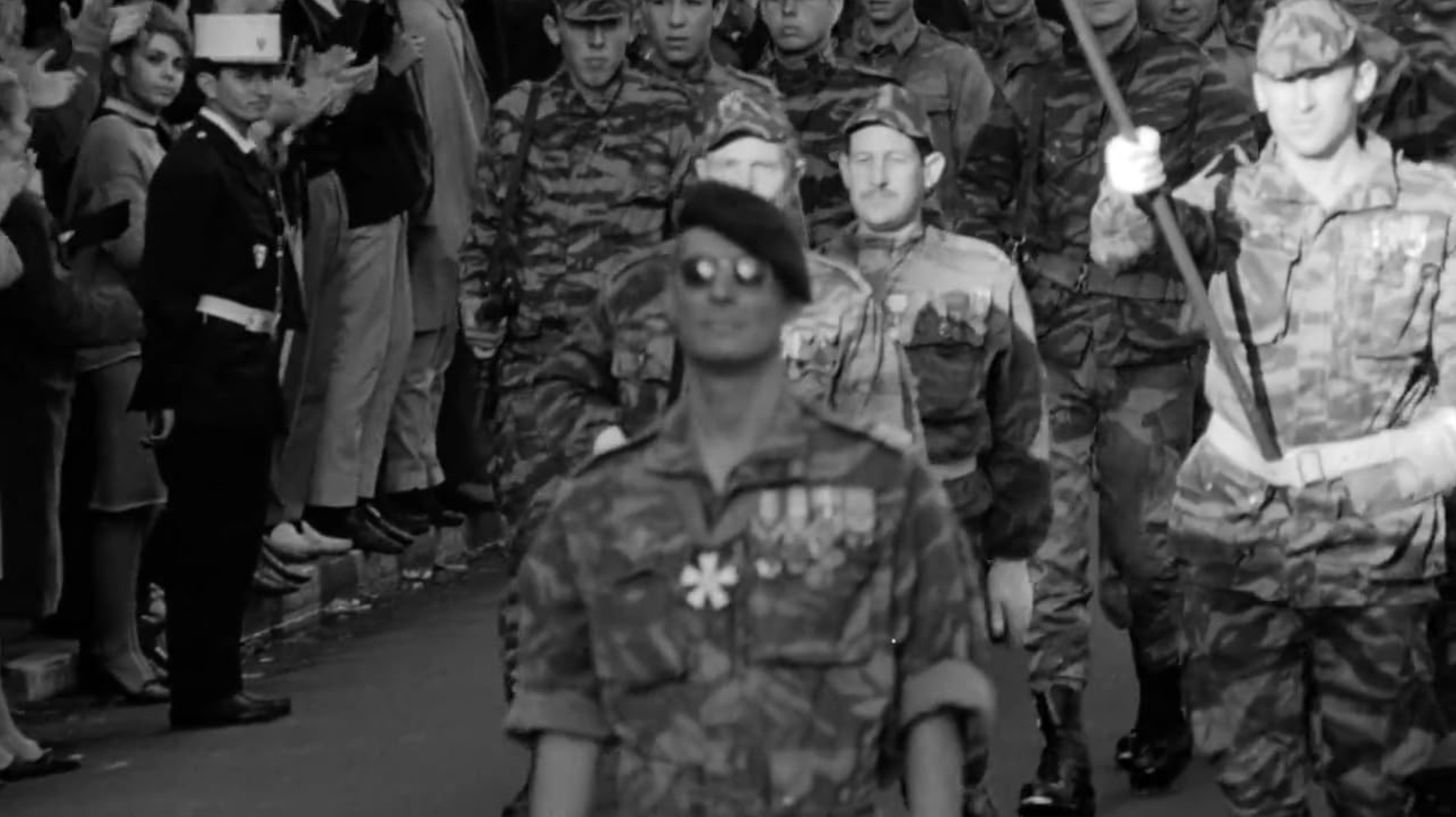
Gillo Pontecorvo, an Italian filmmaker best known for politically committed historical dramas, directed The Battle of Algiers (1966), one of the most studied films in Third Cinema scholarship, even though it was made by a filmmaker from outside the Algerian liberation movement itself. What makes it a useful Third Cinema example is the way its formal choices consistently work in the service of its political argument.
The Documentary Illusion
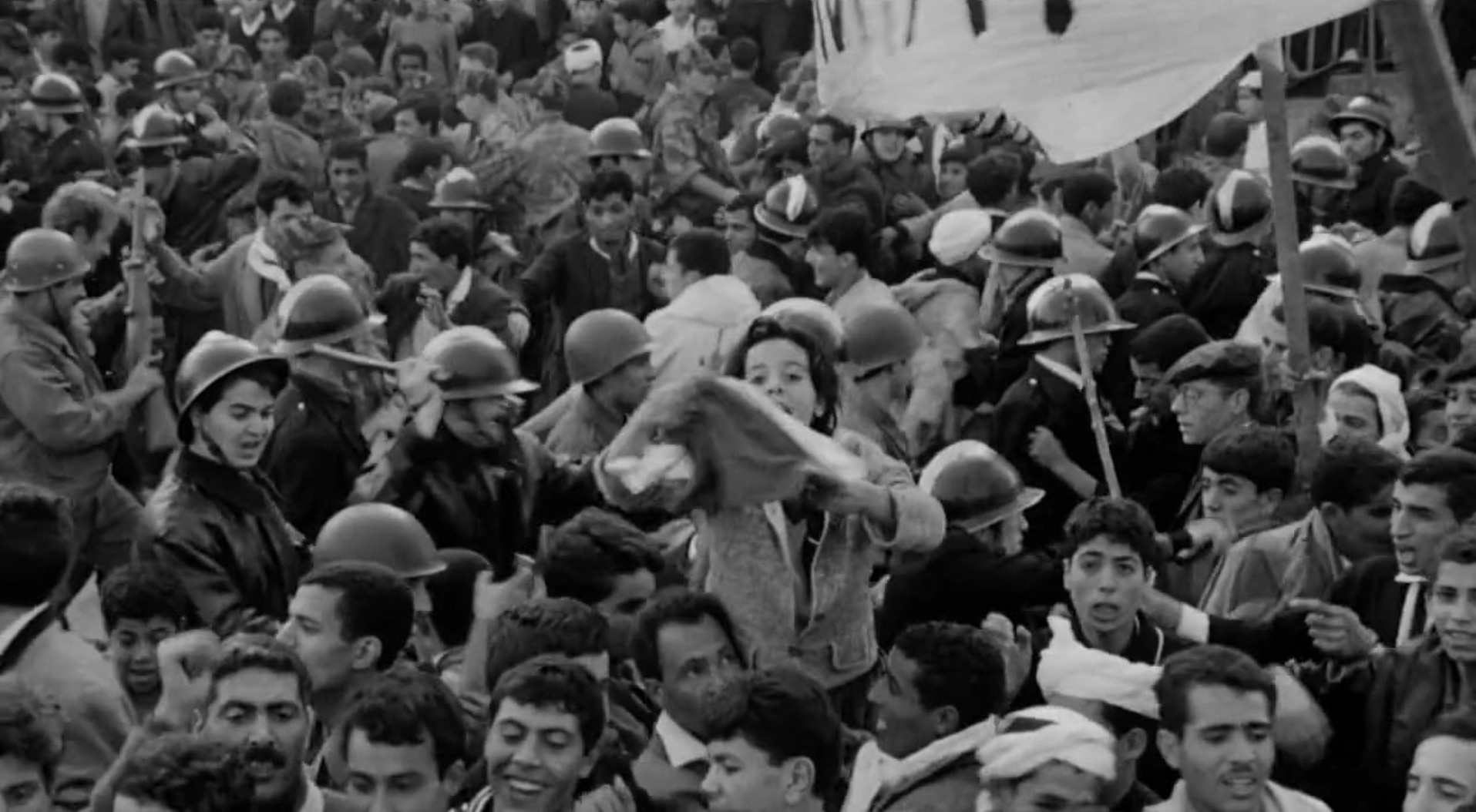
The film opens with a disclaimer: no newsreel footage was used in its production. This disclaimer is necessary because the film looks like a newsreel. Pontecorvo and his cinematographer Marcello Gatti shot on location in the Casbah, the old city of Algiers. They used handheld cameras, grainy high-contrast film stock, and natural light. The crowd scenes feature hundreds of local non-professional participants. The result is footage that many viewers, and many television news editors who later mistook it for documentary, cannot immediately distinguish from the real thing.
Every visual choice in the film is a political argument. The film depicts the 1954-62 Algerian War of Independence against French colonial rule, and Pontecorvo chose a visual style that places you inside the experience of the Algerian population rather than observing it from a safe distance. When the camera follows a young Algerian woman through a French checkpoint, the frame shakes slightly as she moves through hostile soldiers. You feel the danger in the image itself. The formal technique and the political content are inseparable.
Structure and Political Address
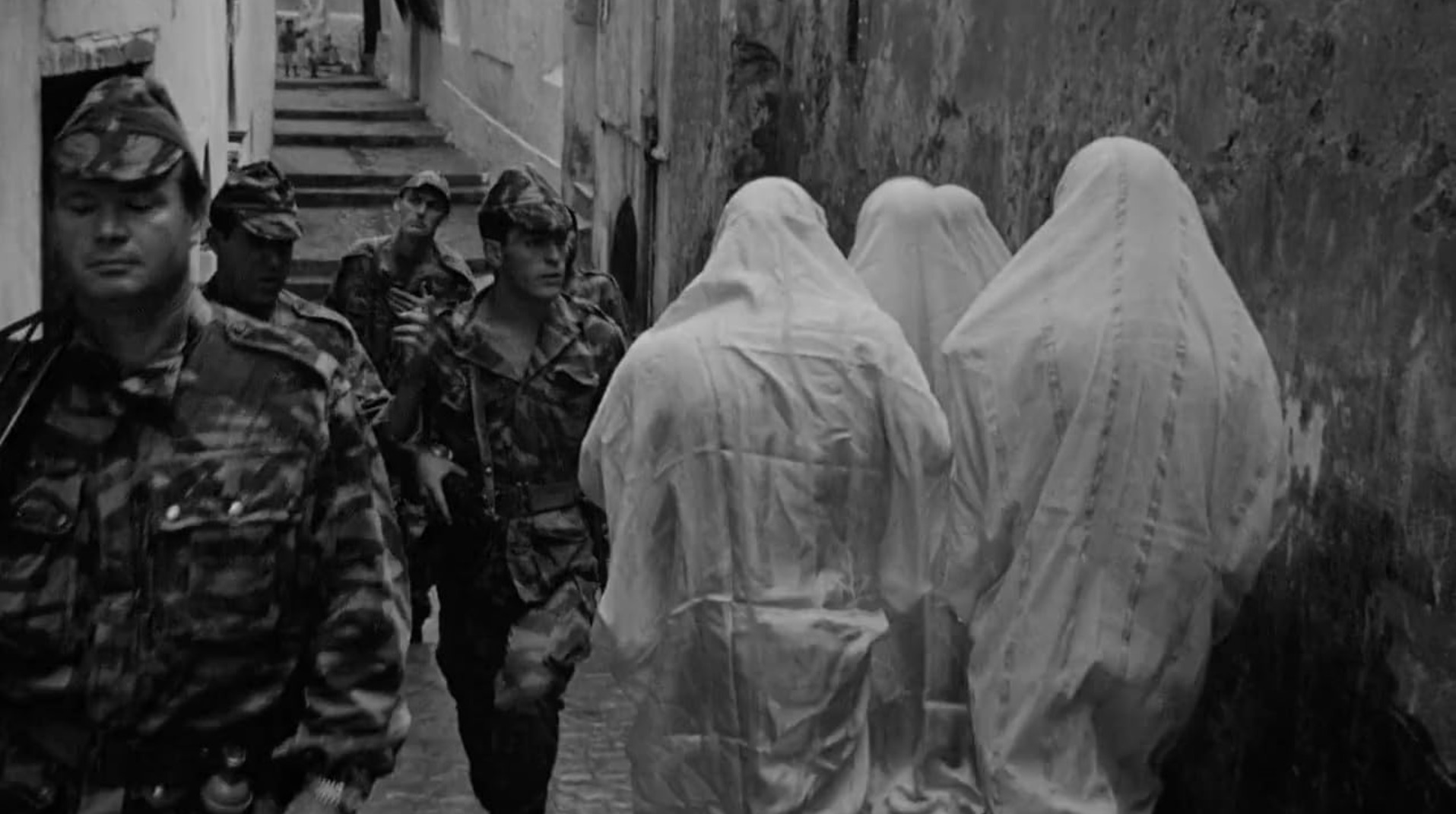
The film also refuses the conventional moral structure of Hollywood war films. It does not assign a single protagonist whose journey organizes the narrative. Instead, it moves between the French military command and the Algerian National Liberation Front (FLN). Both sides commit acts of violence, and the film presents each side in its strategic logic. This refusal to simplify is itself a political argument: the film treats its audience as capable of holding complexity rather than needing a hero to identify with.
The film’s sequence showing FLN women disguising themselves as French civilians to carry bombs into European neighborhoods is presented without explanatory dialogue. You watch the preparations in detail.
Italian film composer Ennio Morricone’s score, when it enters, is spare and mournful rather than triumphant. The film does not celebrate the bombing. It asks you to understand the conditions that produced it.
What makes The Battle of Algiers a sustained Third Cinema text is the way every formal decision works toward a politically engaged viewer. The texture of the image, the structure of the narrative, the handling of the score: all of these choices refuse comfort and demand attention. The film does not resolve the conflict it depicts. It places you inside it and lets the contradictions stand.
Additional Film Examples
Third Cinema produced a wide range of films across different national contexts. Three examples show how different filmmakers applied its principles, and where its edges show.
Memories of Underdevelopment (1968)

Memorias del subdesarrollo, directed by Tomás Gutiérrez Alea, one of Cuba’s leading directors of the revolutionary period, for the country’s state film institute, follows a middle-class Cuban intellectual who stays in Havana after the revolution rather than emigrating. The film mixes fiction with documentary footage, including real news film of the Cuban Missile Crisis, and uses the protagonist Sergio’s internal monologue to expose his inability to commit to the revolution. This is Third Cinema in a subtle register: the film uses the conventions of European art cinema against their usual purpose, and turns the introspective art-house protagonist into a study in political paralysis. The formal intelligence of the film is inseparable from its political argument.
Xala (1975)
Ousmane Sembène’s Xala is a Senegalese film that uses satire to analyze the failure of African independence. The protagonist is a newly appointed Senegalese businessman who, on the day of his country’s independence celebration, takes a third wife and is immediately struck by xala, a curse causing sexual impotence. The film treats his impotence as an allegory for the African bourgeoisie’s inability to break from its colonial inheritance while appearing to rule itself. Sembène layers the film with film semiotics and sign systems: the business suits, the Mercedes cars, and the French language all function as signs of a class that has exchanged one set of masters for another. The realist shooting style emphasizes the contrast between the air-conditioned offices of the elite and the streets outside.
Fourth Cinema and Barry Barclay
In 2003, New Zealand filmmaker Barry Barclay proposed a fourth category: Fourth Cinema, which refers to filmmaking by Indigenous peoples who exist as minorities within postcolonial nation-states. Unlike Third Cinema, which addressed the liberation of whole nations, Fourth Cinema addresses peoples who have survived colonialism but remain politically marginalized within the states that replaced colonial rule. Barclay pointed to films like his own Ngati (1987) and Lee Tamahori’s Once Were Warriors (1994) as examples of cinema made from within Indigenous communities, for those communities, on their own terms. Fourth Cinema extends the Third Cinema argument into a context where national liberation has not resolved the problem of cultural and political subjugation (Barclay 2003, 7–11).
Common Misconceptions
There are a few common misconceptions and confusion about Third Cinema that I think need to be addressed:
Third Cinema Is Not the Same as Third World Cinema
Third Cinema is often misunderstood in ways that flatten a complex framework into something much simpler. Three misconceptions come up repeatedly.
The most common mistake is equating Third Cinema with Third World cinema. The terms are related but not identical. Third Cinema is a political and aesthetic category defined by its commitments, not its geography. A film made in a wealthy country can qualify as Third Cinema if it meets the criteria of collective production and political engagement. Conversely, a film made in a developing country can be pure First Cinema if it imitates Hollywood conventions and serves commercial rather than political ends. Solanas and Getino were explicit about this: the categories describe a film’s relationship to power, not the passport of its director.
Third Cinema Does Not Sacrifice Aesthetics for Politics
A second misconception is that Third Cinema sacrifices aesthetics for politics, as if the political commitment means the films look rough and unfinished because no one cared about how they looked. This misses what makes the best Third Cinema films interesting. The Battle of Algiers is one of the most formally accomplished films ever made. Sembène’s films are meticulous in their visual construction. The argument of Third Cinema is that formal choices carry political meaning, not that films should abandon form in favor of message.
Third Cinema Is Not Simply a Historical Artifact
A third misconception treats Third Cinema as a historical artifact, something that mattered in the 1960s and 1970s but has since been superseded by more sophisticated theoretical frameworks. The framework remains productive for analyzing contemporary films that operate outside commercial and arthouse models, including digital activist filmmaking, community cinema projects, and films made by and for Indigenous communities.
Key Debates and Scholarly Criticism
Third Cinema has attracted serious scholarly criticism since the 1980s, and those debates have refined and complicated the original framework in important ways.
The Problem of the Manifesto
Robert Stam, a Brazilian-American film scholar and author of Film Theory: An Introduction (2000), argues that Solanas and Getino’s original manifesto is too rigid as an analytical tool. The three-cinema model suggests clean categories, but most films resist clean classification. Godard’s political films of the late 1960s, for instance, are formally experimental and politically committed in ways that do not fit neatly into Second Cinema as Solanas and Getino defined it. The manifesto’s polemical clarity was useful as a call to action but limiting as a system for film analysis. Later scholars have tried to use Third Cinema as a flexible framework rather than a fixed taxonomy (Stam 2000, 93).
Gender and the Manifesto’s Blind Spots
Feminist scholars have pointed out that the original Third Cinema manifesto is almost entirely silent on questions of gender. The political subject imagined by Solanas and Getino is implicitly male, and the liberation they describe is framed in terms of class and national identity rather than patriarchal structures. This matters because many Third Cinema films reproduce gender hierarchies even while challenging colonial ones. Women in The Battle of Algiers, for instance, are shown as brave and capable, but their role in the narrative is ultimately in service of a national liberation movement whose leadership is male. Scholars working at the intersection of feminist film theory and postcolonial criticism, including Ella Shohat, an American cultural scholar specializing in postcolonial media studies, and Robert Stam, in their book Unthinking Eurocentrism (1994), have pushed Third Cinema scholarship to account for these tensions (Shohat and Stam 1994, 248–291).
Gabriel’s Three-Phase Model
Teshome H. Gabriel’s framework of three phases, assimilation, remembrance, and combative, has been influential but also criticized for implying a predetermined progression that does not fit every national cinema equally well. Some film movements skip phases, others cycle through them, and others resist the framework entirely. Anthony Guneratne and Wimal Dissanayake, editors of Rethinking Third Cinema (2003), argue that the diversity of global cinema demands more context-specific analytical approaches rather than a single developmental model applied universally (Guneratne and Dissanayake 2003, 1–19).
Quick Contrast: Third Cinema and Postcolonial Film Theory
Third Cinema and postcolonial film theory address overlapping concerns but ask different questions and use different tools.
Third Cinema is primarily a practice-based framework. It was developed by filmmakers for filmmakers, and its central concern is what a film should do in the world. It evaluates films according to their political commitments and their relationship to liberation movements. Its analytical vocabulary comes from political theory more than from linguistics or psychoanalysis.
Postcolonial film theory, associated with scholars like Homi K. Bhabha, a literary and cultural theorist known for his work on colonial discourse, and Gayatri Chakravorty Spivak, a literary critic and translator of Derrida, is primarily a reading practice. It uses post-structuralist methods like deconstruction and discourse analysis (the study of how language and representation produce social meaning) to examine how colonial power structures are reproduced or resisted in cultural texts, including films. It is more interested in ambivalence and contradiction than in clear political commitment, and it tends to find meaning in what is absent or repressed as much as in what is stated directly.
The practical difference works like this. A Third Cinema analysis of Xala would foreground the film’s political program and evaluate its effectiveness as a tool for consciousness-raising (helping audiences see and question the political structures that govern their lives). A postcolonial analysis of the same film might focus on the ambivalences in Sembène’s treatment of tradition and modernity, or on what the film cannot say within the constraints of its own framework. Both approaches are productive. They ask fundamentally different questions, and the best analyses of Third World cinema often use both.
Why Third Cinema Still Matters
Third Cinema emerged in a specific historical moment, but the conditions it addressed have not disappeared. The global dominance of Hollywood continues. The concentration of media ownership in a small number of corporations continues. The marginalization of non-Western cultural production in international distribution networks continues. These are the conditions that made Third Cinema necessary in 1969, and they remain present today in different forms.
The most direct contemporary application of Third Cinema’s framework is in the analysis of digital activist filmmaking. Smartphones and editing software have dramatically lowered the cost of film production. Communities previously excluded from filmmaking can now document their own lives and distribute that documentation widely. The central commitment remains the same: the camera is a political tool, and who holds it and for whom matters.
Fourth Cinema, as defined by Barry Barclay, has developed into a serious area of film scholarship, particularly in relation to New Zealand Maori cinema, Australian Aboriginal cinema, and Indigenous filmmaking in the Americas. This work uses Third Cinema’s political framework while adapting it to the specific situation of peoples who are minorities within states built on their dispossession.
For film students, Third Cinema offers something rare among film theory frameworks and approaches: one built by practitioners, not just scholars, that insists on connecting formal analysis to questions about power, representation, and what cinema can actually do in the world. It is a useful corrective to approaches that treat films purely as aesthetic objects or spectatorship theory in film, disconnected from the political conditions of their production and reception.
Summing Up
Third Cinema is a theory and practice of filmmaking developed in the 1960s and 1970s by filmmakers in Latin America, Africa, and Asia who rejected both the commercial conventions of Hollywood and the individualism of European art cinema. The framework was first articulated by Fernando Solanas and Octavio Getino in their 1969 manifesto “Towards a Third Cinema,” which argued that film should serve as a tool for the political liberation of colonized and oppressed peoples.
The movement developed a distinctive formal language: handheld camera, location shooting, non-professional actors, documentary footage mixed with fiction, and structural disruptions designed to keep the viewer politically engaged rather than passively absorbed. Key films in the tradition include The Battle of Algiers (1966), Memories of Underdevelopment (1968), and Sembène’s Xala (1975). Teshome H. Gabriel later systematized the field with his three-phase model of Third World cinema, and Barry Barclay extended the framework with his concept of Fourth Cinema for Indigenous filmmakers.
The framework has real limits: it struggles with gender, it can be too rigid as a taxonomy, and its original historical context was specific. But its central question, whose interests does cinema serve, remains one of the most productive you can bring to any film.
Read Next: Curious how film theory shapes the way we watch movies?
Start with the Film Theory section to break down realism, formalism, structuralism, and more — with examples from iconic films.
If you want studying film theory I recommend starting with The FilmDaft overview of film theory discourses to break down realism, formalism, structuralism, and more — with examples from iconic films.
Then explore the full Film History, Theory & Genre collection to see how movements, styles, and storytelling traditions have evolved.
Whether you’re into Soviet montage or 2000s genre mashups, there’s something here to sharpen your understanding.
Third Cinema FAQ
What is Third Cinema?
Third Cinema is a militant filmmaking movement and theory that treats the camera as a tool for political liberation. It emerged in the 1960s across Latin America, Africa, and Asia and opposes both Hollywood spectacle and European auteur cinema.
Who coined the term “Third Cinema”?
Argentine filmmakers Fernando Solanas and Octavio Getino, of the Grupo Cine Liberación, in their 1969 manifesto Hacia un tercer cine (“Towards a Third Cinema”).
What are First, Second, and Third Cinema?
First Cinema is Hollywood’s commercial entertainment model; Second Cinema is the European art film centered on the auteur; Third Cinema is collective, revolutionary cinema aimed at educating and mobilizing audiences against colonialism and capitalism.
What are examples of Third Cinema films?
The Hour of the Furnaces (Solanas & Getino, 1968), Glauber Rocha’s Black God, White Devil (1964), The Battle of Algiers (1966), Memories of Underdevelopment (1968), and Ousmane Sembène’s Xala (1975).
What is the difference between Third Cinema and Third World Cinema?
Third World Cinema simply means films made in the Global South, whereas Third Cinema is a specific political practice and aesthetic. A film can come from the Third World without being Third Cinema, and Third Cinema has also been made in the Global North.
References
- Barclay, Barry. 2003. “Celebrating Fourth Cinema.” Illusions 35: 7–11.
- Gabriel, Teshome H. 1982. Third Cinema in the Third World: The Aesthetics of Liberation. Ann Arbor: UMI Research Press.
- Guneratne, Anthony R., and Wimal Dissanayake, eds. 2003. Rethinking Third Cinema. New York: Routledge.
- Shohat, Ella, and Robert Stam. 1994. Unthinking Eurocentrism: Multiculturalism and the Media. London: Routledge.
- Solanas, Fernando, and Octavio Getino. 1969. “Towards a Third Cinema.” Tricontinental 14: 107–132.
- Stam, Robert. 2000. Film Theory: An Introduction. Oxford: Blackwell.
- Wayne, Mike. 2001. Political Film: The Dialectics of Third Cinema. London: Pluto Press.
