

Published: March 3, 2026 | Last Updated: July 3, 2026

Overview
Postmodern film theory examines how certain films reject the idea that cinema can deliver a transparent, stable version of reality. Its key thinkers are Jean-François Lyotard, Jean Baudrillard (simulacra and hyperreality), and Fredric Jameson (pastiche and late capitalism). Instead of treating the screen as a window onto the world, postmodern theory asks how films construct their own realities, how they borrow and remix images from earlier culture, and how they question the stories societies tell about history, identity, and truth.
You will encounter this framework in courses on contemporary cinema, cultural studies, and critical theory. It draws on a broader philosophical movement that emerged in the mid-twentieth century and challenged the Enlightenment belief that reason, progress, and objective knowledge could anchor human experience.
In film studies, it became a major lens for understanding the self-conscious, media-saturated cinema that developed from the 1970s onward. It is closely connected to psychoanalytic film theory and post-structuralism, both of which defined the intellectual climate in which it developed.
The theory asks a central question: what happens when a film stops trying to represent reality and starts commenting on the act of representation itself? That shift, from window to mirror, is what postmodern film theory sets out to analyze. You may also want to read our guide to formalism in film to understand an earlier framework that postmodern theory partly responds to. See also postmodernism.
What Is Postmodern Film Theory? Definition and Meaning
Postmodern film theory is a critical framework that analyzes how films undermine fixed meanings, challenge historical grand narratives, and foreground their own constructed nature as media objects.
It sits within a larger theoretical landscape that includes semiotics, psychoanalytic theory, and post-structuralism. Where semiotics asks how films produce meaning through signs and codes, and psychoanalysis examines how cinema engages the unconscious, postmodern theory focuses on the relationship between cinema, culture, and the crisis of representation itself.
The theory applies primarily to films and filmmaking practices from the late 1970s onward, though its analytical tools can be applied to earlier work. Its main evidence is found in a film’s formal choices: how it handles genre, how it cites or parodies earlier films, whether it breaks the fourth wall, whether it mixes registers of high and low culture, and how it treats historical or biographical material.
Historical Background
Postmodern theory entered film studies through philosophy and cultural criticism, not through cinema itself. Its intellectual roots run through several thinkers working across the 1950s through the 1980s who challenged the assumption that Western modernity had produced stable, universal truths.
Jean-Francois Lyotard, a French philosopher, published The Postmodern Condition in 1979, where he introduced the idea that postmodernity is characterized by incredulity toward metanarratives: a loss of confidence in the grand stories, progress, science, liberation, that Western culture had used to organize and justify itself. Film theorists drew on this to argue that postmodern cinema enacts that same skepticism and refuses to settle into coherent moral or historical frameworks.
Simulacra and Simulation (1981) by Baudrillard
Jean Baudrillard, a French cultural theorist, developed a parallel argument through his concept of the simulacrum. In Simulacra and Simulation (1981), he argued that contemporary culture no longer distinguishes between the real and its representation. Signs and images no longer refer to an underlying reality. They refer only to other signs and images and produce what he called hyperreality: a condition in which the copy has replaced the original so thoroughly that the original no longer exists as a stable reference point.
Fredric Jameson and Postmodernism
Fredric Jameson, an American literary and cultural critic, applied these ideas directly to cultural production, including film, in his 1984 essay “Postmodernism, or, the Cultural Logic of Late Capitalism,” later expanded into a book.
Jameson argued that postmodern culture is defined by pastiche (the imitation of past styles without critical distance), the waning of affect (a flattening of genuine emotional depth), and a crisis of historicity (an inability to represent the past as a real, lived past rather than a collection of recycled images).
A Poetics of Postmodernism (1988) by Linda Hutcheon
Linda Hutcheon, a Canadian literary theorist, offered a somewhat different account in A Poetics of Postmodernism (1988). She emphasized the concept of historiographic metafiction: works that are formally self-conscious about their own status as constructions while still engaging seriously with historical material. Her framework opened a way to see postmodern work as critically engaged rather than simply ironic or nihilistic.
Post-Theory: Reconstructing Film Studies (1996) by Bordwell and Carroll
In film studies specifically, the debate was sharpened by what became known as the Post-Theory moment. David Bordwell, a film scholar at the University of Wisconsin, and Noel Carroll, a philosopher and film theorist, edited the collection Post-Theory: Reconstructing Film Studies (1996), which criticized what they saw as an overreliance on Grand Theory that includes psychoanalytic, apparatus theory, and ideological critique, and called for more modest, empirically grounded approaches.
This created a productive split in the field between those committed to large theoretical frameworks and those who favored cognitive and historical approaches.
Core Mechanism: How Postmodern Film Theory Works
Postmodern film theory operates by identifying specific formal and narrative strategies that distinguish postmodern cinema from classical or modernist cinema. These strategies are not random stylistic choices. Each one performs a specific theoretical function: destabilizing meaning, disrupting the viewer’s immersion, or calling attention to the film as a cultural construction.
Movies as Pastiche
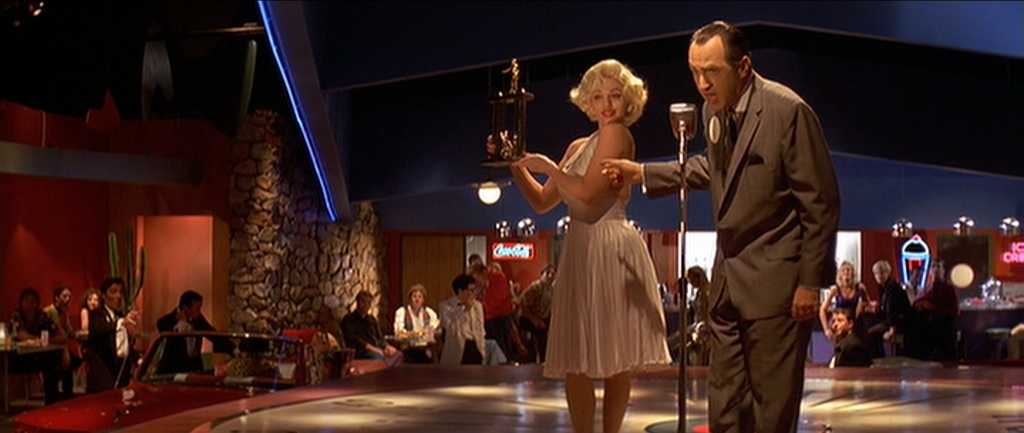
Pastiche is the most commonly cited strategy. A film using pastiche assembles fragments of earlier genres, styles, or cultural references without using them to build a coherent new statement. The borrowing is the point.
The result is a text that exists in permanent quotation mode and never settles into a single style or period. Quentin Tarantino’s Pulp Fiction (1994) is often cited as a textbook example: its dialogue, visual grammar, and narrative structure all quote from 1970s crime cinema, French New Wave techniques, and American B-movies simultaneously, without any one influence anchoring the whole.
Movies as intertextuality
Intertextuality operates alongside pastiche but is distinct from it. Pastiche is primarily about style, while intertextuality refers to the web of references a text makes to other texts. These references can be explicit or embedded in formal choices. A postmodern reading of a film traces these references not to decode the real meaning but to show how meaning is always borrowed from elsewhere, never originating in the text itself.
Read more about the many ways movies pay tribute – from homage to plagiarism.
Metafilm and Self-referentiality in film
Self-referentiality, sometimes called metafilm or reflexivity, is another central mechanism. When a film calls attention to its own status as a film, through a character who knows they are in a movie, a camera movement that breaks genre convention, or a narrative that comments on storytelling itself, it refuses the classical cinema contract of seamless illusion. The viewer is not allowed to forget they are watching a construction.
Scream (1996), directed by Wes Craven, makes self-referentiality its central comedic and analytical device: characters explicitly discuss the rules of horror films while living through a horror film.
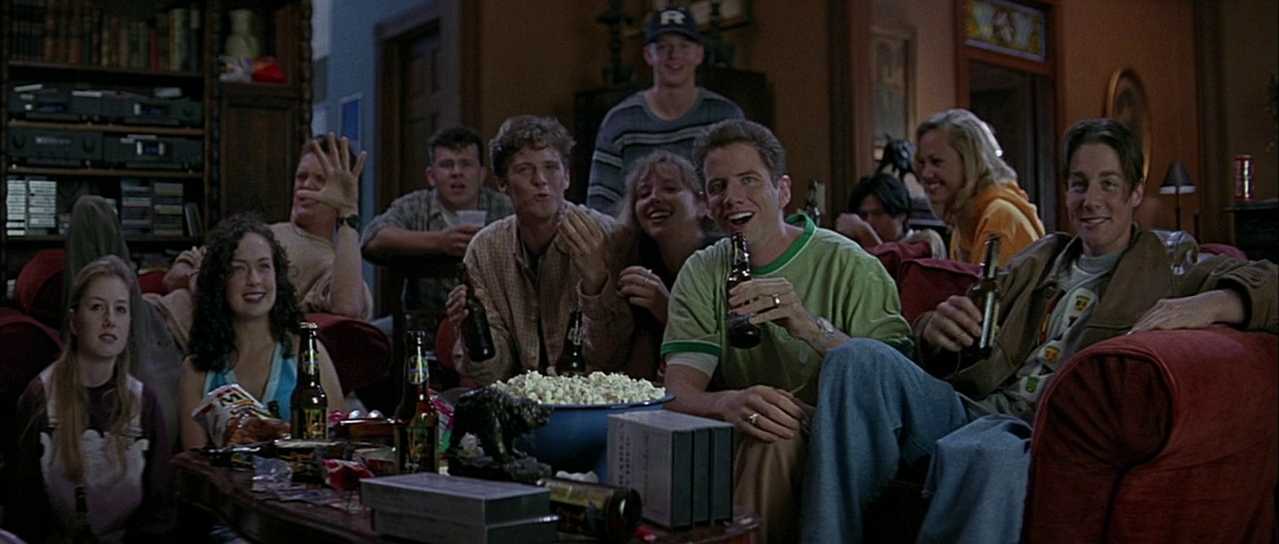
The simulation of the real is the most philosophically ambitious mechanism and is drawn most directly from Baudrillard. A film built around simulation does not merely represent a reality that exists outside it. It produces a reality effect so complete that the distinction between the real and the represented collapses.

The Matrix (1999) literalizes this argument by making the simulated world the only world its characters know, but the theoretical point is that all cinematic reality operates along the same logic, just less visibly.
What to Look For: A Postmodern Film Analysis Checklist
Applying postmodern film theory to a specific film requires attending to formal features rather than themes alone. The following items serve as a starting guide. Not every postmodern film will display all of them, but each one is an observable marker that invites theoretical analysis.
- Genre mixing and generic self-awareness: Does the film deliberately blend incompatible genres? Does it comment on genre conventions while using them?
- Pastiche and stylistic quotation: Are there sequences that visibly imitate earlier films, movements, or visual styles? Is the imitation playful, critical, or both?
- Intertextual references: Does the film quote or cite other texts, cultural products, or images? How do these references function within the scene?
- Reflexivity and fourth-wall breaks: Does the film acknowledge its own constructed status? Does a character address the camera or comment on narrative conventions?
- Non-linear or fragmented narrative: Does the film disrupt chronology in ways that foreground storytelling as artificial rather than inevitable?
- Treatment of history: If the film engages with historical material, does it present that history as recoverable fact or as a contested, constructed narrative?
- Surface and depth: Does the film resist psychological depth in characters? Does it prioritize surface image, style, and affect over interiority?
- Simulation and hyperreality: Does the film stage environments, societies, or identities that exist without a clear original they are copying?
Once you have identified these features, the analytical step is to ask what each one does in context. A fourth-wall break in a comedy functions differently from one in a political thriller. The question is always how the formal strategy affects the viewer’s relationship to meaning, reality, and representation in that particular film.
Micro-Analysis: Blade Runner (1982) and the Logic of the Simulacrum
Ridley Scott’s tech-noir Blade Runner (1982) is, in its essence, a film about the present condition of images, identity, and the real. A postmodern reading centers on the film’s treatment of the simulacrum and the impossibility of locating an original beneath the copies.
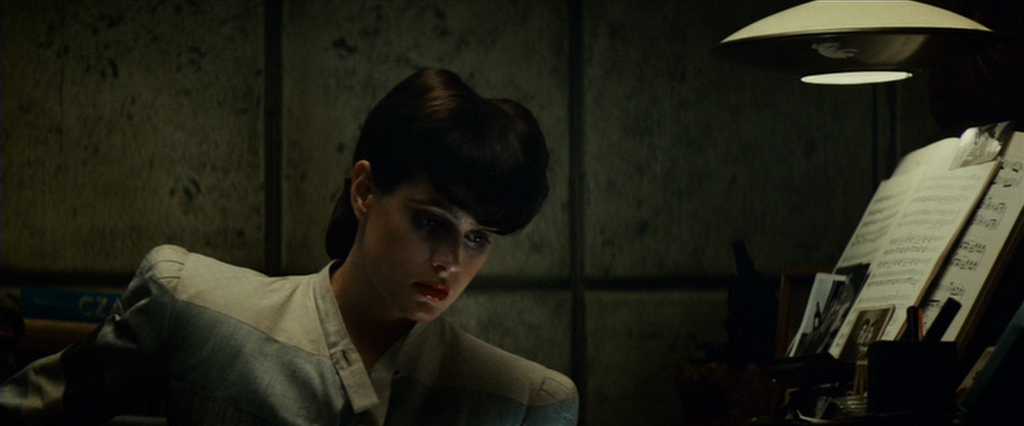
The replicants in the film are biological copies of human beings. They are so complete in their imitation that the central problem of the film (identifying who is a replicant and who is not) can only be resolved by a machine: the Voigt-Kampff empathy test. But the test itself is unreliable.
The character Rachel (Sean Young) has been implanted with false memories and does not know she is a replicant. Her memories are real to her, which raises the question of whether real memories and implanted memories are meaningfully different once they are experienced as one’s own.
This is Baudrillard’s logic of the simulacrum in concrete form. A copy that cannot be distinguished from its original is not simply a very good copy. It is a sign that the category of “original” has ceased to function as a stable anchor. If Rachel’s memories produce genuine emotional responses, and if those responses are indistinguishable from responses produced by “real” memories, then the designation “real” has lost its analytical usefulness.
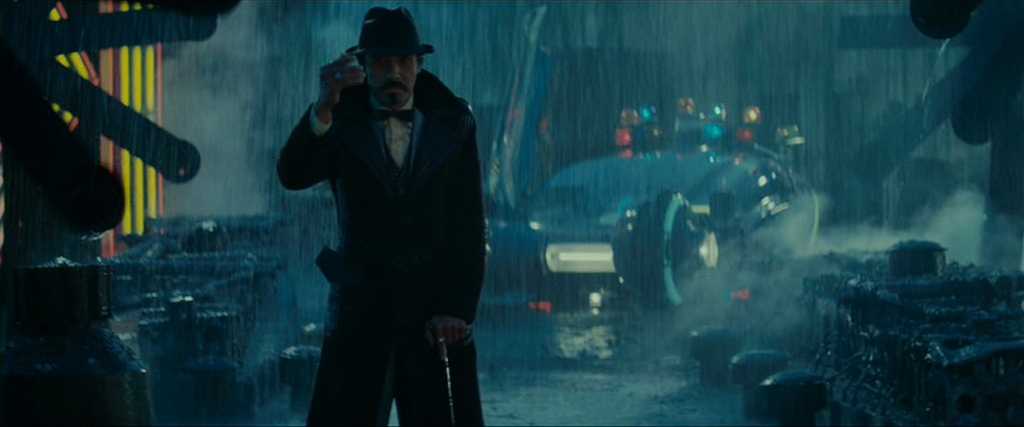
Scott reinforces this through the film’s visual language. The Los Angeles of 2019 is a layered pastiche of visual styles: film noir cinematography (low-key lighting, rain-slicked streets, femme fatale iconography), 1940s architectural references (the Bradbury Building, an 1893 Los Angeles landmark used in the film), Japanese commercial signage, and corporate brutalism. No single historical period or cultural reference anchors the setting.
The city exists as a surface composed of already-used images, which is exactly the condition of hyperreality Baudrillard describes.
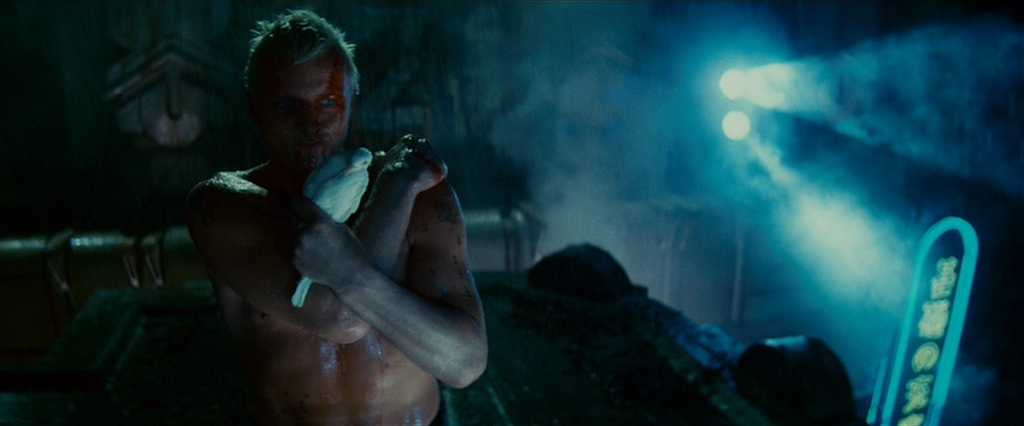
The character Roy Batty (Rutger Hauer) crystallizes the film’s postmodern argument in its final scene. His dying monologue, delivered on a rain-soaked rooftop, describes moments of experience: “attack ships on fire off the shoulder of Orion,” moments that are irreducibly real to him even though they occurred outside human history. His memories cannot be verified or archived.
They exist only in the moment of speech and then vanish with his death. The film frames this as a tragedy but also as a philosophical provocation: if his experiences were vivid and real to him, in what sense does their artificial origin diminish them?
Additional Film Examples

Pulp Fiction (1994) uses non-linear narrative and genre pastiche to dissolve any stable moral or causal framework. The film’s three interlocking storylines do not add up to a unified moral argument. They circulate around each other and create meaning through juxtaposition rather than development.
Jameson’s concept of the waning of affect is useful here: characters deliver violence with the same flat register as casual conversation, and the film treats neither as more significant than the other. The emotional flatness is a formal statement about the difficulty of genuine affect in a culture saturated with recycled images and genres.
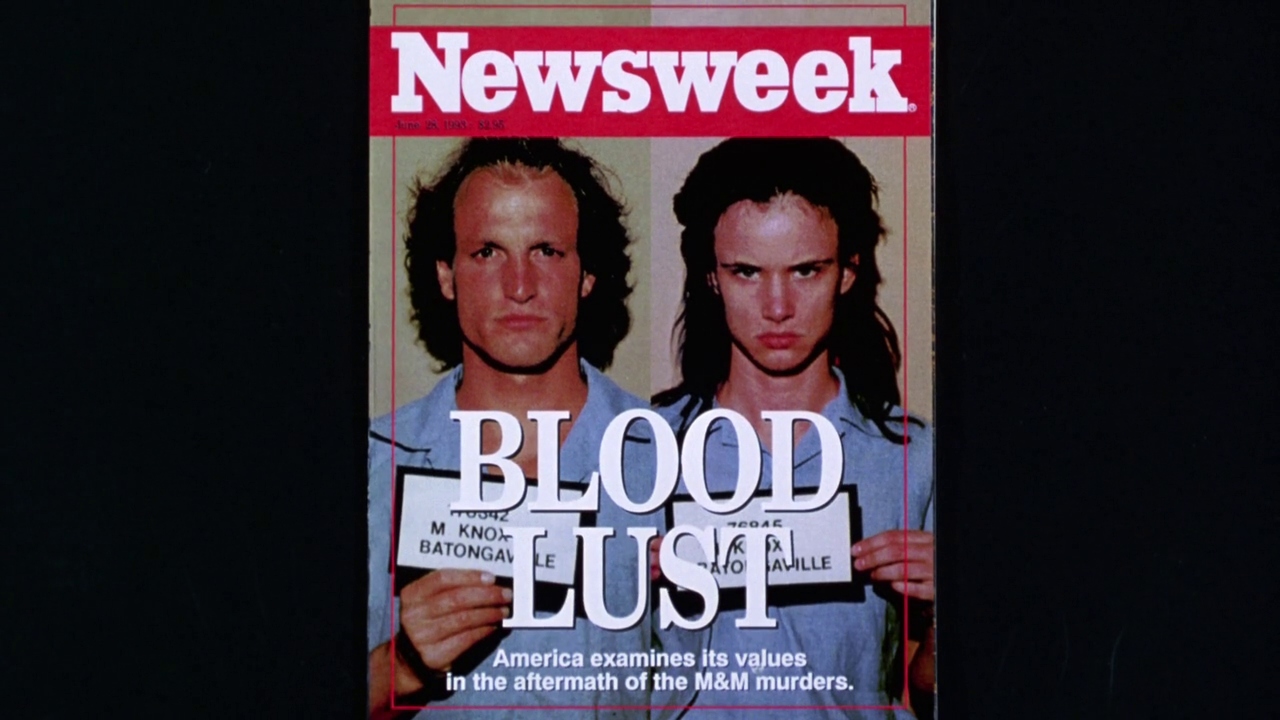
Natural Born Killers (1994), directed by Oliver Stone, foregrounds the simulation of reality through aggressive media saturation. The film uses multiple film stocks, video formats, archival footage, and genre parody to argue that media representation produces violence rather than simply reflecting it, or at least produces the cultural context in which violence acquires meaning and spectacle.
The film’s constant switching of registers and image textures prevents the viewer from settling into any stable vantage point. There is no outside position from which to observe the media system because the film is itself part of that system.
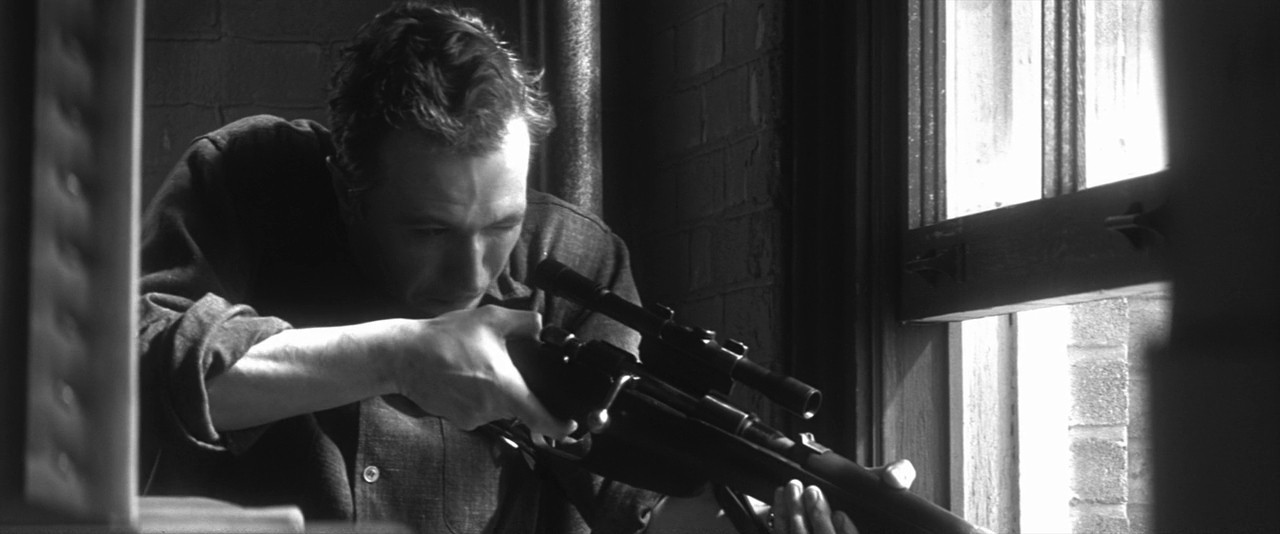
JFK (1991), also directed by Oliver Stone, works as an example of historiographic metafiction in Hutcheon’s sense. The film dramatizes the Warren Commission’s investigation of President Kennedy’s assassination while simultaneously dismantling the Commission’s authority to establish historical truth. It does this through formal means: the mixing of archival footage with reconstructions, the staging of multiple contradictory versions of the same events, and a systematic casting of doubt on documentary evidence.
Rather than offering a definitive counter-narrative, JFK stages the impossibility of arriving at one, which is its postmodern position in both form and epistemology. If you are interested in how postmodern theory connects to broader questions about contested histories in film, our guide to postcolonial theory covers related terrain.
Common Misconceptions
Postmodern film theory is frequently misread as a claim that films have no meaning at all, or that, because all meaning is constructed, no interpretation is better than another. This is not what the framework argues. It argues that meaning is constructed rather than given, which shifts the analytical question from “what does the film mean?” to “how does the film produce meaning effects, and through what mechanisms?”
Another common error is conflating postmodern theory with postmodern cinema. Not every film that uses irony or genre mixing requires a postmodern theoretical framework, and postmodern theory can be applied to films that do not obviously signal their own self-consciousness. The theory is a tool for analysis, not a label that attaches only to certain films.
A third misconception is treating Baudrillard’s theory of simulation as a pessimistic claim that cinema is fundamentally deceptive. Baudrillard was making a structural argument about the condition of representation in late capitalism, not a moral accusation about the sincerity of filmmakers. The simulation of the real is a condition that all cinema participates in to varying degrees, not a trick used by cynical directors.
Finally, the distinction between postmodern film theory and Post-Theory is often blurred. Post-Theory, associated with Bordwell and Carroll, is a reaction against Grand Theory rather than a continuation of it. Post-Theory advocates for empirical, cognitive, and historical approaches to film analysis. Postmodern film theory remains committed to ideology, representation, and cultural critique as its primary analytical categories.
Key Debates and Scholarly Criticism
The framework has attracted sustained criticism from several directions since its peak influence in the 1980s and 1990s.
Bordwell and Carroll’s Post-Theory challenge remains the most structurally significant. In Post-Theory (1996), they argued that Grand Theory, the umbrella under which postmodern film theory sits alongside feminist film theory, psychoanalytic, and ideological frameworks, is unfalsifiable, universalizing in its claims, and disconnected from the actual cognitive and perceptual processes through which viewers experience films.
They argue that postmodern theory tends to find what it is already looking for before engaging with specific films. This criticism has genuine force, though defenders respond that cognitive approaches suppress questions of power, ideology, and historical context that are not reducible to perceptual psychology (Carroll 1996; Jameson 1991).
Postmodern theory and the relation to politics
A second line of criticism concerns the theory’s relationship to politics. Jameson himself acknowledged that postmodern culture’s ironic distance may be a symptom of late capitalism rather than a resistance to it.
If pastiche and self-referentiality are simply the cultural logic of consumer capitalism, then films using these strategies are articulating the system rather than subverting it. This argument, developed also by Terry Eagleton, a British literary critic and cultural theorist, in The Illusions of Postmodernism (1996), suggests that the celebration of irony and fragmentation leaves no stable political ground from which to mount critique.
Hutcheon’s response is that postmodern self-reflexivity is precisely how culture maintains the capacity for critique under conditions where direct political art has been absorbed by the market. Her concept of complicitous critique holds that postmodern art acknowledges its own implication in the systems it examines, and that this honesty is itself a critical position (Hutcheon 1988). Whether complicitous critique constitutes genuine political engagement or sophisticated evasion remains an open debate.
Quick Contrast: Postmodern Theory and Structuralism
Structuralism and postmodern theory share an interest in how cultural systems produce meaning, but their conclusions pull in opposite directions. Where structuralism looks for underlying systems of rules, binary oppositions, and deep structures that organize cultural production, postmodern theory argues that no such stable system exists. The postmodern position is that what looks like a deep structure is always an effect produced by surface arrangements, not a foundation beneath them.
The practical difference in film analysis is significant. A structuralist reading of a Western film looks for recurring binary oppositions, civilization versus wilderness, law versus chaos, that organize the genre’s meaning across many films. A postmodern reading of the same film asks how those binaries are constructed and then destabilized, how the genre quotes itself, and how the film positions the viewer in relation to images it knows the viewer has seen before. The two frameworks ask fundamentally different questions and produce different kinds of evidence.
Why Postmodern Film Theory Still Matters
Postmodern film theory remains analytically useful for understanding a substantial portion of the cinema produced since 1975. Films that use pastiche, generic self-awareness, simulation, or historiographic complexity do not yield their full meaning to frameworks that assume cinema’s primary job is realist representation. The theory provides the vocabulary and analytical logic needed to describe what these films are doing at a formal level.
For those interested in how audiences engage with such films, our guide to spectatorship theory covers the viewer’s side of that equation.
It also remains relevant because the cultural conditions it describes have not receded. Digital culture, social media, deepfakes, and the proliferation of image production have deepened the conditions that Baudrillard described in 1981. The theoretical framework, though developed before the digital age, has acquired new applications in contemporary film and media studies.
Its limits are real, however. Postmodern theory is least useful when applied to films not primarily concerned with representation and self-consciousness. This group includes straightforward genre work, documentary, and films centered on emotional realism. In those contexts, cognitive approaches or sociological frameworks tend to yield more precise analytical results. Postmodern theory is a strong lens for a defined range of objects, not a universal framework for all cinema.
Summing Up
Postmodern film theory analyzes how certain films dissolve the boundary between the real and its representation, recycle cultural images through pastiche, foreground their own construction, and challenge historical narrative. Its key thinkers, Baudrillard on simulacra and hyperreality, Jameson on pastiche and the waning of affect, Hutcheon on historiographic metafiction, and Lyotard on the collapse of grand narratives, provide a set of concepts that can be applied to a defined range of cinematic objects.
The framework has been challenged by cognitive and Post-Theory approaches, and its political status remains contested, but it continues to offer precise analytical tools for films that refuse to behave like transparent windows onto the world.
Read Next: Curious how film theory shapes the way we watch movies?
Start with the Film Theory section to break down realism, formalism, structuralism, and more — with examples from iconic films.
If you want studying film theory I recommend starting with The FilmDaft overview of film theory discourses to break down realism, formalism, structuralism, and more — with examples from iconic films.
Then explore the full Film History, Theory & Genre collection to see how movements, styles, and storytelling traditions have evolved.
Whether you’re into Soviet montage or 2000s genre mashups, there’s something here to sharpen your understanding.
Postmodern Film Theory FAQ
What is postmodern film theory?
An approach that examines how films reject the idea of a single, stable reality — embracing pastiche, self-reference, irony, and a blurred line between the real and the simulated.
What are simulacra and hyperreality?
Jean Baudrillard’s idea that copies and signs (“simulacra”) become detached from any original and feel more real than reality itself (hyperreality). The Matrix drew directly on his book Simulacra and Simulation.
What is pastiche in postmodern film?
The playful borrowing and mixing of older styles, genres, and references — without the mockery of parody. It is a hallmark of directors such as Quentin Tarantino.
Who are the key postmodern theorists?
Jean-François Lyotard (“incredulity toward metanarratives”), Jean Baudrillard (simulacra and hyperreality), and Fredric Jameson (postmodernism as the logic of late capitalism).
What are examples of postmodern films?
Blade Runner, Pulp Fiction, The Matrix, and Fight Club are often cited for their self-awareness, genre mixing, and blurring of reality and simulation.
References
- Baudrillard, Jean. 1994. Simulacra and Simulation. Translated by Sheila Faria Glaser. Ann Arbor: University of Michigan Press. (Originally published 1981.)
- Bordwell, David, and Noel Carroll, eds. 1996. Post-Theory: Reconstructing Film Studies. Madison: University of Wisconsin Press.
- Carroll, Noel. 1996. “Prospects for Film Theory: A Personal Assessment.” In Post-Theory: Reconstructing Film Studies, edited by David Bordwell and Noel Carroll, 37–68. Madison: University of Wisconsin Press.
- Eagleton, Terry. 1996. The Illusions of Postmodernism. Oxford: Blackwell.
- Hutcheon, Linda. 1988. A Poetics of Postmodernism: History, Theory, Fiction. New York: Routledge.
- Jameson, Fredric. 1991. Postmodernism, or, the Cultural Logic of Late Capitalism. Durham: Duke University Press.
- Lyotard, Jean-Francois. 1984. The Postmodern Condition: A Report on Knowledge. Translated by Geoff Bennington and Brian Massumi. Minneapolis: University of Minnesota Press. (Originally published 1979.)
