Published: January 17, 2020 | Last Updated: May 26, 2025

DISCLOSURE: AS AN AMAZON ASSOCIATE I EARN FROM QUALIFYING PURCHASES. READ THE FULL DISCLOSURE FOR MORE INFO.
If you’ve been in filmmaking and videography for some time, you’ve probably heard of speed boosters.
These devices, adequately known as focal reducers, are often costly and little understood. Considering their cost, it may not seem worth investing in them.
Yet, if you’re looking to get an extra stop of light from your lenses, adapt non-native lenses, and make your lenses capture a wider angle, focal reducers are for you.
The most recognizable brand is the Metabones Speed Booster, so focal reducers are often referred to as speed boosters.
Metabones Speed Boosters are top-of-the-line adapters, and their prices reflect that. And the high prices make this technology seem inaccessible to many filmmakers.
Luckily, there are a few cheaper and lesser-known alternatives on the market, and this guide will look at some of the best.
But first, here’s a brief overview of how focal reducers function. If you’ve never used a focal reducer, we recommend you read this guide first to learn how they work on a basic level.
What is a Focal Reducer?
A focal reducer is a lens adapter that adapts larger lenses to smaller-sized, a.k.a. crop-sized sensors. For example, you can use a full-frame Canon lens with EF-Mount on a Micro-Four-Thirds camera.
Now, you can get many adapters—electronic adapters and “dummy” adapters—that also do that.
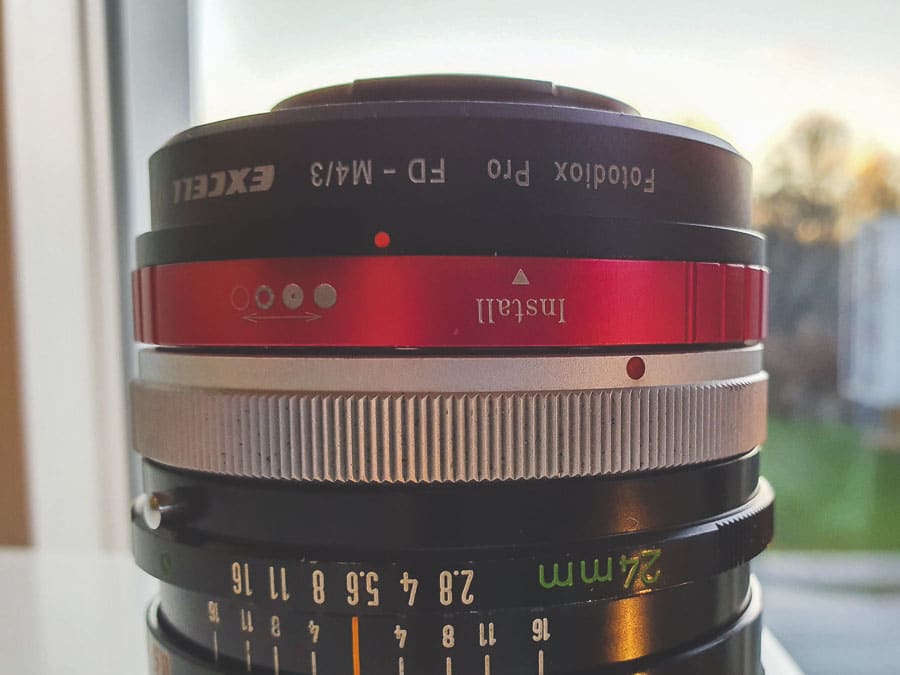
But a focal reducer is constructed in such a way that you do not only gain an extra stop of light but also a wider field of view when you do so.
Focal reducers only exist for mirrorless cameras. The mirror in a DSLR camera would get in the way because of how these adapters function.
Focal reducers exist for many different mirrorless cameras with cropped sensors. The different sensor sizes will affect the impact of focal reducers.
In this guide, we will be focusing specifically on Micro Four Thirds (MFT) mounts. When you put a focal reducer on an MFT sensor, you’ll get a wider field of view than on a super 35mm/APS-C sensor.
How Does A Focal Reducer (Speedbooster) Work?
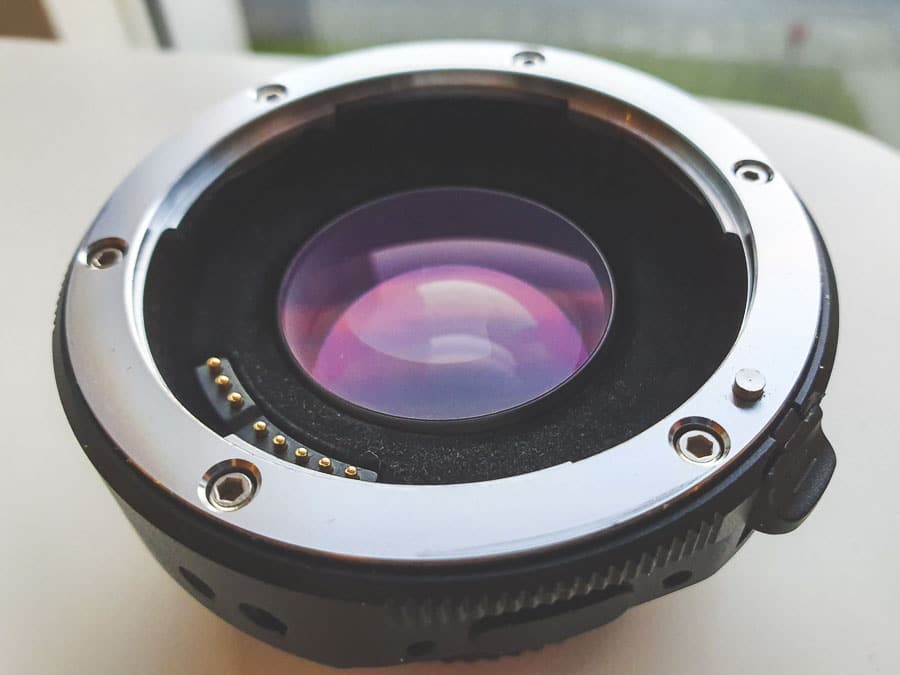
A large factor making focal reducers different from standard lens adapters and more expensive is that they contain glass.
The addition of glass in these adapters effectively puts a lens between the original lens and the camera, which shortens the focal length.
Instead of measuring the distance from the lens to the sensor, a piece of glass between the lens and the sensor now affects the focal length of your camera.
Since the f-number is found by dividing the focal length by the aperture diameter, reducing the focal length makes the f-number smaller and, therefore, faster.
Gain One Stop of Extra Light
Also, the added glass is why focal reducers make the lens “faster,” adding up to an extra stop of exposure. The curved glass of the focal reducer concentrates the light entering through your lens onto the sensor.
So, while the same amount of light passes through the lenses, it’s packed into a smaller sensor area.
This can be very helpful if you need to shoot in low light or achieve a very shallow depth of field.
This also means that for a focal reducer to work, the lens should be designed for a larger sensor than the camera.
For example, you can use a lens designed for a full-frame or APS-C sensor on an MFT camera. But you can’t do it the other way around without heavy vignetting.
Something to consider is that while focal reducers boost the lens’s maximum aperture, they also boost the minimum.
You must remove your booster if you want to set your camera to something like f/22.
Metabones vs. Cheaper Alternatives
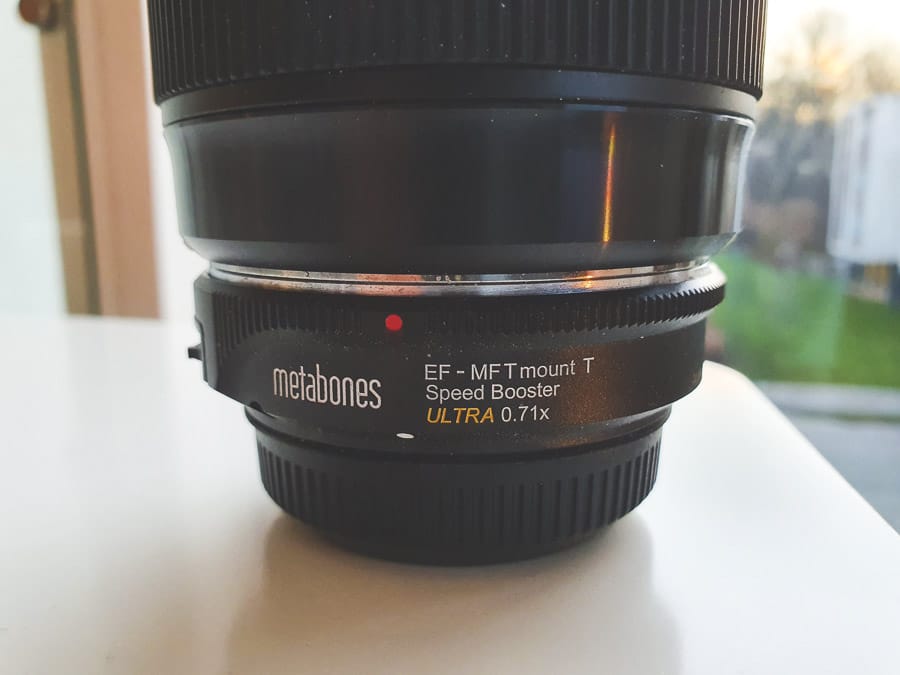
Now, with focal reducers, you get what you pay for. That doesn’t mean you can’t use more budget-friendly alternatives. Many people, both amateurs and professionals, do so with great success.
However, there are some caveats you should be aware of.
A benefit of using a high-quality focal reducer like Metabones is that the lens’s Modulation Transfer Function (MTF – not to be confused with MFT) is also increased.
What this means is that the resolution and the contrast of the lens are improved upon. Lenses tend to get softer and contrast less as you move from the center to the edges.
But with a good focal reducer like Metabones, your lens becomes sharper and has more contrast near the edges.
This is a point where the cheaper alternatives often fall short. Instead of increasing the MTF, they decrease it, which results in a softer image. But a softer image isn’t always a bad thing when it comes to video.
No Electronic Connections
Many cheap focal reducers also do not offer an electronic connection between the lens and your camera. If you’re using a cine or a manually controlled lens, this won’t cause any issues.
Still, suppose your lens can only have the aperture and focus adjusted in-camera. In that case, spending extra money and acquiring an adapter with an electronic connection is strongly recommended.
The issues of electronic connection will be covered in more detail as we cover the specifications of our recommended focal reducers.
Notes on Adapting Micro Four-Thirds Lenses
Adapting lenses to MFT lenses using a focal reducer is helpful due to the small size of the MFT sensor.
The small size of an MFT sensor doesn’t make it as good in low light as APS-C or full-frame sensors. So, having the ability to gain an extra stop of light is great.
Furthermore, on MFT, it can be challenging to find genuinely wide-angle lenses, and you’re limited to a few options. One of these is the amazing Laowa 7.5mm f/2.0, which you can read in my review here.
Focal reducers can be very helpful if you’re like me and like the look of wide-angle lenses but shoot with a sensor other than a full-frame.
These adapters give those of us who shoot on crop sensors a much wider array of glass options.
A Quick Note that there are special Focal Reducers for BMPCC 4K
Due to the filter stack thickness of 2.4mm found in the Blackmagic Cinema Camera 4K (compared to the 4mm found in standard Micro-Four-Thirds cameras), Metabones has developed a unique series of focal reducers for this camera.
The special version differs from the ordinary Metabones XL and Ultra in that 1) it offers a new optical design optimized for the BMPCC4K, which gives you a sharper image across the lens, and 2) it comes with a longer tripod mount that matches the height of the BMPCC 4K camera body.
While the ordinary Metabones Ultra and XL can be used on BMPCC4K, the special BMPCC4K edition cannot be used on other MFT systems.
So if you own a BMPCC4K, you must be aware of this.
How to Calculate the New Focal Length
I often see a lot of bad math when people discuss calculating the new focal length using a focal reducer. But it’s pretty simple.
The equation looks like this:
Focal Length x Crop Factor x Focal Reduction
In terms of hardware:
Focal length (lens in mm) x Crop Factor (camera sensor type) x Focal Reduction (type of focal reducer)
Let’s look at an example:
The Panasonic GH5 is an MFT system, which means you get a 2x crop factor.
We now take a Canon EF 100mm lens and put it on the GH5 with a dummy adapter (non-focal reducer).
The field-of-view from this lens on the GH5 corresponds to a 200mm lens on a Canon full-frame camera because of the 2x crop factor: 2 x 100mm = 200mm.
Now we put a Metabones Speedbooster XL, which offers 0.64x focal reduction between the GH5 and the lens.
The new focal length is 200mm x 0.64 = 128mm. In other words, the 100mm lens now gives you the equivalent field-of-view of a 128mm lens on a full-frame system.
If we used the Metabones Speedbooster Ultra instead, which has a 0.71x focal reduction, we would get the field-of-view of using a 142mm lens on a full-frame camera (200mm x 0.71 = 142mm).
Lots of Lenses to Choose From
You can adopt many lenses from APS-C and full-frame camera systems with a focal reducer.
You can even adopt vintage glass. For example, Metabones makes a focal reducer for Canon FD-mount glass to MFT.
If you own cine lenses, Metabones also makes special adapters for cine glass.
And this is where the MFT system shines: you can use so many different lenses from all kinds of systems with all kinds of adapters – focal reducers being only one.
Using focal reducers can affect image quality, though certain models and brands do a good job of limiting the impacts. As with any adapter and cheap lenses, field curvature, distortion, light leaks, and chromatic aberration are risks.
Ensuring that you get the best focal reducer for your price point is extremely important to avoid future headaches.
Summing Up
Focal reducers often seem like expensive pieces of gear that aren’t worth it. After seeing some affordable options, you may consider picking one up. Focal reducers can greatly expand the number of lenses available and their usability, especially for filmmakers, videographers, and photographers using crop sensors. Additionally, focal reducers can be a great way to equip old lenses with new cameras if you are transitioning between cameras.
While Metabones sets the standard in quality, many of these cheap options are a great foray into the world of focal reducers. Adapters such as the Commlite Lens Adapter offer solid image quality at a reasonable price and can help offset the crop factor of an MFT sensor. Focal reducers have numerous benefits, from the widened focal length to an extra stop in the aperture.
Read Next: The Broke Filmmaker’s Guide to Cine Lenses.