

Published: January 31, 2024 | Last Updated: February 6, 2026

Overview
Definition: A climax is the story moment where the main conflict reaches its highest pressure and the protagonist makes the decisive action that settles the central question.
What you’ve seen before: You have felt this when a film stops delaying the outcome and forces the lead to act, even if the choice costs them something.
Example: In The Lion King (1994), Simba returns to Pride Rock and confronts Scar while the future of the Pride Lands hangs on what Simba does next. The fight and confession force a final, irreversible shift in who rules and what Simba becomes.
Why it matters: If you misplace the climax, your ending drifts and your “final beat” can feel like extra scenes after the real peak. When you plan the climax, you can aim your coverage, performance beats, and music toward one clear turning point. In writing, it helps you test whether your protagonist actually answers the film’s main question through action, not explanation.
- Key takeaway 1: Identify the central story question, then make the climax the moment that question gets answered through a decision.
- Key takeaway 2: Put the biggest obstacle in front of the protagonist at the climax so the outcome feels earned.
- Key takeaway 3: Keep the resolution after the climax short and focused on consequences, not new conflicts.
Now let’s explore this in more detail and define climax in a broader, educational context.
What Is the Climax in Film?? Definition & Meaning
The climax is the most intense turning point of your story, where the central conflict reaches its peak, and the outcome is decided.
In most films, everything is quietly pointing toward one moment. It is the point where the main conflict can no longer be avoided. The stakes are at their highest. The protagonist must choose who they are and what they want. That moment is the climax.
You can also think of it this way:
The climax is the decisive moment when your protagonist faces their biggest obstacle, makes an irreversible choice, and determines how the main story question will be answered.
When the climax lands, you often feel an emotional release. This effect connects to catharsis.
Typical traits of a strong climax:
- Highest stakes. What can be gained or lost is at its most extreme.
- Maximum opposition. The antagonist or opposing force is at full strength.
- No more dodging. The protagonist cannot escape, delay, or avoid the issue.
- Character-defining choice. The decision shows who they are now.
- Irreversibility. The story cannot return to the old normal after this.
The climax is not just the most exciting scene. It is the answer to your story’s main dramatic question.
Where Does the Climax Sit in Story Structure?
This section places the climax inside the most common narrative frameworks you will use when you outline.
Most mainstream narratives use some version of the three-act structure:
- Act I: Setup. The film introduces the world, the protagonist, and the central problem.
- Act II: Confrontation. The protagonist struggles, fails, learns, and escalates the conflict.
- Act III: Resolution. The conflict peaks in the climax, then the film shows consequences and a new status quo.
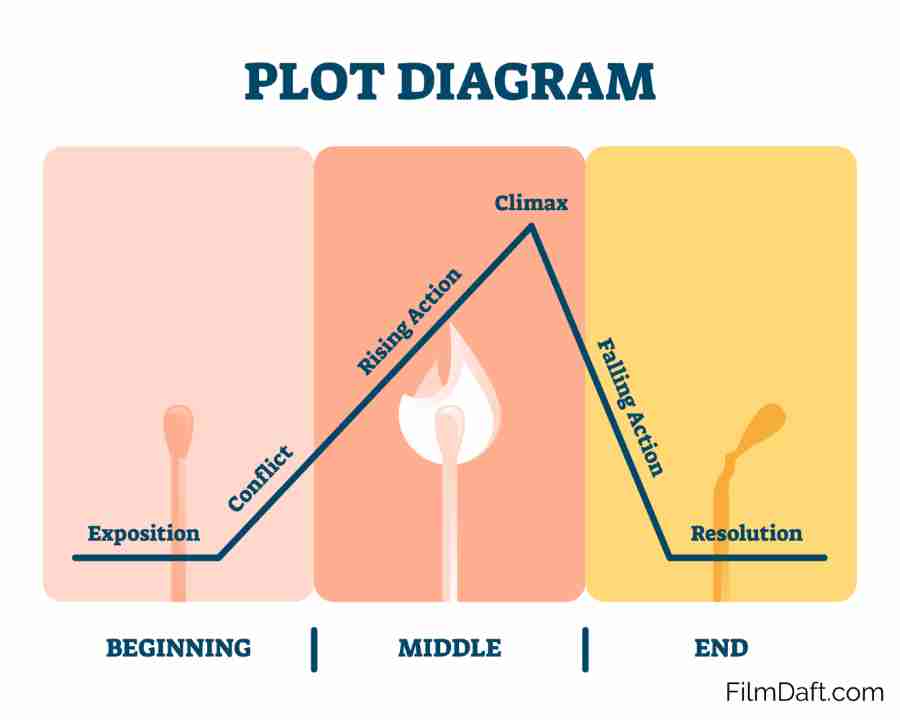
The same placement shows up in other models. A good example is The Hollywood Model and Dan Harmon’s Story Circle.
If you want a broader look at cause, effect, and escalation across a whole narrative, you can also revisit plot in film.
Climax is not the same as the ending.
- The climax is the decisive battle, confrontation, or emotional turning point.
- The resolution shows the outcome of that decision and gives closure.
External vs. Internal Climax
This section breaks the climax into two linked layers. Most strong scripts connect them.
Some climaxes are visually spectacular. Others are almost entirely emotional. Most good ones combine both.
External Climax (Plot-Level)
The external climax is the peak of the outer conflict. It is about what happens in the physical or practical world of the plot.
- Defeating the villain
- Winning or losing the competition
- Escaping danger
- Revealing the truth
- Stopping a disaster
This layer often includes physical action, direct confrontation, or high-pressure set pieces.
Internal Climax (Character-Level)
The internal climax is the peak of the inner conflict. It is where the protagonist makes the emotional or moral choice that finalizes their arc.
- Letting go of guilt or shame
- Choosing honesty over self-protection
- Choosing love over fear
- Accepting identity or responsibility
- Breaking a destructive pattern
In a strong story, the internal climax drives the external climax. The inner change allows the final action to happen.
Do All Films Have a Big, Explosive Climax?
This section shows how genre and style change the scale of a climax.
Not always.
- Hollywood genre films often build toward a big set-piece climax.
- Ensemble films may stack smaller climaxes across multiple characters.
- Character dramas and arthouse films can land on a quiet choice or confession.
- Subversive stories may intentionally deny a conventional peak and use an anticlimax.
Even when the moment is subtle, you will usually find a scene that answers the main dramatic question and represents the peak of emotional intensity for the protagonist.
Climax Examples from Famous Movies (And Why They Work)
This section breaks down different kinds of climaxes across genres. Each example links the external action to the internal decision.
Let’s look at some well-known films from different genres and see why certain scenes function as the climax.
1. Die Hard (1988, 20th Century Fox): Action Thriller

Premise in one line: An off-duty cop, John McClane, must stop terrorists who have taken over a Los Angeles skyscraper where his wife is among the hostages.
Climactic sequence: The final confrontation between McClane and Hans Gruber ends with Gruber falling from the window while holding onto Holly’s wrist.
Why this is the climax:
- Central question: Can McClane stop the terrorists and save his wife?
- External stakes hit their peak with Holly, the hostages, and the escape plan on the line.
- Internal stakes center on McClane’s fear of losing his marriage for good.
- Character-defining choice resolves both layers at once.
Takeaway for writers: Connect personal stakes to physical stakes so the climax lands as both spectacle and character payoff.
2. Titanic (1997, Paramount): Epic Romance and Disaster

Premise in one line: A poor artist and an upper-class young woman fall in love aboard the doomed RMS Titanic.
Climactic sequence: After the ship sinks, Jack and Rose cling to debris in the freezing ocean. Jack dies, ensuring Rose’s survival.
Why this is the climax:
- Central question: Will Rose escape the life that is suffocating her, and what will it cost?
- External stakes are life and death in the freezing Atlantic.
- Internal climax: is Rose choosing to live on her own terms?
Takeaway for writers: In romance and drama, the final emotional decision is often the true peak, even when the scale is massive.
3. The Matrix (1999, Warner Bros.): Science Fiction

Premise in one line: A hacker named Neo discovers that reality is a simulation and that he may be The One meant to free humanity.
Climactic sequence: Neo is killed by Agent Smith, then returns fully embracing his role as The One, changing what he can do inside the simulation.
Why this is the climax:
- Central question: Is Neo really The One, and will he accept that role?
- Internal stakes: focus on self-doubt versus belief.
- Internal climax: is Neo choosing faith in himself?
- External payoff: follows from that choice.
Takeaway for writers: If your story is about identity or destiny, force a final decision that can only be made by the protagonist.
4. Bridesmaids (2011, Universal): Comedy

Premise in one line: Annie’s life unravels as she tries to be the perfect maid of honor for her best friend’s wedding.
Climactic sequence: After repeated disasters, Annie hits bottom and chooses to repair her friendships and change her self-destructive pattern.
Why this is the climax:
- Central question: Can Annie stop sabotaging herself and save her friendship?
- Internal climax: is her choice to take responsibility?
- External payoff: is the path back to Lillian and the life she wants?
Takeaway for writers: In comedy, the biggest shift can be emotional, not physical.
5. Gone Girl (2014, 20th Century Fox): Psychological Thriller

Premise in one line: A woman disappears under suspicious circumstances, and her husband becomes the main suspect, but the truth twists the idea of marriage into something much darker.
Climactic sequence: Amy returns after staging her disappearance. Nick discovers the truth. He chooses to stay when Amy reveals she is pregnant.
Why this is the climax:
- Central question: What is this marriage, and can Nick ever escape Amy?
- External stakes: include Nick’s freedom, reputation, and safety.
- Internal climax: is Nick choosing survival inside a toxic bond?
- The decision lands like a plot twist because it locks the story into a disturbing new status quo.
Takeaway for writers: A climax does not need to be uplifting. It needs to answer the central question in a final way.
6. Get Out (2017, Blumhouse): Horror and Social Thriller

Premise in one line: Chris, a Black photographer, visits his white girlfriend’s family and discovers a horrifying secret.
Climactic sequence: Chris breaks free from captivity and fights his way out, confronting and killing members of the Armitage family to escape.
Why this is the climax:
- Central question: Will Chris survive and escape this system of exploitation?
- External stakes: are his life and autonomy.
- Internal climax: is Chris stopping his own impulse to accommodate danger?
If you want tighter genre context for this label, you can revisit FilmDaft’s breakdown of the horror vs. thriller split.
7. Lost in Translation (2003, Focus Features): Quiet Drama

Premise in one line: Two lonely people form a deep emotional connection in Tokyo during a brief overlapping period in their lives.
Climactic moment: Bob and Charlotte share a final private moment on the street before going their separate ways.
Why it works as the climax:
- It is their last and most honest connection.
- The central tension is emotional, not physical.
- The decision to part becomes the irreversible turning point.
Takeaway for writers: A climax can be quiet. What matters is peak emotional clarity and a decisive shift.
How to Design a Strong Climax in Your Script
This section gives you practical steps you can use during outlining and rewrites.
1. Define Your Central Story Question
Your central story question is the one question your plot must answer.
- Will they survive?
- Will they stay together?
- Will they accept who they really are?
- Will they defeat the antagonist?
Your climax should answer that one primary question.
2. Make the Stakes Unmissable
Stakes are what your protagonist can gain or lose. You should make them clear before the final sequence begins.
- What the protagonist stands to gain
- What the protagonist stands to lose
- Why that cost matters to them
3. Force a Difficult, Character-Revealing Choice
A strong climax requires an active choice from your protagonist.
If you can remove the protagonist from the scene and the outcome does not change, the climax is not strong enough.
4. Align Internal and External Conflict
When the internal arc drives the external outcome, the climax feels earned.
- Accepting responsibility leads to facing the villain
- Embracing vulnerability leads to telling the truth
- Choosing self-respect leads to leaving a toxic relationship
5. Build Escalation Toward the Climax
Escalation makes the final moment feel inevitable.
- Increase time pressure
- Reduce safe exits
- Remove easy compromises
6. Resolve Cleanly After the Climax
The resolution shows the consequences of the climax. Keep it short so the peak does not lose its intensity.
Common Climax Mistakes (and How to Fix Them)
This section helps you diagnose weak endings and repair them with simple structural choices.
1. The Climax Feels Random or Unset Up
Problem: New information, powers, or rules appear at the last second.
Fix: Foreshadow key elements earlier so the payoff feels surprising and earned.
2. The Protagonist Is Passive
Problem: Someone else saves the day while the hero watches.
Fix: Give the protagonist the final decisive action or choice, even if they fail.
3. Stakes Are Too Low or Vague
Problem: You cannot feel why this moment matters.
Fix: Clarify what is at risk and why the protagonist cares.
4. Too Many Competing Climaxes
Problem: Fake endings confuse which moment is the real peak.
Fix: Decide which moment resolves the central story question. Frame other big moments as build-up or fallout.
5. No Connection to the Character’s Arc
Problem: The climax is only about plot mechanics and not connected to character arcs.
Fix: Make the internal decision the reason the external outcome becomes possible.
Quick Climax Checklist
Use this list as a fast self-edit tool while you outline or revise your third act.
- Can I state my story’s central question in one sentence?
- Does my climax answer that question?
- Are the stakes at their highest here?
- Is the protagonist making the decisive choice?
- Does that choice show growth or failure to grow?
- Is this moment irreversible?
- Is there a short resolution that shows consequences?
Further Reading on Story Structure and Climax
These FilmDaft articles expand the structure tools that connect directly to the climax.
- The Hollywood Model
- What Is Plot in a Movie?
- The Dan Harmon Story Circle Explained
- What Is Conflict in Film?
- What Is Catharsis in Film?
- What Is a Plot Twist?
- The Anticlimax
- The Screenwriters’ Quick Guide to Screenwriting Formulas
Summing Up
The climax is the decisive moment where your protagonist faces the peak of the main conflict and makes an irreversible choice that answers the central story question.
When your internal and external climaxes lock together, your ending feels earned and personal.
Use the checklist above during your next outline. It will help you spot weak stakes, passive heroes, and last-minute fixes before they reach your draft.
Read Next: Got a cool idea but no story yet?
Check out our Story Development section for help turning rough ideas into clear concepts, building stronger characters, and finding the heart of your script before you write page one.
Want to build the whole toolkit? Explore the Screenwriting archive for structure, formatting, and career advice that supports every step of your writing process.