

Published: July 17, 2024 | Last Updated: July 2, 2026

Overview: What is Film Style?
Film style is the recurring pattern of craft choices that gives a movie its look, sound, and expressive feel. In practice, this includes choices in mise-en-scène, cinematography, editing, sound, and performance direction.
What you’ve seen before: You have seen film style every time two movies tell a similar story but feel very different because of how they are shot and cut. A crime story can feel cold and tense through low-key lighting and slow reveals, or playful and fast through bright color, quick cutting, and comic timing.
Example: In Citizen Kane (1941, RKO Radio Pictures), Orson Welles, an American director and actor, and Gregg Toland, an American cinematographer, use deep-focus staging, low angles, and layered composition so you can watch more than one important action in the same frame. The effect does not come from plot alone. It comes from a repeated style pattern that keeps your attention on power, distance, and control inside the image.
Why it matters: If you write or analyze film, style helps you explain how meaning is created, not just what happens. It gives you evidence you can point to in the frame and on the soundtrack. It also helps you write stronger screenplays because you start thinking in filmable terms, not vague literary description.
Key takeaways:
- Film style is a pattern of repeated technique choices, not a random “look.”
- Style works across image, sound, editing, and performance, not just cinematography.
- You can analyze style with evidence-first method: describe what you see and hear, identify the function, then explain the effect.
The sections below start with the broader meaning of style in writing, then move into how the same idea works on the screenplay page and in finished films.
What Style Means in Writing, Screenplays, and Film
Style is a cross-medium craft term. The core idea stays the same, but the evidence changes depending on whether you are reading prose, reading a screenplay, or analyzing a finished film.
Style is the organized way a work uses craft tools again and again to guide attention, control pace, and create a consistent expressive result. In other words, style is not only “how it looks.” It is how a work repeatedly handles selection, emphasis, and presentation.
In writing, style appears in word choice, sentence length, rhythm, figurative language, and the distance of the narrator’s voice. In a screenplay, style appears in action-line density, scene construction, dialogue compression, page rhythm, and how clearly the page points toward filmable behavior. In film, style appears through mise-en-scène, cinematography, editing, sound, and performance direction working together.
When you analyze style, your evidence must match the medium. In prose, you quote and track language patterns. In a screenplay, you point to what the page makes visible or audible and how the page controls reading speed. In film, you point to what the camera and soundtrack actually present: framing, blocking, cut rhythm, sound cues, repetition, and contrast across scenes.
This is why style analysis works best when you ask a practical question first: What is this scene trying to make you notice, feel, or understand right now? Then you can test how the craft choices support that job.
Core Explanation for Writing and Literature
Most readers first meet the term style in literature classes. That matters for film analysis too, because the same core logic applies: style is a pattern of choices that affects how you receive the material.
What Style Is in Writing
Writing style is the way an author presents ideas on the page through language. It includes diction (word choice), syntax (sentence structure), rhythm, imagery, and the level of detail. Two writers can describe the same event, but one may use short plain sentences while another uses long flowing sentences with dense description. The event stays the same. The style changes how you experience it.
How Style Works
Style works by controlling attention and processing speed. Short sentences can push speed and blunt force. Longer sentences with layered clauses can slow you down and keep you inside a character’s thought process. Repeated words can build pressure. Specific nouns and verbs make scenes easier to picture. Abstract language can create distance.
If you want a practical test, read a paragraph out loud. You will hear rhythm, pauses, and emphasis. Those are style signals, not only content.
How to Recognize Style
You can recognize style by looking for patterns instead of isolated lines. One unusual sentence does not define a writer’s style. A repeated pattern does.
- Word pattern: plain vs ornate vocabulary
- Sentence pattern: short bursts vs long flowing structures
- Description pattern: sparse detail vs dense sensory detail
- Narration pattern: distant summary vs close interior access
- Figurative pattern: frequent metaphor/symbolic language vs direct statement
Why Writers Use Style
Writers use style to match the material. A war scene written in clipped language can feel immediate because the prose removes extra processing steps. A memory scene written with drifting syntax can feel unstable because the form mirrors the character’s mental state. The point is not decoration. The point is fit between method and effect.
Common Mistakes and Misreadings
A common mistake is to treat style like a surface label, such as “dark” or “beautiful,” without evidence. Those words describe your reaction, but they do not explain how the text creates that reaction.
Another mistake is to confuse style with genre. A story can be a mystery, but the style can still be plain, lyrical, comic, or clinical. Genre tells you a category. Style tells you how the work is executed.
Key Distinctions From Similar Terms
These terms overlap, but they do different jobs. Keeping them separate makes your analysis stronger.
- Style vs. tone: Style is the craft pattern. Tone is the attitude or emotional stance that the work communicates.
- Style vs. mood: Style is what the work does. Mood is the feeling you receive.
- Style vs. voice: Voice usually points to the personality of narration or dialogue. Style is broader and includes structure and presentation choices too.
- Style vs. form: Form concerns the larger system of parts and how they connect over time. Style concerns the recurring technique choices that present each part.
Concrete Examples in Literature and Writing
These examples show style in action before we move fully into film. Each one focuses on a defendable pattern and explains how the effect is created.
Ernest Hemingway’s Prose Style
Ernest Hemingway, an American novelist and short story writer, is often taught as an example of compressed prose style. His style is known for direct verbs, short-to-medium sentence lengths, and selective detail.
What the style is doing: It creates force through restraint. You do not get long explanation for every emotion. You get observable actions and concrete details that let you infer the emotion.
How the effect is created: Hemingway often cuts modifiers, keeps syntax simple, and lets repetition carry emphasis. That makes the page move quickly and keeps attention on behavior and result.
Virginia Woolf’s Interior Prose Style
Virginia Woolf, an English modernist novelist, is often used to show a very different style pattern. Her prose can move through perception, memory, and thought in the same passage.
What the style is doing: It puts you close to mental experience. Instead of only reporting events, the writing tracks how a character notices the world and how one thought leads to another.
How the effect is created: Woolf uses longer sentence structures, shifting attention, and rhythmic phrasing that follows mental association. The prose slows the reader down and keeps the focus on consciousness, not only external action.
William Shakespeare’s Dramatic Style in Macbeth
William Shakespeare, an English playwright from the late 16th and early 17th centuries, shows how style works in playwriting. In Macbeth, the language often becomes compressed, image-heavy, and rhythmically sharp when fear, guilt, and ambition intensify.
What the style is doing: It turns internal conflict into spoken texture. The language itself feels pressured, which supports the play’s violent and unstable world.
How the effect is created: Shakespeare uses recurring imagery, patterned sound, and heightened phrasing in key moments. The dramatic effect comes from repeated language choices that keep conflict active in the dialogue, not only in plot events.
Why These Writing Examples Matter for Film
These examples help because they train the same skill you need in film analysis: find the pattern, then explain the function. When you move from prose to cinema, the tools change, but the method stays useful.
How to Use Style in a Screenplay
If you write scripts, screenplay style matters because it controls how a reader imagines the film before the film exists. The goal is not to write “pretty” prose. The goal is to write a page that produces a clear, filmable experience.
Start With the Scene Job
Screenplay style should begin with function. Ask what the scene must do in the story. Does it reveal information, build suspense, create comic timing, or shift power between characters? Your page style should support that job.
For example, a suspense scene usually reads better with clean action lines, clear spatial logic, and controlled release of information. A comic scene may use faster dialogue rhythm and sharper page turns.
Write What the Camera and Microphone Can Prove
This rule keeps your screenplay style production-facing. If a line describes a feeling, make sure the page also gives visible or audible behavior that can communicate it.
Instead of writing “She is overwhelmed by guilt,” write behavior the film can show: what she looks at, what she avoids, how her speech changes, what she does with her hands, and what sound or silence surrounds the moment.
This logic becomes even stronger when you later analyze point of view, continuity editing, or voice-over in the finished film. The page gives the plan, but the film gives the proof.
Use Action Lines to Control Reading Speed
Action lines are a style tool. Dense blocks slow reading. Short lines speed it up. White space can create urgency because the reader moves faster down the page.
Use this on purpose. A chase beat can use short clear lines. A tense reveal can use a slightly slower paragraph if you need the reader to process space, props, or blocking.
Use Dialogue Style to Reveal Character and World
Dialogue style should do more than deliver information. It can show class, education, confidence, anxiety, cultural context, and relationship dynamics.
You can track dialogue style through sentence length, interruption patterns, repeated phrases, and indirect speech. This is where screenplay style overlaps with literary style. The difference is that a screenplay must still stay playable and readable on set.
When you write dialogue, think about how it may work with spoken performance, pauses, and pacing after the cut.
Build Repeatable Patterns Across the Script
A strong screenplay style is usually visible through repetition. You may repeat a type of transition, a sound cue, a visual action, or a point-of-view setup. Repetition makes the later payoff easier to read because the pattern already exists.
This is where style connects to motif and theme. The connection only works if the repeated element is specific and filmable, not a vague idea on the page.
Common Screenplay Style Problems
These problems are common when writers try to make a script “cinematic” without keeping it producible.
- Overwriting camera directions: too many shot calls can block reading flow unless a specific shot is essential.
- Novel-style interior prose: long internal commentary can become unfilmable if no visible behavior supports it.
- Generic description: words like “intense” or “weird” do not help unless you explain what is visible or audible.
- No pattern: isolated style flourishes do not create a consistent style.
How to Analyze Style in a Film Scene
You can analyze film style in a repeatable way. This helps you avoid vague comments and gives you a method you can use for essays, reviews, or scene breakdowns.
A Repeatable Evidence-First Method
Use this order when you analyze a scene:
- Describe the scene job. What does the scene need to accomplish in the story right now?
- Describe what we see and hear. Stick to observable details first: framing, blocking, lighting, cut rhythm, dialogue, sound cues, silence.
- Identify the repeated style choices. What keeps returning across the scene or across nearby scenes?
- Explain the function. How do those choices guide attention, delay information, create pressure, or direct sympathy?
- Explain the effect. What does the viewer understand or feel because of that function?
- Test the claim. Could another viewer point to the same evidence and follow your reasoning?
What to Track in the Four Main Style Areas
Most scene analysis becomes easier if you sort your evidence into the four major style areas from film studies.
- Mise-en-scène: setting, props, costume, makeup, lighting, and blocking within the frame
- Cinematography: framing, lens effect, camera angle, camera distance, movement, focus, exposure, color
- Editing: shot order, duration, transitions, continuity, jump cuts, montage, parallel cutting
- Sound: dialogue, ambience, effects, music, silence, sound perspective, diegetic/non-diegetic use
If you are new to this method, start with one area first. A focused mise-en-scène analysis or one editing pattern often gives a stronger paragraph than a broad summary of everything in the scene.
How Major Film Theories Change the Questions You Ask
Film theory gives you lenses, not automatic answers. Different theories emphasize different style functions.
- Formalist approaches: ask how style organizes attention through design, contrast, rhythm, and constructed form.
- Realist approaches: ask how style preserves duration, space, ambiguity, or a sense of lived reality.
- Auteur theory: asks whether recurring style patterns across a director’s films support a consistent artistic signature.
- Feminist film theory: asks how style frames bodies, looking, agency, and power, and whose perspective gets priority.
- Psychoanalytic film theory: asks how style organizes desire, fear, identification, and the act of looking itself.
These theories can overlap in one analysis. You can analyze the same scene for suspense mechanics, gendered framing, and authorial pattern, as long as your evidence stays specific.
A Simple Paragraph Model You Can Reuse
You can use this structure when you write about film style:
Claim: Name the style pattern.
Evidence: Describe the visible/audible details.
Function: Explain what the pattern does in the scene.
Effect: Explain what the viewer understands or feels because of it.
This keeps your writing grounded and stops the paragraph from turning into plot summary.
Film Examples
The examples below use the same format, so you can see how style analysis stays consistent across very different films, movements, and directors.
The Cabinet of Dr. Caligari (1920, Decla-Bioscop) and German Expressionist Style
What we see/hear: The film uses painted shadows, distorted sets, sharp angles, and exaggerated spatial design. Streets and rooms look unstable instead of natural.
What the device is doing: This German Expressionist style externalizes fear and instability. The world looks psychologically bent, so the setting itself becomes part of the drama.
How the film creates the effect: The effect comes from stylized mise-en-scène, contrast-heavy lighting design, and performance choices that match the set design. The repeated distortion pattern teaches you to read the frame as expressive, not realistic.
Breathless (1960, Société Nouvelle de Cinématographie) and French New Wave Technique
What we see/hear: The film uses location shooting, looser camera behavior, and noticeable jump cuts that break smooth continuity.
What the device is doing: The style creates speed and instability while also calling attention to the act of editing. You feel the scene as constructed instead of invisible.
How the film creates the effect: The effect comes from elliptical cutting, handheld and location-based shooting choices, and a rhythm that refuses classical smoothness. This is a clean case for discussing formalist ideas because the style asks you to notice technique as technique.
Double Indemnity (1944, Paramount Pictures) and Film Noir Aesthetics
What we see/hear: The film uses low-key lighting, shadow patterns, tense interiors, and a confession structure with voice-over. Characters move through frames that often restrict space and visibility.
What the device is doing: The film noir style supports suspicion, moral compromise, and fatalism. The world feels trapped because the visual and narrative design keeps pressure on the characters.
How the film creates the effect: The effect comes from lighting contrast, framing through doors and blinds, controlled performance, and voice-over narration that turns the story into a retrospective confession. Style and theme connect through repetition, not through one isolated shot.
Rear Window (1954, Paramount Pictures) and Alfred Hitchcock’s Suspense Style
What we see/hear: Alfred Hitchcock, an English film director known for suspense design, builds scenes around Jeff’s limited view from the apartment window. We watch across the courtyard, scan for details, and wait for confirming evidence. Sound often comes from the shared courtyard space rather than a heavy score.
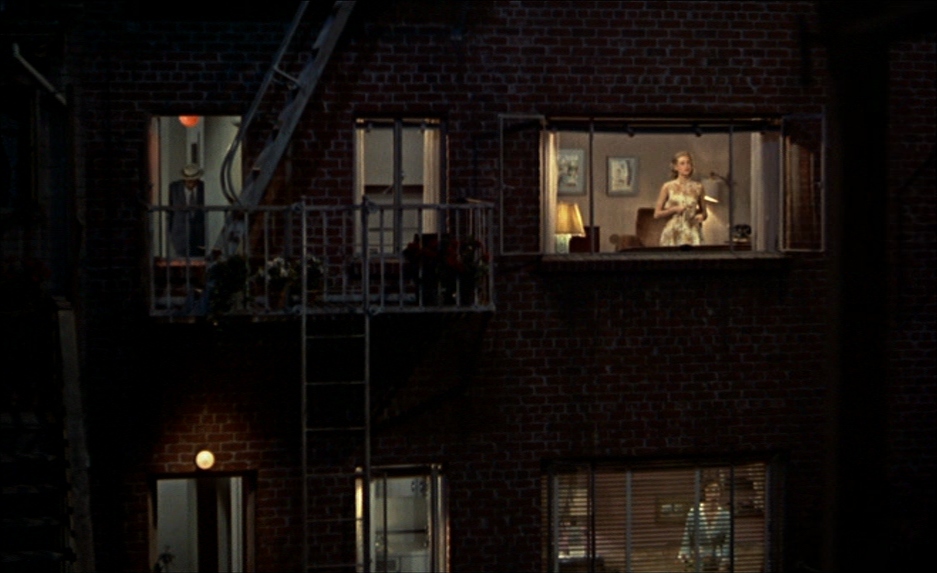
What the device is doing: The style turns looking into the main dramatic action. Suspense grows because you receive partial information and must interpret what a glance, movement, or sound may mean.
How the film creates the effect: Hitchcock uses controlled point-of-view structure, repeated window framing, reaction shots, and delayed confirmation. The cut pattern trains you to compare what Jeff sees, what he thinks he sees, and what the film later proves.
The Grand Budapest Hotel (2014, Fox Searchlight Pictures) and Wes Anderson’s Directorial Style
What we see/hear: Wes Anderson, an American filmmaker often discussed through auteur theory, uses centered framing, symmetrical visual composition, precise blocking, stylized production design, and highly controlled color design.
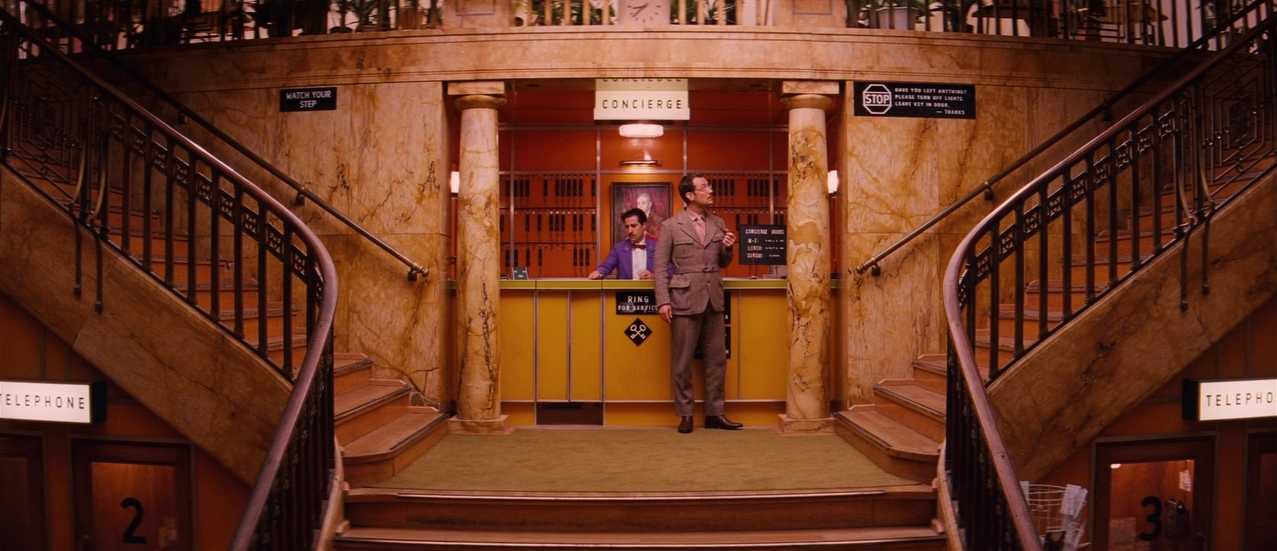
What the device is doing: The style creates a storybook sense of order while also making emotional loss stand out when the order breaks. The precision is part of the meaning because it sets a baseline that later disruption can disturb.
How the film creates the effect: The effect comes from repeated frame geometry, lateral movement patterns, costume and set coordination, and editing that respects the designed compositions. The style is easy to recognize because the pattern repeats across scenes and across multiple films.
Citizen Kane (1941, RKO Radio Pictures) and Deep-Focus Style Analysis
What we see/hear: In the childhood contract scene, young Kane plays outside in the snow while adults discuss his future inside the room. The frame keeps foreground and background actions readable at the same time.

What the device is doing: The style lets you watch a power decision and its human cost in one visual field. You do not need a cut to understand the split between adult control and the child’s distance from the decision.
How the film creates the effect: The effect comes from staging in depth, deep-focus cinematography, and frame composition that keeps multiple planes active. This example is useful for film style analysis because it shows how cinematography and blocking can create meaning before dialogue explains it.
Related Terms
This section clarifies the terms that most often get mixed together when people write about film style. I also link to FilmDaft guides where the overlap matters in practice.
Film Style vs. Film Form
Film form is the larger system of relationships across the whole movie. It covers setup, payoff, repetition, reveal, and overall structure. Film style is the repeated technique pattern in image and sound that presents those parts scene by scene.
If a payoff feels unearned, the problem may be form. If a scene is hard to read, the problem may be style. You can go deeper in FilmDaft’s guide to film form vs film style.
Film Style vs. Genre
Genre gives you conventions and audience expectations. Style is how a specific film executes those conventions. Two noirs can share crime and fatalism, but one may lean toward hard visual contrast while another leans toward procedural realism.
If you are sorting categories first, review genre in film and film movements. Then return to style and ask what the individual film does inside that category.
Film Style and the Four Main Craft Areas
When people say “style,” they often mean only camera work. That is too narrow. Film style usually becomes readable through several craft areas working together.
- Mise-en-scène gives the frame its physical design and blocking logic.
- Cinematography controls framing, movement, focus, and image texture.
- Editing controls sequence logic and viewer attention over time. You can also compare montage, parallel editing, and jump cuts.
- Sound design controls emphasis, space, tension, and rhythm through dialogue, ambience, effects, music, and silence. FilmDaft’s guides on diegetic sound and dialogue help here.
Auteur Theory, Formalism, Realism, Feminist Theory, and Psychoanalytic Theory
Auteur theory can help when a director’s recurring choices keep returning across multiple films. It becomes weaker if it ignores collaborators or treats every choice as one person’s intention.
Formalist vs. realist film theory is useful when you need to explain what kind of style work a film prefers. Formalist analysis often highlights visible design, construction, and rhythm. Realist analysis often highlights duration, spatial continuity, and a less forced presentation of events.
Feminist film theory and psychoanalytic film theory become useful when the scene depends on looking, desire, identification, or control of perspective. A style choice like framing, reaction-shot order, or camera distance can become evidence in those readings if you show exactly how it operates in the scene.
Frequently Asked Questions
What is style in simple terms?
Style is the distinctive way a writer or filmmaker uses language and technique to express ideas.
What are the elements of style in writing?
Word choice (diction), sentence structure (syntax), tone, imagery, and figurative language.
What are the types of writing style?
The four common types are expository, descriptive, persuasive, and narrative.
What is the difference between style and tone?
Style is the overall manner of expression, while tone is the attitude conveyed within it.
What is an example of style?
Hemingway’s short, spare sentences, or Wes Anderson’s symmetrical, meticulously designed frames.
Summing Up
Film style is the repeated craft pattern that gives a film its look, sound, and expressive method. It is not only cinematography, and it is not only a director “signature.” It is the coordinated use of mise-en-scène, camera work, editing, sound, and performance.
If you are writing scripts, thinking about style helps you write pages that are filmable and readable. If you are analyzing movies, style gives you evidence you can point to instead of broad reactions. Start with what you can see and hear, track the pattern, and explain what that pattern does.
Read Next: Curious how visual styles define film genres?
Explore our breakdown of Genre & Visual Style to see how movements like naturalism, noir, and surrealism shape what we watch.
Looking for the big picture? Visit our Film History, Theory & Genre page to connect techniques with the eras and ideas that shaped them.
Sources and Suggested Further Reading
- Bazin, André. What Is Cinema? (Vols. 1–2).
- Bordwell, David, Kristin Thompson, and Jeff Smith. Film Art: An Introduction.
- Arnheim, Rudolf. Film as Art.
- Eisenstein, Sergei. Film Form.
- Eisenstein, Sergei. The Film Sense.
- Monaco, James. How to Read a Film.
- Mulvey, Laura. “Visual Pleasure and Narrative Cinema.” Screen 16, no. 3 (1975).
- Sarris, Andrew. The American Cinema: Directors and Directions, 1929–1968.