

Published: December 16, 2025 | Last Updated: January 19, 2026

What is Book lighting? Definition & Meaning
Book lighting is a lighting setup where you aim a lamp into a bounce surface, then push that bounced light through diffusion, so your subject is lit by a larger, softer source that you can control with flags, grids, and negative fill.
You see book lighting in interviews, close-ups, and beauty-style keys because the source is large, so skin and shadows look smoother at close distance. The trade-off is space and brightness. You need room for frames, and you lose output because the light bounces once and diffuses again. If you want a broader overview of lighting styles and setups, start here: Lighting on FilmDaft.
What “book lighting” means on set
Think of it as a key light built in two steps: bounce first, diffusion second. You build a large glowing surface in the room instead of aiming a lamp at the face.
The two layers that make it “book lighting”
The setup does two things. The bounce spreads a small source across a wide surface. The diffusion becomes the final glowing source, so its size and distance control softness.
- Bounce surface: Foam core, bead board, white show card, bleached muslin, or ultra bounce.
- Diffusion: Silk, grid cloth, magic cloth, or diffusion gel on a frame. If you want a deeper breakdown of modifiers, see what a light diffuser is.
How to set up book lighting step by step
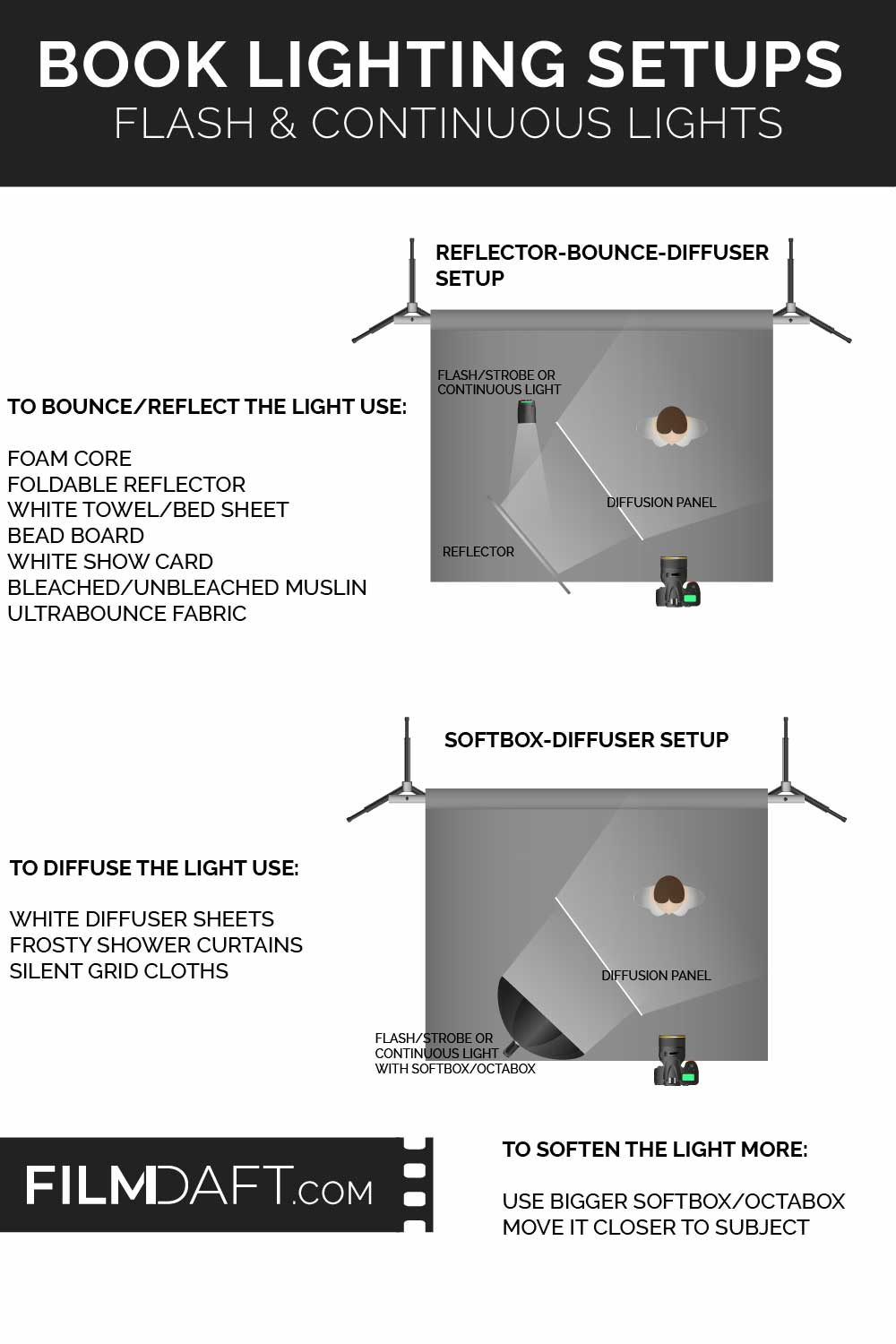
Build the book first, then dial it in. Moving the diffusion 20–40 cm can change softness and shadow depth fast, so make one change at a time. If you are building a full interview setup, you can pair a book-light key with a simple three-point lighting plan.
- Choose the key direction. Start around 30–45° from camera because it gives face definition and still feels natural for interviews.
- Place the bounce on the key side. Angle the bounce toward the subject so it “aims” the light in the right direction.
- Aim the lamp into the bounce. Look for an even glow across the bounce. If you see a hot spot, back the lamp up, widen the beam, or change the angle.
- Add diffusion as the final source. Put the diffusion between bounce and subject. This is the surface that should look big from the subject’s position.
- Set softness and falloff with diffusion distance. Closer diffusion looks softer and falls off faster, so the background goes darker faster as the distance increases.
- Stop spill early. Add a top flag and a camera-side flag. If walls and ceiling brighten, add skirts or a grid.
- Set contrast with negative fill. Place negative fill close to the shadow side of the face. This often fixes a flat look faster than moving the key.
- Lock exposure and color. Set your key level, then check white balance and tint after material changes.
A concrete setup you can copy
This starting setup works in a small room. You can scale it later with larger frames and more control.
- Place a 4×4 bounce 1–2 meters from the subject on the key side, angled toward the face.
- Aim a COB LED into the bounce until the surface looks evenly lit.
- Place a 4×4 diffusion frame 30–60 cm from the subject on the same side.
- Add a black floppy or black fabric as negative fill on the shadow side, close to the subject.
- Flag the top edge so the ceiling does not lift.
How to control softness, contrast, and spill
Book lighting can light the whole room if you let it. Flags, skirts, grids, and negative fill keep the look controlled and repeatable.
Softness is set by diffusion size and distance
The diffusion is your source. Bigger and closer reads softer. Smaller or farther reads more defined with sharper shadow edges.
- Softer: Larger diffusion, closer to the subject.
- More defined: Smaller diffusion, farther from the subject.
Contrast usually comes from what you block
White walls bounce light back into the face. That extra bounce can remove shadow definition, even with a soft key.
- Place negative fill on the shadow side, close to the subject.
- Flag nearby white walls that reflect into the face.
- Add flags and skirts first, then decide if you still need another light.
Spill control keeps the background from lifting
If the background gets too bright, the frame can lose depth. Control spread so the key stays on the subject.
- Flag the bounce: Stop the lamp from filling parts of the bounce that aim toward the background.
- Skirt the diffusion: Add black cloth to the sides of the diffusion frame.
- Add an eggcrate: Narrow the diffusion spread, especially in small rooms.
What really makes it soft
Softness comes from how big the final diffusion looks from the subject’s point of view. In a book light, the diffusion is the source. The bounce step helps the diffusion glow evenly instead of having a bright center. If you want a plain-language refresher on what “diffused light” means, read what diffused light is.
What to change first
When the look is off, change the big levers first. Adjust diffusion size, diffusion distance, and negative fill before you redesign the whole setup.
- Need softer light: Use larger diffusion, then move diffusion closer to the subject.
- Need more contrast: Move diffusion farther back, then place negative fill close to the shadow cheek, just out of frame.
- Need cleaner direction: Aim the bounce so the brightest part of the diffusion points at the face, then add a top flag and camera-side flag to stop wall and ceiling bounce.
Why book lighting can look different from a softbox
A softbox is one unit with diffusion. A book light builds the source in the room, so you can aim the bounce where you want, then let the diffusion do the final softening. If you want a softer, brighter look across the whole face with fewer shadows, compare this setup with high-key lighting.
- Even glow: The bounce helps the whole diffusion frame glow, not just the center.
- More control options: Flag the bounce to stop background spill, skirt the diffusion to narrow spread, and add negative fill to deepen the shadow side.
- Output loss: Bounce plus diffusion costs brightness, so you may need more lamp output, higher ISO, or a wider aperture.
Gear you need for book lighting
You can build a book light with pro frames or basic grip tools. You still need the same core pieces: a lamp, a bounce, diffusion, and control.
Core kit
These are the minimum pieces for a working setup in most locations.
- Light: Flash/Strobe, COB LED, HMI, or tungsten.
- Bounce: Foam core, bead board, muslin, or Ultrabounce.
- Diffusion: A frame with cloth, or a diffusion panel.
- Grip: Stands, clamps, arms, and sandbags.
Why a focused lamp often helps
A lamp with a tighter beam can hit the bounce with less spill, so more of your output ends up in the diffusion. That matters because book lighting can get dim fast.
Control tools that matter
These tools keep the light aimed at the subject instead of lifting the walls, ceiling, and background.
- Flags and cutters: Block spill from hitting walls, ceiling, background, and lens.
- Negative fill: Black fabric or a floppy that absorbs bounce light and deepens shadows.
- Eggcrate or grid: Narrows the spread from the diffusion.
- Skirts: Black cloth on the sides of the diffusion frame that reduces side spill.
Material choices that change output and color
Bounce and diffusion materials do more than soften. They can cut output and shift color. Muslin can warm the light. Heavy diffusion can cost enough exposure that you need a stronger lamp or higher ISO. If you also care about how accurate skin tones look under your lights, check what CRI means for film lighting.
Quick bounce surface cheat sheet
Pick a bounce based on the look you want and the exposure you can afford to lose.
- Bead board: Soft bounce with wide spread, so it fills diffusion easily, but can spill more if you do not flag it.
- Ultrabounce: Even bounce that often keeps more brightness than many cloth bounces.
- Bleached muslin: Dense, smooth bounce that often loses more light than rigid board.
- Unbleached muslin: Warmer bounce that can flatter skin, but it can make matching other lights harder.
What to remember about exposure loss
A book light stacks two loss steps. First, you bounce. Then you diffuse. Plan for higher lamp output, closer placement, or lighter diffusion. If your lamp is already near max, book lighting can force higher ISO, wider aperture, or a stronger fixture. If you want a fast refresher on ISO, aperture, and shutter speed, see the exposure triangle.
How to measure and repeat the setup
If you need repeatable results across multiple shoot days, measure your key level and write it down. You can measure illuminance in lux or foot candles with a light meter, then rebuild the setup to match your notes.
- Foot candles: See what a foot candle is and how to measure it.
- Lux and light output terms: See watts, lumens, and lux for quick on-set context.
When book lighting is a good choice
Reach for book lighting when you want a soft key that still reads as directional light. It works best when you have room for frames, and you can control spill.
Interviews and close-ups
A large diffused source gives you a wider sweet spot. Small head turns stay consistent from take to take.
Beauty-style keys
Skin often looks smoother under a large source. Keep the key angle clear, then add negative fill so cheek and jaw shadows stay present.
Window-motivated interiors
Place the diffusion on the window side of the subject, slightly forward of their eyeline. Angle the bounce so it fills the diffusion evenly and matches the “window” direction.
Read more about motivated lighting.
Common mistakes to avoid
Most problems come from low output, uncontrolled spill, or missing negative fill. Fix those first before you move everything to new positions.
- It is too dim. Start with lighter diffusion if you have a small lamp, or bring the lamp closer to the bounce.
- It is too flat. Add negative fill, then block wall bounce near the subject.
- The whole room glows. Add flags, skirts, and grids so the diffusion does not spray the walls.
- Eye light looks dead. Adjust diffusion angle and height until you see a catchlight from the diffusion in the eyes.
- Skin tone shifts. Re-check white balance and tint after you change muslin or diffusion.
Fast troubleshooting checklist
When you are short on time, follow this order. It fixes the most common causes first.
- Too harsh? Increase diffusion size or move diffusion closer.
- Too flat? Add negative fill, then reduce wall bounce with flags.
- Background too bright? Flag and skirt, then add a grid.
- Too dim? Increase lamp output, move the lamp closer to the bounce, or swap to lighter diffusion.
- Color mismatch? Re-check white balance and tint after material changes.
Safety notes
A book light uses large frames and tall stands. Treat it like a grip build, even on a small shoot. If you work with a lighting crew, it also helps to know what a gaffer does and who handles power and safety on set.
- Sandbag stands. Add more weight if frames go high.
- Watch heat. Hot lamps can heat diffusion. Keep safe distance and monitor materials.
- Secure arms. Lock grip heads, then keep stands out of walkways.
Summing Up
Book lighting is a bounce-then-diffuse setup that turns your diffusion frame into a big, soft source. Softness comes from diffusion size and distance. The bounce step helps the diffusion glow evenly. Plan for output loss, test for color shifts, and use negative fill plus flags to keep face definition and stop background spill.
Read Next: Want to explore how lighting transforms the mood of a scene?
Browse all lighting articles, from hard and soft light to color temperature, contrast, and key light setups.
Or return to the Cinematography section for lenses, framing, and camera movement techniques.
