
Published: May 28, 2024 | Last Updated: December 16, 2025

What is a Foot-candle? Definition & Meaning
A foot-candle (FC) is a unit used to measure how much light hits a surface. It tells you how bright the light is one foot away from the source. One foot-candle equals one lumen per square foot. This measurement helps you figure out how much light you need in a room or on a film set. Foot-candles are mostly used in the U.S. Most other countries use lux (lx) instead. One foot-candle is equal to 10.764 lux.
So, what is illumance exactly?
Illuminance measures the amount of light that hits a surface. It shows how bright that surface appears to the human eye. This matters in areas like photography, film, and workplace safety, anywhere the strength and quality of light affect the result.
Why It Matters
Understanding foot candles is fundamental for several reasons:
- Lighting Design: Ensures optimal lighting for different spaces.
- Film and Photography: Helps achieve the desired visual effects.
- Safety and Compliance: Meets regulatory standards for illumination.
Calculation and Measurement
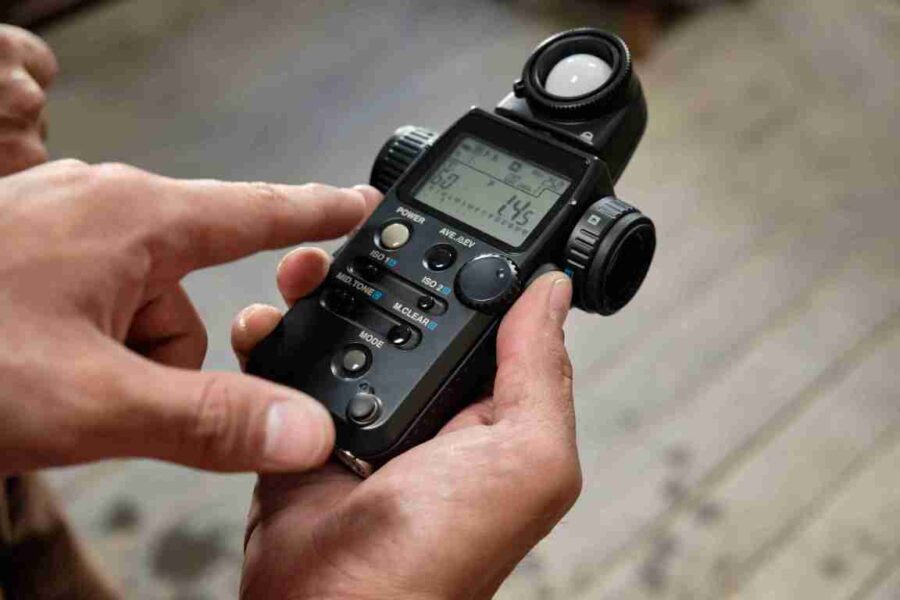
To measure foot candles, you use a light meter. This tool tells you how much light is hitting a certain spot, so you can adjust your lights as needed.
Read more on how to use a light meter.
- Set Up the Light Meter: Place the light meter at the surface where you want to measure illuminance.
- Read the Value: The device will display the amount of light in foot candles.
- Adjust Lighting: Increase or decrease light sources to achieve the desired foot candle level.
Foot Candles vs. Lux
It’s also key to understand the relationship between foot candles and lux, another unit of illuminance.
While foot candles are used predominantly in the United States, lux is the metric equivalent used internationally.
You can use this calculator to convert the most common units cinematographers use.
Factors Affecting Foot-Candle Measurements
Several factors can influence foot-candle measurements:
- Distance from the Light Source: Light gets weaker the farther it travels. This follows the inverse square law, which means if you double the distance, the light intensity drops to one-quarter.
- Reflective Surfaces: Different surfaces affect light in different ways. Some absorb it, some bounce it back, and some scatter it. This changes how bright an area looks.
- Angle of the Light: The angle where light hits a surface matters. Light that hits straight on (at a 90° angle) will be stronger than light coming in at a slant.
Summing Up
Foot-candles are a key way to measure light levels in film and other technical fields. They give you a standard method for controlling light with precision. On a film set, knowing how to measure foot-candles helps you make sure every shot is lit the way you want.
Read Next: Want to explore how lighting transforms the mood of a scene?
Browse all lighting articles, from hard and soft light to color temperature, contrast, and key light setups.
Or return to the Cinematography section for lenses, framing, and camera movement techniques.
