

Published: October 1, 2025 | Last Updated: July 4, 2026

What is A poem? Definition & Meaning
A poem is a written work that uses rhythm, language, and structure to express ideas, emotions, or stories in a condensed form. Poems often rely on sound patterns like rhyme and meter, but they can also be written in free verse without a fixed form. What makes a poem distinct is how it concentrates meaning into a small space, using carefully chosen words and literary devices to leave a strong impression.
Poems are More than Meets the Eye
Poetry has existed across cultures for thousands of years. Most dictionaries define a poem as a composition written in verse, often using meter or rhyme. But that surface-level description misses how poems work.
A poem builds layers of meaning through sound, structure, and symbolism. Long before printed books, poetry was used to share stories, pass down laws, and preserve memory, often in spoken or sung form. This oral origin is part of why rhythm and repetition still shape how poems are written today.
The Difference Between Poetry and a Poem
It’s easy to mix up poetry and poem, but they’re not the same.
Poetry is the art form as a whole. It includes all the styles, techniques, and traditions used to write poems.
A poem is one single piece of poetry, a specific work, like a haiku or a sonnet. You read a poem. You study poetry.
Key Features of a Poem
What sets a poem apart from other types of writing isn’t just length or topic, but how the words are arranged, and how they sound. Whether the poem is tightly structured or completely freeform, each line is crafted to do something specific.
Below, I’ve written a list of some of the most common features that help poems create meaning and mood. Later, in the article, you can see some examples of poems.
- Line and stanza structure: Poems use lines and stanzas instead of full sentences and paragraphs. Line breaks can affect pacing, rhythm, and emphasis.
- Sound and rhythm: Many poems use patterns of sound like meter, rhyme, or alliteration. These help create musical flow, even in poems without a regular structure.
- Figurative language & imagery: Poets often use metaphors, similes, and symbols. These add deeper meaning or emotion to the poem without stating things directly.
- Condensation: Poems are usually short. Every word, pause, or image must carry weight. The goal is to say more with less.
- Multiple readings: Most good poems reward rereading. You might notice something new each time, especially in how images or phrases connect.
Types & Forms of Poems
There isn’t one way to write a poem. Over time, poets have developed hundreds of distinct forms. Some follow strict rules. Others break those rules completely. Below are some of the most common types you’re likely to see, each with its own structure and a famous example included.
Sonnets
A sonnet is a fourteen-line poem, usually with a fixed meter (often iambic pentameter) and a rhyme scheme. Shakespeare’s sonnets focus on themes like love, time, and mortality.
Example – Shakespeare’s Sonnet 18:
Shall I compare thee to a summer’s day?
Thou art more lovely and more temperate:
Rough winds do shake the darling buds of May,
And summer’s lease hath all too short a date;
Sometime too hot the eye of heaven shines,
And often is his gold complexion dimm’d;
And every fair from fair sometime declines,
By chance or nature’s changing course untrimm’d;
But thy eternal summer shall not fade,
Nor lose possession of that fair thou ow’st;
Nor shall death brag thou wander’st in his shade,
When in eternal lines to time thou grow’st:
So long as men can breathe or eyes can see,
So long lives this, and this gives life to thee.
Haiku
A haiku is a three-line poem with a 5‑7‑5 syllable pattern. Traditional haiku comes from Japan and often captures nature or seasonal change in a single moment.
Example – Matsuo Bashō:
An old silent pond…
A frog jumps into the pond,
Splash! Silence again.
Narrative Poems
Narrative poems tell a story, often including plot, setting, and characters. Edgar Allan Poe’s The Raven builds suspense using rhyme and repetition.
Example – Edgar Allan Poe (Opening):
Once upon a midnight dreary, while I pondered, weak and weary,
Over many a quaint and curious volume of forgotten lore…
Free Verse
Free verse poems do not follow strict meter or rhyme. Instead, they use natural rhythms and line breaks to guide your attention.
Example – Walt Whitman, Song of Myself (Excerpt):
I celebrate myself, and sing myself,
And what I assume you shall assume,
For every atom belonging to me as good belongs to you.
Lyric Poems
Lyric poems are short and personal. They focus on emotions or thoughts rather than stories. Many modern and spoken word poems fit into this category. Lyric poems often use repetition, strong rhythm, and direct language to express inner strength or vulnerability.
Example – Maya Angelou, Still I Rise (Closing Lines):
You may shoot me with your words,
You may cut me with your eyes,
You may kill me with your hatefulness,
But still, like air, I’ll rise.[And the final lines:]
Bringing the gifts that my ancestors gave,
I am the dream and the hope of the slave.
I rise
I rise
I rise.
Dramatic Poems
Dramatic poems are written for performance and may include dialogue or be structured as monologues. They often explore conflict or character directly on stage or page.
Example – Robert Browning, My Last Duchess (Opening):
That’s my last Duchess painted on the wall,
Looking as if she were alive.
Epic Poems
Epic poems are long works that tell stories of heroes or historic events. They combine narrative scope with elevated language and often reflect cultural values.
Example – Homer, The Odyssey (Opening):
Sing to me of the man, Muse, the man of twists and turns
driven time and again off course…
Odes
Odes are poems written in praise of a person, object, or idea. They often use elevated language and complex structure to celebrate or reflect deeply on the subject.
Example – John Keats, Ode to a Nightingale (Opening):
My heart aches, and a drowsy numbness pains
My sense, as though of hemlock I had drunk…
Other Forms
There are many more forms, including elegies (for mourning), ballads (set to music), concrete poems (where the shape mirrors the content), sestinas, and villanelles. Each form carries its own constraints and creative opportunities.
Why Poets Use Poetry
Poetry gives you a focused way to shape meaning. Because a poem is short, every word has to do more work than it would in a longer piece. Repetition builds rhythm and makes phrases memorable. A repeated line, like “I rise” in Maya Angelou’s poem, feels stronger each time it returns.
Poets also use line breaks and enjambment to guide how a poem is read. Where a line ends can shift its meaning or create a pause that feels like a breath or interruption. Even without rhyme, poems use sound techniques like alliteration or assonance to create flow.
The patterns of sound make the language feel more musical. And instead of stating ideas directly, poetry relies on strong images. A red leaf drifting across a dark pond can suggest grief, change, or memory without ever naming them. That’s the power of compression, showing more by saying less.
Poems in Film, Media & Culture
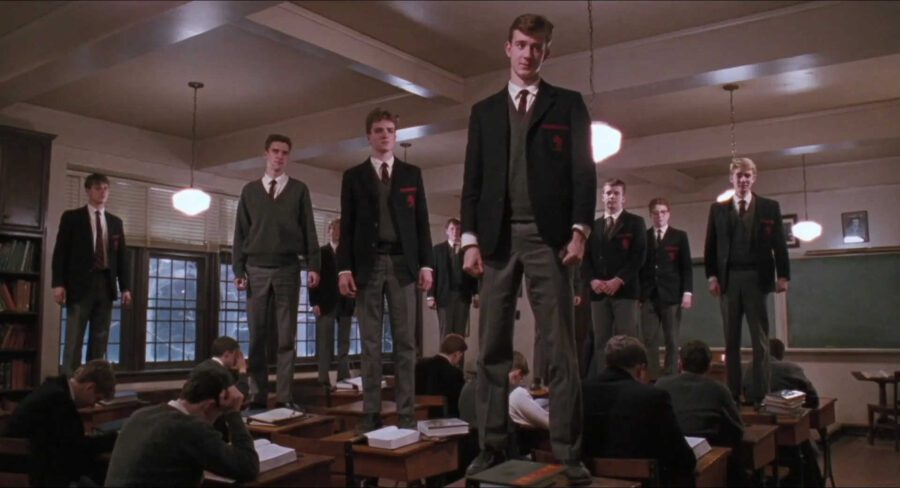
Poetry plays a bigger role in visual storytelling than you might think. In film, it often shows up in voiceover, monologues, or dialogue.
In Dead Poets Society (1989), the teacher’s use of Walt Whitman’s “O Captain! My Captain!” gives the students a way to express respect, grief, and rebellion all at once. Poetry lets a few lines carry emotional weight that dialogue alone can’t reach.
Song lyrics use similar techniques. They rely on repetition, meter, and metaphor to express big feelings in a few tight verses. Even without music, spoken word poetry delivers impact through voice, pacing, and performance.
What’s on the page becomes part of the body. In all these formats, poetry lets creators shape moments that stick, not by explaining them, but by making you feel them.
Summing Up
A poem is a condensed, structured way to express ideas, emotions, or stories through carefully chosen language, sound, and form. Whether it follows strict rules or free verse, poetry focuses on how language feels and sounds. It asks you to slow down, reread, and listen more closely to the meaning hidden in short lines and simple words.
Poem FAQ
What is a poem?
A piece of writing that uses rhythm, imagery, sound, and line breaks to express feeling or ideas in a compressed, heightened form.
What are the main types of poem?
Narrative, lyric, and dramatic poems, plus set forms like the sonnet, haiku, ode, elegy, ballad, and free verse.
What are the elements of a poem?
Lines and stanzas, meter and rhythm, rhyme, imagery, figurative language, and sound devices.
What is the difference between a poem and its form?
A poem is the whole work; its form is the pattern it follows — the sonnet’s 14 lines, the haiku’s 5-7-5, and so on.
Does a poem have to rhyme?
No — free verse poems do not rhyme, relying instead on rhythm, imagery, and line breaks.
Read Next: Want to dig deeper into screenwriting?
Start with the Screenwriter’s Toolkit on literary devices vs. elements – a deep resource covering every major literary device and element used in writing.
Then explore our collection of practical writing techniques covering dialogue, structure, and pacing.
Or jump into the free screenwriting course to start your first draft today.
You can also head back to the Screenwriting section for more tools, theory, and breakdowns.
