

Published: October 2, 2025 | Last Updated: July 4, 2026

What is A haiku? Definition & Meaning
A haiku is a traditional Japanese poem made of three lines with a 5-7-5 syllable pattern. It captures a brief moment, often from nature, using simple, clear language. The original Japanese form is based on sound units called on, which are similar to syllables but not exactly the same.
Editor’s Note:
At FilmDaft, we look at how stories work. Haiku might be short, but it uses the same tools you use in film: sharp images, rhythm, pacing, and what’s not said.
Learning haiku helps you build stronger scenes. It teaches you how to say more with less, how to hold a moment, and how to create emotion without spelling everything out. That’s why we’re covering it, not just as poetry, but as a tool you can use in screenwriting and visual storytelling.
Origin and History
The haiku developed from a longer form of linked-verse poetry called renga. The first stanza of a renga was called a hokku, and it introduced the scene or season. In the 1600s, poets like Matsuo Bashō made the hokku an art form of its own. Later, in the late 1800s, poet Masaoka Shiki gave it the modern name “haiku.”
Haiga: When Haiku Meets Painting
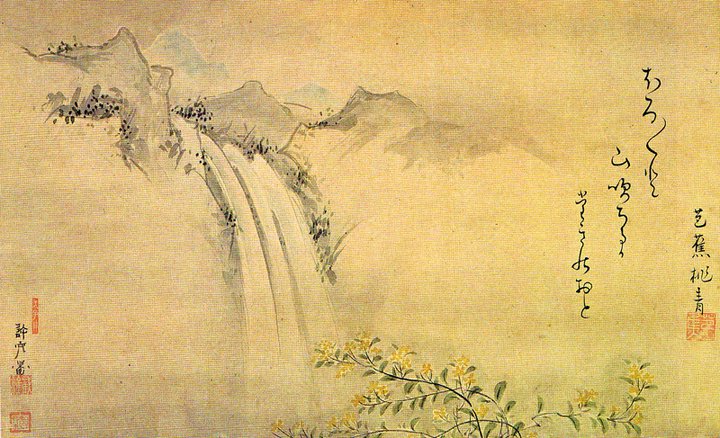
Artwork title: Haiga illustrating Bashō’s haiku “Shizukasa ya / iwa ni shimi-iru / semi no koe”
Poem author: Matsuo Bashō (1644–1694)
Artist (haiga): Yosa Buson (1716–1784)
Date: Edo period, c. mid–18th century
Medium: Ink on paper (haiga: painting + calligraphy)
Collection/source: Wikimedia Commons
License: Public domain
In traditional Japanese culture, haiku was often paired with brush painting to create a form called haiga. A haiga combines a haiku poem with a simple ink or watercolor image. The poem and the picture are placed together on the same surface, usually as part of a scroll or album page.
Unlike Western illustrations, haiga paintings don’t explain the poem. Instead, they show a mood or moment that matches the feeling of the haiku. The brushstrokes are minimal, and the composition leaves open space for the viewer to reflect.
Structure and How to Write a Haiku
A haiku has three lines. The traditional English form uses this pattern:
- First line – 5 syllables
- Second line – 7 syllables
- Third line – 5 syllables
Classical haiku often include two other features:
- Kigo — a seasonal reference that connects the poem to a time of year
- Kireji — a cutting word or pause that separates two contrasting images
In English haiku, writers often skip the formal kireji but still build contrast between two ideas or images. Some modern haiku also avoid strict syllable counts to focus more on the mood or rhythm. Still, the 5-7-5 pattern remains the most recognized version.
To write a haiku, follow these steps:
- Notice something simple and real: a sound, a change in light, or a shift in the season.
- Choose two images or ideas that connect in a subtle or surprising way.
- Write them across three short lines, using 17 syllables or fewer.
- Keep your language clear and concrete. Avoid big or abstract words.
Haiku examples and translation notes
Bashō’s famous “old pond” poem has been translated countless ways. Here are a few approaches, from close-to-literal to more stylized English:
| Version | Haiku |
|---|---|
| Original (Romaji) | furu ike ya kawazu tobikomu mizu no oto |
| Literal sense (one common rendering) | An old pond— a frog jumps in, the sound of water. |
| Stylized English (5–7–5 style) | An old silent pond A frog jumps into the pond— Splash! Silence again. |
| Modern English variation | old pond, frog leaps into the stillness— a single ripple |
Each version captures a similar moment, but the mood and rhythm vary depending on the language and structure. The stylized version fits the 5–7–5 syllable rule, while the literal version is shorter and more direct.
An original English haiku in 5–7–5
While many modern English haiku don’t follow strict syllable counting, some published haiku do. Here’s an example credited in the original article:
Winter twilight,
on the piano’s shadow
her silver bracelet
Angelee Deodhar, published in The Heron’s Nest (2008).
What makes it work isn’t just the syllable count—it’s the concrete image, the quiet season cue (“winter twilight”), and the implied story that’s never explained outright.
Haiku in English and Modern Use
When haiku entered English writing, many poets kept the 5-7-5 pattern. Others trimmed it down to match the rhythm of everyday speech. The key idea remained the same: say something real in as few words as possible.
Some modern haiku keep the contrast between two lines and the final image. Others break the form to focus more on tone or atmosphere. Both styles are accepted. What’s important is keeping the poem short, clear, and focused on one moment.
Related forms: haibun (prose + haiku)
A haibun blends short prose with haiku. The prose sets a scene—often travel, memory, or a lived moment—and the haiku acts like a final lens: it distills or sharply contrasts what came before. Bashō used haibun extensively, and the form remains popular in journals and creative writing today.
Glossary (quick reference)
Here’s a brief summarizing glossary you can use as a quick reference:
- Haiku: A short poem focused on a single moment, often built around an image and a turn.
- Hokku: The opening stanza of a renga; the historical ancestor of the modern haiku.
- Renga: Linked-verse poetry written collaboratively, stanza by stanza.
- Kigo: Seasonal reference that anchors the poem in time and atmosphere.
- Kireji: “Cutting word” that creates a pivot or pause; often recreated in English through punctuation/line breaks.
- Mora (on): A Japanese sound unit; haiku counts are traditionally described in morae rather than English syllables.
- Haiga: A haiku paired with a simple ink/watercolor image, usually on the same surface.
- Haibun: A short prose passage followed by a haiku.
Summing Up
A haiku is a short poem built around a moment: one clear observation, a sharp turn, and language stripped down to essentials. The 5–7–5 pattern is a helpful way to start in English, but what matters most is the haiku’s core effect: presence. The same principle shows up in filmmaking too: one quiet shot can say more than a page of dialogue.
Haiku FAQ
What is a haiku?
A short Japanese poem of three lines in a 5-7-5 syllable pattern, traditionally capturing a single moment in nature.
What is the structure of a haiku?
Three lines of 5, 7, and 5 syllables (17 in total), often with a seasonal reference (kigo) and a cutting word or pause (kireji).
Who are famous haiku poets?
Matsuo Bashō, Yosa Buson, and Kobayashi Issa are the great classical masters.
Does a haiku have to be 5-7-5?
Traditionally yes, but modern and English-language haiku often relax the syllable count while keeping the brevity and single-image focus.
What is the difference between a haiku and a senryū?
Both are 5-7-5, but haiku focus on nature and the seasons, while senryū focus on human nature, often with humour or irony.
Read Next: Want to dig deeper into screenwriting?
Start with the Screenwriter’s Toolkit on literary devices vs. elements – a deep resource covering every major literary device and element used in writing.
Then explore our collection of practical writing techniques covering dialogue, structure, and pacing.
Or jump into the free screenwriting course to start your first draft today.
You can also head back to the Screenwriting section for more tools, theory, and breakdowns.
