
Published: April 18, 2025 | Last Updated: January 15, 2026

TL;DR: Freeze Frames in Film
- A freeze frame holds a single frame to stop motion entirely.
- It’s best used for emphasis, reflection, irony, or thematic punctuation.
- Freeze frames are different from slow motion (time stretched) and still-image montages (multiple photos).
- Overuse can feel gimmicky—clarity of intention matters more than duration.
- Audio choices (silence, music hit, narration) often matter more than the image itself.
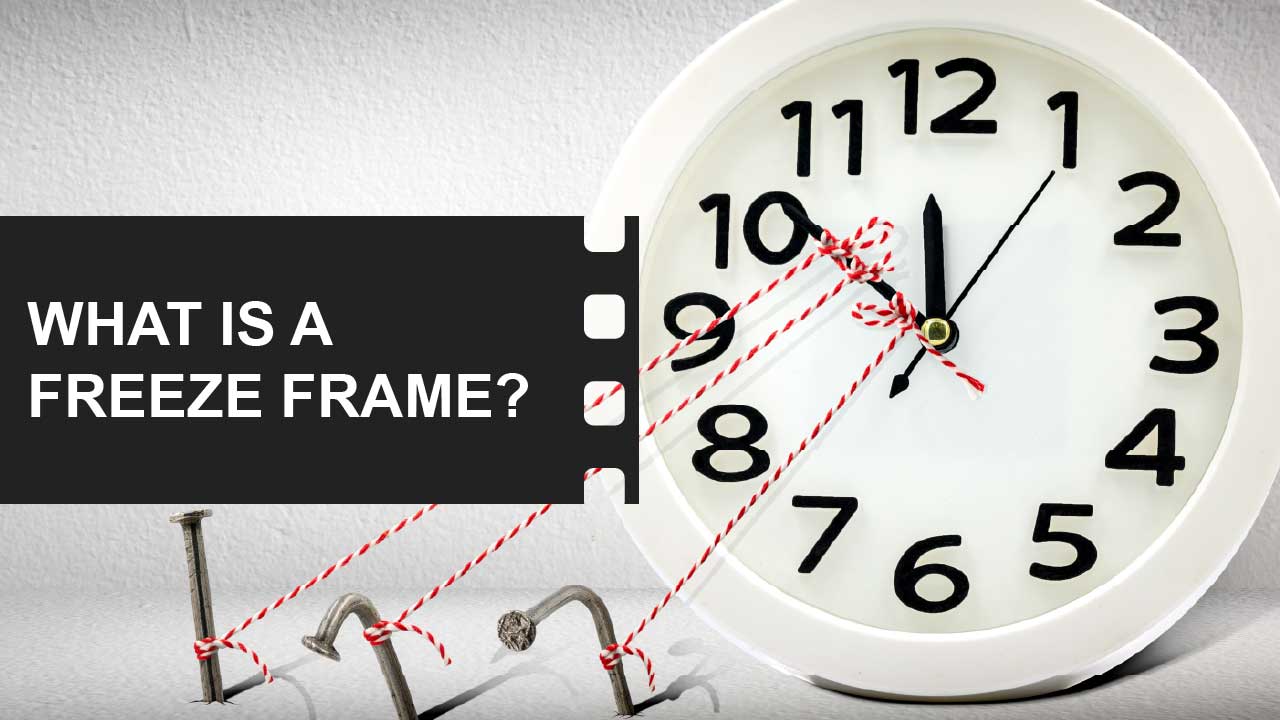
Freeze frames feel like hitting the brakes mid-scene. The character or action locks into place, and for a few seconds, nothing moves. It’s a bold way to shout “this moment matters” without saying a word. Whether it’s to give you space to think or to slam a joke into place, freeze frames grab your attention and… hold it.
How Freeze Frames Actually Work
A freeze frame works by holding a single film or video frame on screen, stopping motion while time (for the audience) continues. But how that freeze is created (and how it’s presented) can significantly affect its meaning.
Frame Hold vs. In-Camera Freeze
- Frame hold (most common): Editors duplicate or “hold” a single frame in post-production. This offers precise control over duration, timing, and sound design.
- In-camera freeze (rare): Motion is stopped during recording itself (historically achieved with step-printing or optical techniques). This often produces a more textured or stylized look.
Cadence and Timing
Freeze frames are most effective when they interrupt motion at a moment of peak meaning:
- A character mid-action
- A revealing facial expression
- A decisive or ironic instant
Holding too early feels confusing; holding too late feels redundant.
Duration: How Long Should a Freeze Frame Last?
There’s no fixed rule, but editorial intent matters:
- 0.5–1.5 seconds: Emphasis or punctuation
- 2–4 seconds: Reflection or thematic weight
- Longer holds: Deliberate discomfort, irony, or audience confrontation
If viewers start wondering why it’s still frozen, the hold may be too long (unless that discomfort is intentional, of course).
Text, Narration, and Overlay
Freeze frames are often paired with:
- On-screen text (titles, epilogues, ironic captions)
- Voice-over narration that reframes the image
- Graphic overlays that add context or commentary
Editorially, the freeze creates space for information that the moving image alone cannot express.
Music Hits and Sound Design
Audio choices often define the emotional impact:
Ambient sound continuation: Preserves realism while halting motion
Silence: Creates distance, reflection, or shock
Music hit: Locks the moment into memory
When Should You Use a Freeze Frame? (Decision Framework)
A freeze frame should be a conscious storytelling choice—not a stylistic reflex. It works best when it serves a clear narrative or emotional function.
Strong Use Cases
Use a freeze frame when you want to:
- Underline a defining moment in a character’s arc
- Invite reflection at the end of a scene or film
- Create irony or contrast between image and meaning
- Break audience immersion deliberately
- Highlight transformation or realization
- Introduce or conclude a story chapter
- Reframe an action with narration or text
When Not to Use a Freeze Frame
Avoid freeze frames when:
- The scene already communicates its point clearly
- Slow motion would better express emotion or physicality
- It’s used repeatedly without narrative justification
- The pause kills momentum in an action-driven sequence
Common Mistakes
- Freezing too late, after the emotional peak
- Holding the frame without supporting audio intent
- Using freeze frames as decoration rather than punctuation
- Repeating the technique until it loses impact
Quick Self-Check Before Using One
Ask yourself:
- What new meaning does the freeze add?
- Would the scene still work without it?
- What should the audience feel during the hold?
Freeze Frame vs Similar Techniques
| Technique | What Happens | Best Used For | Key Difference |
|---|---|---|---|
| Freeze Frame | Motion stops on a single frame | Emphasis, reflection, irony | Time stops completely |
| Slow Motion | Motion continues at reduced speed | Emotion, physical detail | Time stretches, not stops |
| Pause / Step-Printing | Motion advances in visible steps | Stylization, disorientation | Still implies movement |
| Still-Image Montage | Multiple still images shown in sequence | Memory, passage of time | Uses multiple images, not one |
Iconic Freeze Frame Examples and Use Cases
Below, I’ve selected some of my favorite use cases of movie frame holds. Of course, there are many more, but I think these give us a good idea of the many ways you can use freeze frames to tell a story.
The 400 Blows (1959, Cocinor)
The final frame locks on Antoine’s face as he stares at the camera, caught between childhood and adulthood.

This ending freeze frame is all about emotional punctuation. It holds the uncertainty of the character’s future and leaves you hanging in that ambiguity.
Goodfellas (1990, Warner Bros.)
The freeze lands on young Henry Hill just as he says, “As far back as I can remember, I always wanted to be a gangster.”
It works as both a character introduction and ironic foreshadowing. The narration kicks in as time stops, giving space to reflect before things spiral.
The Breakfast Club (1985, Universal)
Bender throws his fist in the air, and the film freezes. It’s an iconic use of a closing frame: defiant, triumphant, and character-driven. It bookends his emotional arc without needing a single word. Rocky II ends in the same fashion.
Thelma & Louise (1991, MGM)
Just before their car crashes, the film freezes mid-leap and quickly fades to white. It avoids showing the violent end and immortalizes their final moment of freedom. It’s bittersweet and bold, showing character resolve without visual finality.
Snatch (2000, Columbia Pictures)
Each main character is introduced with a fast cut and a freeze, usually timed to a motion graphics name card. This style turns intros into punchlines, using the freeze for both rhythm and comic punch.
Funny Games (2007, Warner Independent)
In Funny Games, there’s a moment where the film freezes just as Ann shoots Peter; it’s like the movie itself is saying, “Hold up.” Then Paul grabs a remote and literally rewinds the scene, erasing Peter’s death. This isn’t just a plot twist; it’s a direct challenge to the audience.
By breaking the fourth wall, the film confronts our expectations for justice and catharsis in violent narratives. It forces us to question our role as viewers and our consumption of violence as entertainment. In this story, the usual rules don’t apply, and the audience’s desire for a satisfying resolution is deliberately subverted.
Freeze Frame vs. Slow Motion
Freeze frame is a total stop. It halts time. Slow motion stretches time, showing the action in extreme detail but never fully pausing it.
Use freeze frames to highlight decisions or endings. Use slow motion to show tension, beauty, or chaos inside the action.
Summing Up
Freeze frames are visual punctuation. They stress key moments, shift tone, break the fourth wall, or let narration catch up. They give you space to feel something or question what you’re watching. Whether it’s a triumphant fist pump or a tragic mid-air flight, freezing the frame can turn a second into cinema history.
Read Next: Want to sharpen your editing instincts?
Start with our breakdown of the different types of video editing and learn how each approach shapes tone and flow.
Then explore how film cuts function as visual punctuation, or how scene transitions control time, emotion, and rhythm.
Still curious? Browse the full Editing section for techniques, examples, and theory.
Further Reading & References
- Bordwell, David & Thompson, Kristin — Film Art: An Introduction (1979) (on time manipulation in cinema)
- Monaco, James — How to Read a Film (1997)
