Published: March 30, 2020 | Last Updated: May 26, 2025

Photos and illustrations by Otis Ryder
One of the trickiest things you may find when shooting real estate videos or taking photos of a home is a pesky mirror in a small bathroom or randomly down a hallway. In this article, I’ll go over a few different techniques you can use to ensure that your shots are clean, professional, and, most importantly, lacking your physical self.
There are two solutions for photography: angle change and post-production work. For videography at the standard price that realtors are willing to pay for media, you only have one option: a change of angle. So, we will start there.
Tip: If you’re planning on starting a real estate videography business, I recommend you read my article How To Shoot Real-Estate Videos. A Beginners’ Guide.
1. Change the angle
A simple change of perspective on the subject or room you are shooting is all you need to remove yourself from a photo.
Don’t be afraid; you need a little perspective. Take the camera off the tripod and get your eye into the viewfinder. Move the camera around to find an angle that represents the space and doesn’t have you in the shot.
If the camera cannot be hidden, always shoot with it on the edge of the frame as much as possible. This will make your post-production work much easier, which I’ll return to later in the article.
Try to angle the shot so that whatever is shown as the camera’s background is as constant as possible with a single color or shade.
For video, you want to do the same. You may find that shooting with the door frame in the shot is an excellent way of hiding the camera and gives the space a much more realistic perspective by introducing a scale of the door frame in your shot.
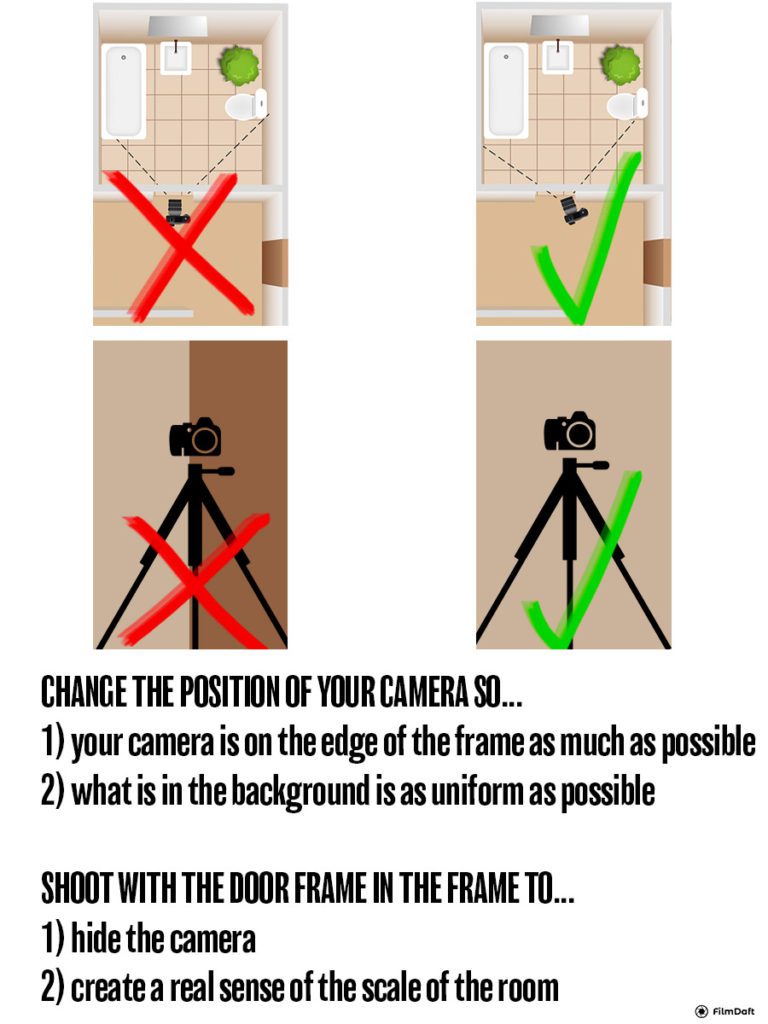
This is your only real option with video, as it is not time-efficient or cost-effective to remove a camera appearing in the reflection of the mirror with a shot that has movement. You can also give yourself some time by making the shot slow motion.
Outside of that, be a professional and advise against shooting an ultra-tight area, as if it cannot be done right, it shouldn’t be done at all.
2. How to Remove Yourself (or your camera) from mirrors in Adobe Photoshop
If you cannot change the angle of a must-have home feature, such as a mirror, and you have to shoot the camera’s reflection, you will have to execute corrections in Adobe Photoshop or another image editing software.
The following are the primary forms of editing that can remove the vast majority of the reflections you might encounter on your shoots. However, each house is different, and the chances that the background behind your camera will not be solid or have non-patterned backgrounds may be a serious issue.
Step One: Use the Pen Tool
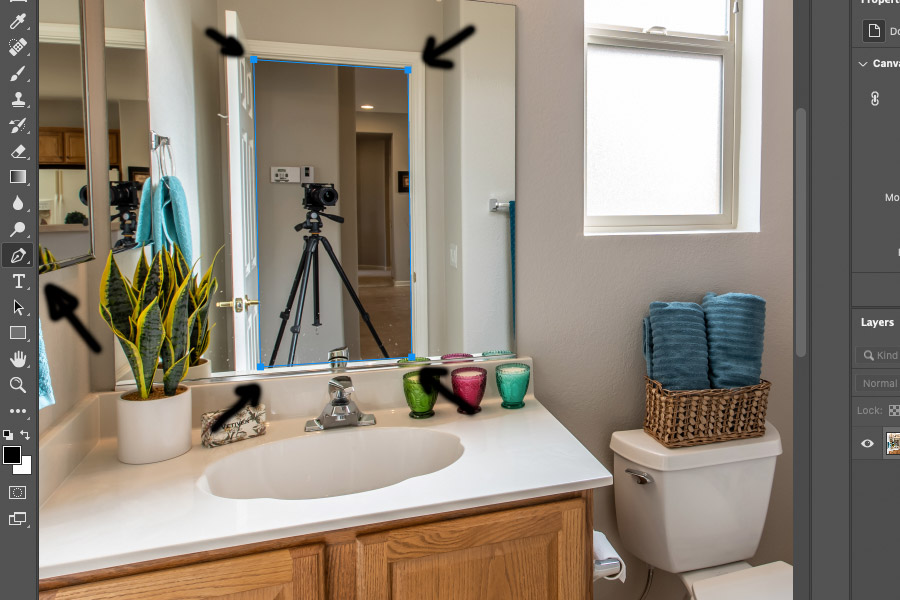
Zoom in and click around the edge of the mirror or around the camera if shadows exist. Be as precise as possible when selecting the area. (Click and drag points if the mirror is curved.)
Once you have connected to the final dot a path with be created. (Check your path tab on the right.) Hold down Command on a path and click the thumbnail. A selection will be made.
After the initial selection, you have several options:
Option One: Smudge Tool
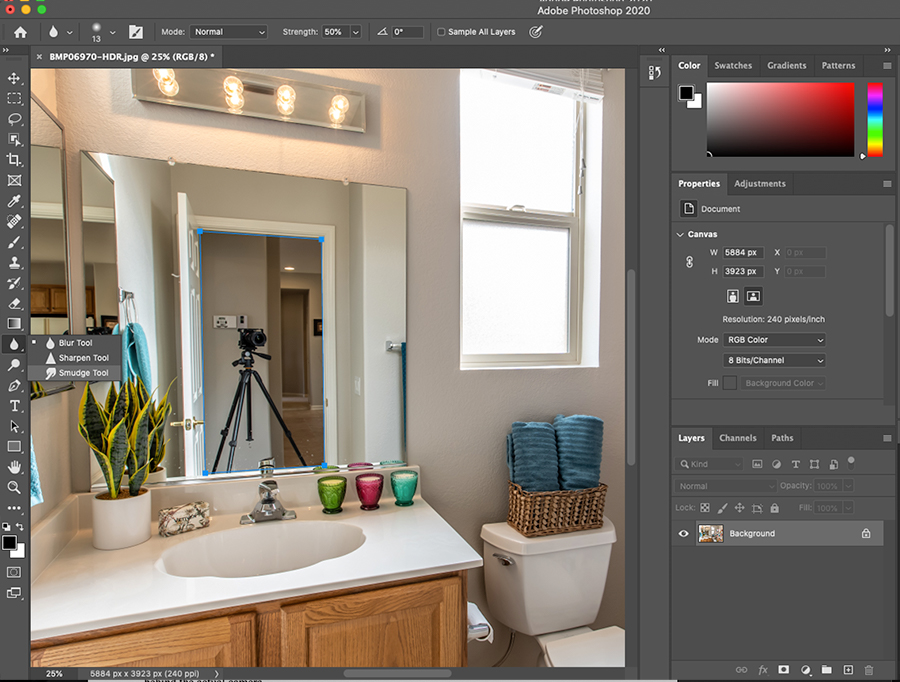
Use the smudge tool and work the camera out of the shot completely. As you can see from the image below, it will take several passes with the Photoshop smudge tool before the camera can be completely removed from the frame.
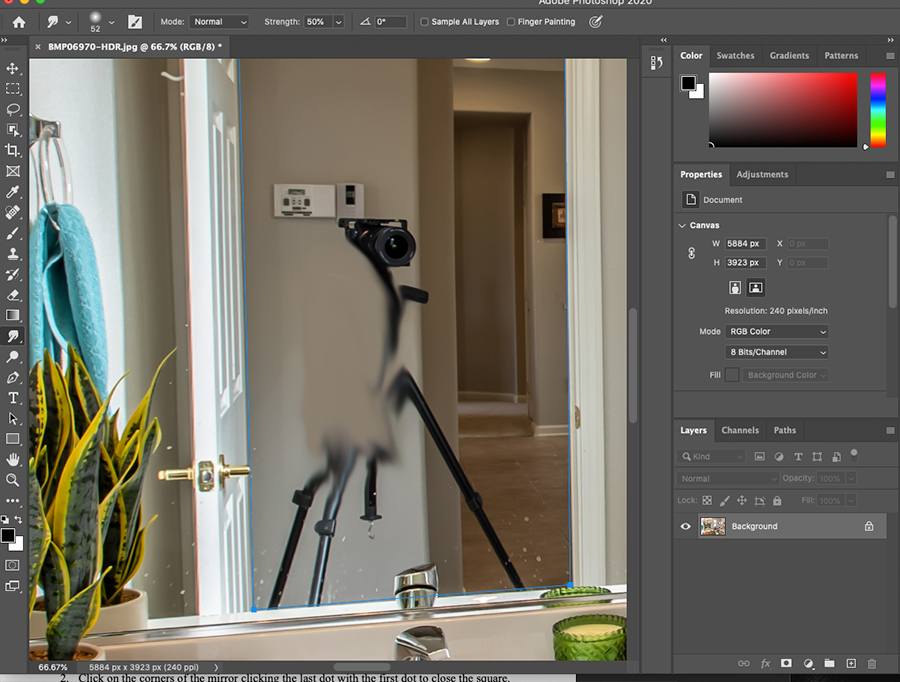
This is why you want to shoot a reflection with the camera towards the edge of the frame. This allows you to take the smudge tool and push the camera while warping the background completely out of frame. This is most effectively done when a mask is made with the mirror’s pen tool and duplicated over the top of the image.
Option Two: Create a Fake Mirror Reflection with the Gradient Tool
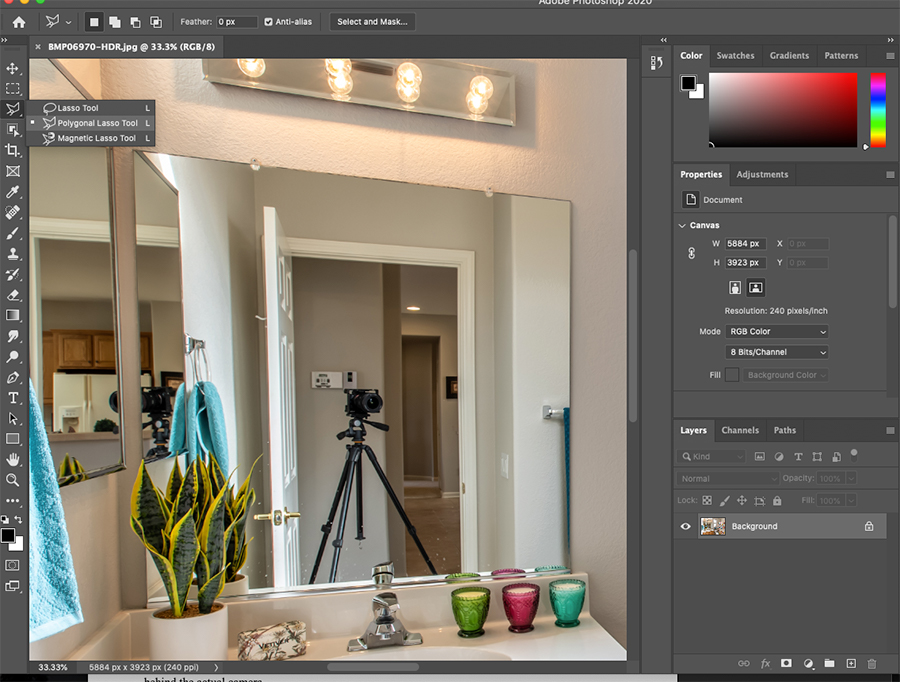
Sometimes, you don’t want to show what the mirror’s reflection looks like because of some architectural issue or because it is not pleasing to the eye.
In that case, you can create a fake mirror to replace a real-world mirror that has reflections by using the gradient tool:
- Create a new layer, then select the mirror with the polygonal lasso tool on that layer.
- Click on the corners of the mirror, and click the last dot with the first dot to close the square.
- Click the gradient tool and select a black-to-white gradient with a linear application.
- Click from one corner to the other in this layer and release it.
This will give you a replicated mirror look:
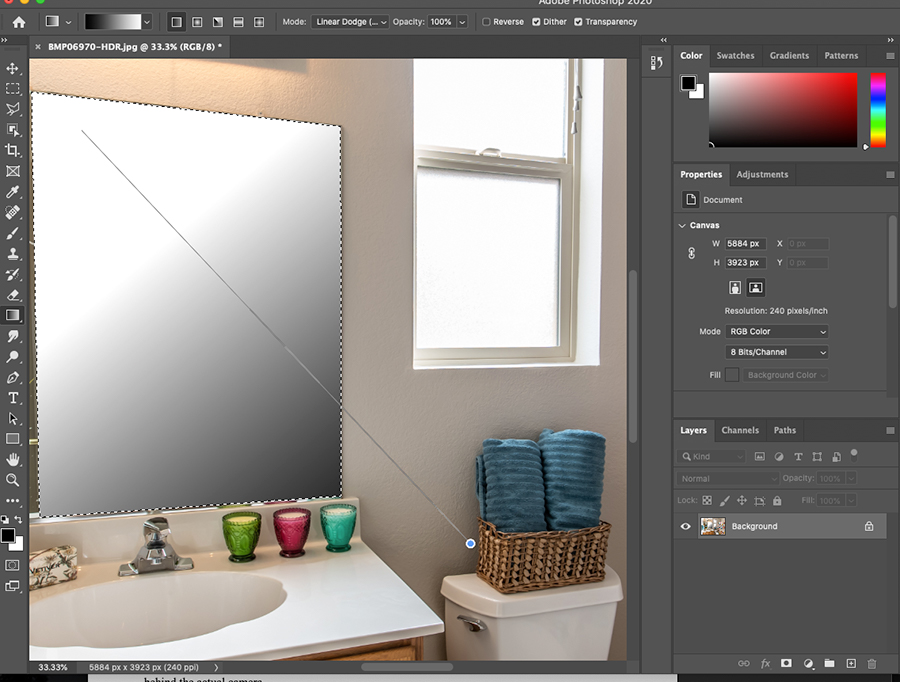
You will have to fine-tune it to make it look correct, but this is an acceptable way of replacing a mirror.
Alternatively, you can use Photoshop’s built-in AI function generative fill to create a mirror. Sometimes you get lucky, and sometimes you don’t. So often, it’s quicker to use a gradient.
Option Three: Spot Healing
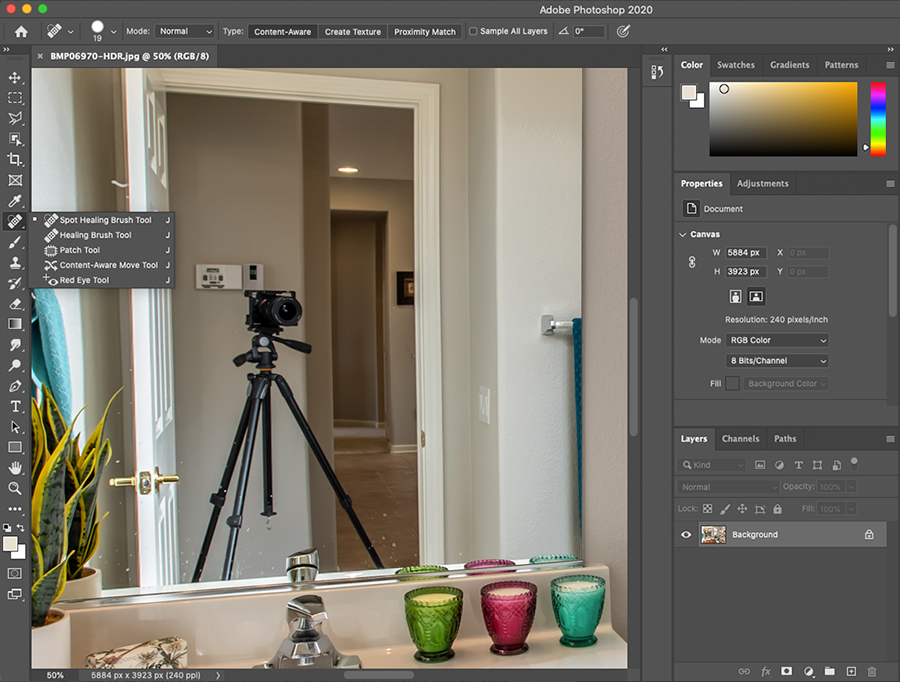
Another option is to use the Spot Healing tool in Adobe Photoshop. This is a 50-50 outcome, however.
Start by using the spot healing tool and moving it over the camera in the shot. Photoshop will then try to predict what you were trying to remove or fill in.
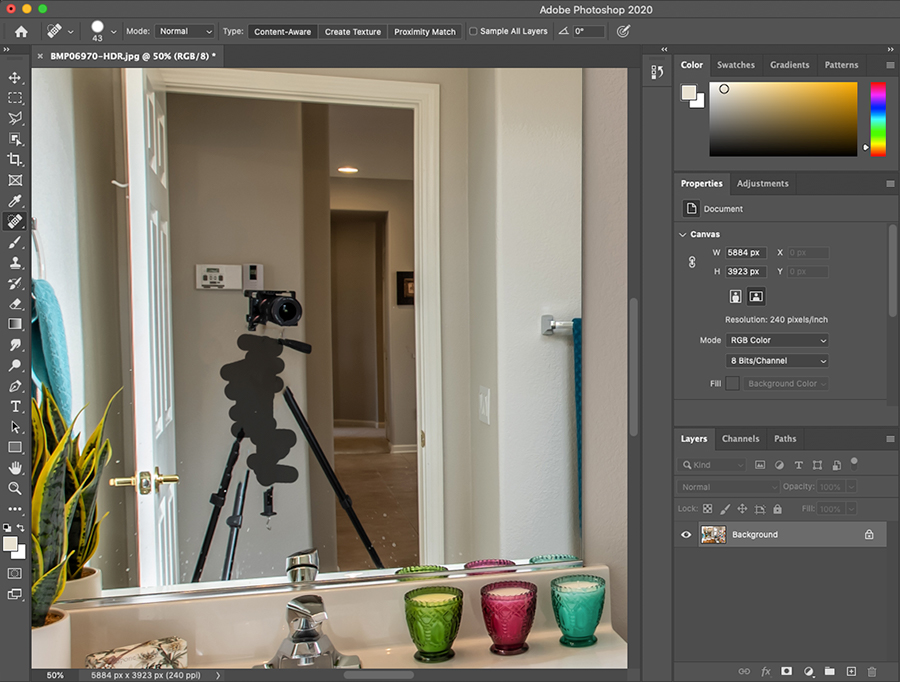
If it doesn’t work, try finding an area of the image that most resembles what you think is behind the camera. Then, take the spot healing tool and alt-click the area that most represents what should be behind the actual camera.
Then click over the camera, and it will fill from that area.
Option Four: Clone Stamping
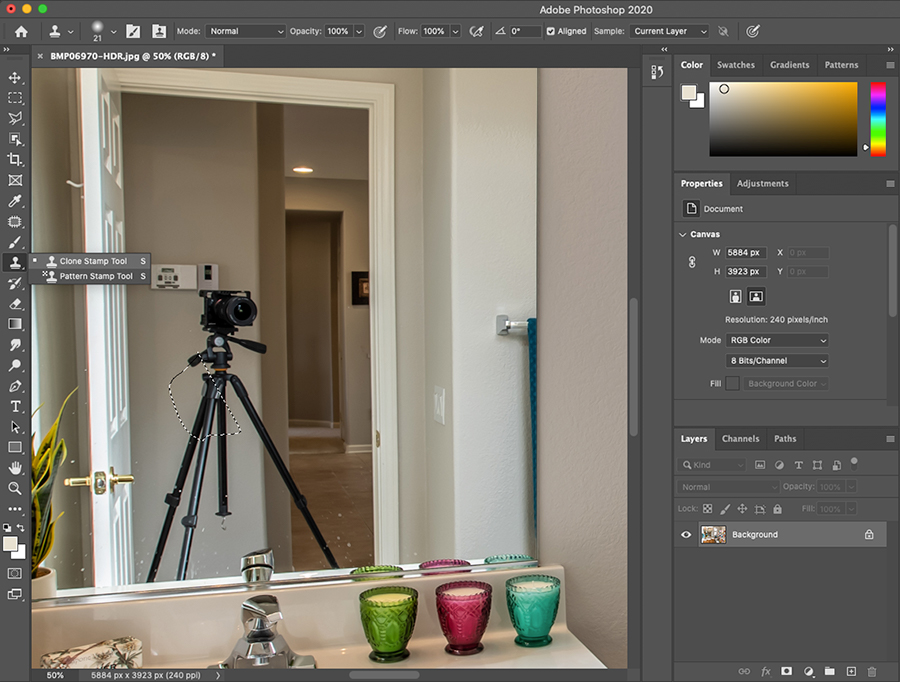
If the area behind the camera has a consistent pattern and a flat exposure, you can duplicate that pattern with Photoshop’s Cone Stamping feature.
Click the clone stamping icon and hover over an area similar to what you are trying to copy/replicate.
Adjust the tool size for the size you want and click on that area.
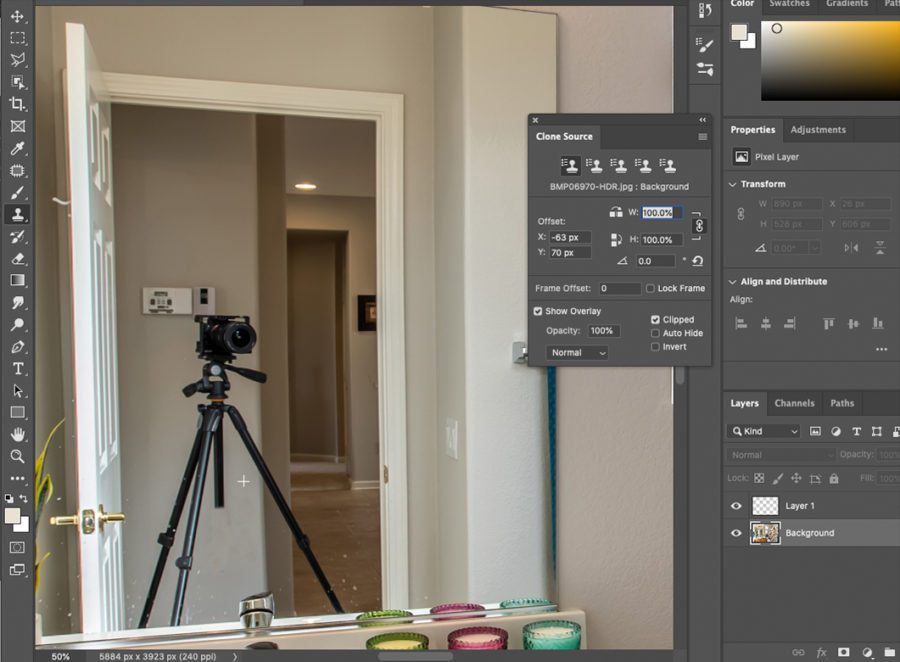
Then hover over the camera and click there as well. The cloning will begin.
Summing Up
When shooting real estate videos or photos, it’s good to know a few different techniques for removing yourself from photographs and videos of mirrors because you’ll quickly learn that every single one of your properties will be different and mirrors can be found in all sorts of places.
As I said, each home will be different, so you’ll have to use different techniques from job to job. Sometimes, the answer is not straightforward but needs to be explored, tested, and changed. Don’t be surprised if you must use multiple techniques to cover up your gear in one shot.
We should aim to finesse each shot and remember every day is a new learning experience. And remember, sometimes you’ll find the place with the mirror too tight to make for a useful photo. When that is the case, be professional and advise against it.
Read Next: How to Export High-Quality Video With Small File Sizes In Premiere