Published: May 9, 2021 | Last Updated: October 15, 2025

This article explains how to import and edit a MOGRT file that was pre-made by someone else.
Here’s an illustrated guide to making MOGRT files yourself in Premiere Pro.
Step 1: Locate MOGRT Files in Premiere
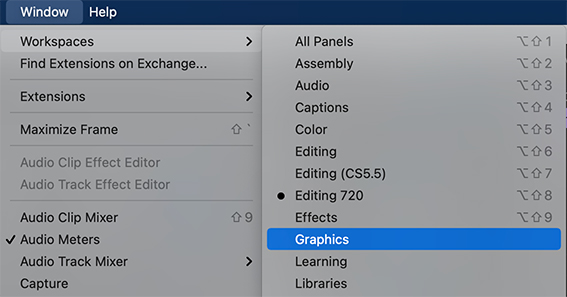
MOGRT files can be found in the Essential Graphics Panel in Premiere Pro. Let’s jump into this panel by hitting WINDOW > WORKSPACES > GRAPHICS. The Essential Graphics panel will be displayed on the right side of your screen.
Highlighted automatically is the “My Templates” button, which will display any MOGRT files you have installed.
Premiere also has a few MOGRT files installed with the software to use if you don’t have any others.

The simplest way to use one of these files is to drag and drop the icon directly onto the sequence. The MOGRT file will take a second to load onto the sequence, and then it will appear like any other piece of media.
Step 2: Import the MOGRT File
There are two ways to import a MOGRT file: via the Essential Graphics Panel or the local templates folder.
Method 1: Import MOGRT directly via the Essential Graphics Panel in Premiere Pro
The simplest way is to import directly from Premiere. There is an import button on the right corner of the Essential Graphics panel.

Once clicked, a window will appear where you can locate the .morgt file. Import the file just as you would any other file inside of Premiere. The MOGRT file will then appear with a preview icon inside the Essential Graphics panel. Note that you can only import these files one at a time using this method.
Method 2: Copy the MOGRT files into your local templates folder directly
The second method is to copy the MOGRT files into your local templates directly. Below are paths you can use to locate these folders.
Mac > username/Library/Application Support/Adobe/Common/motion Graphics Template/
Windows > root://Users/Username/AppData/Roaming/Adobe/Common/Motion Graphics Templates
This method will also allow you to import multiple MOGRT files at once. All of your MOGRT files will be stored in this folder.
Next, let’s learn about how to preview, add, and edit a MOGRT file.
How to Preview a MOGRT File
To preview a MOGRT file before placing it on the sequence, hover your mouse over the icon window and scrub through it like a video file.

How to Add a MOGRT File to the Timeline
Once you’ve decided on a MOGRT file to use, drag and drop it onto your sequence. Once the file has been placed, a red bar will appear above the timeline.

The file should play without rendering, but for best results, I recommend rendering the file. Use the following steps to render quickly:
- Hover the sequence playhead over the clip.
- Use the keyboard shortcut X to select the file.
- Use the keyboard shortcut (Mac: Return) or (Windows: Enter) to render
Check out our guide to Premiere Pro shortcuts [PC/Mac].
You will need to do this any time you change the elements of the MOGRT file for smooth playback, as Premiere will need to render new changes.
Now, let’s edit the elements of the MOGRT file.
How to Edit the MOGRT File
First, click the MOGRT file on the sequence inside the Essential Graphics panel. This will bring up the Edit tab of the Essential Graphics panel.

Depending on the file, you will have control over elements such as the font, font size, background colors, duration of the clip, etc. However, this will depend highly on which elements the creator added to the MOGRT file.
Let’s look at an example.

Above is a photo of a simple MOGRT file imported into Premiere. This file allows us to edit the Title Text, Font and Font Size, the length of the colored background, colors of the font and background, and positioning and scale.
I want this file to read “MOGRT Example” in Helvetica with a blue background.
First, I would change the Title Text to read “MOGRT Example.”
Second, I will change the font to Helvetica in the Text Properties window. I can also change the Font Style underneath the Font dropdown window, but I will leave it at its default settings for this example.
Third, I will change the text box length so there isn’t too much negative space inside the colored background.
Fourth, I can change the text color and color of the background. I first changed the background to blue to see how it looks with the white. I prefer the white-colored text against this background, so I will leave this alone.
Fifth, I can change the position and scaling of the entire graphic. I enlarged the graphic from 67 to 77 to show the change. I also moved the graphic near the top of the window on the Master Position to show as an example.

That’s it. As mentioned earlier, what you can adjust will depend on what the creator of the MOGRT file allowed during its creation. It’s recommended to make sure you know what settings are adjustable before downloading a file.
Summing Up
MOGRT files are a fast and easy solution for adding motion graphics to any video project. You can find free MOGRT files on many websites.
I would recommend trying a couple of free ones and learning about what you can and cannot do with these files. You’ll have a much easier time finding the ones you like once you understand how they work.
Read Next: How to create your own MOGRT files in Adobe After Effects.