

Published: September 4, 2025 | Last Updated: September 19, 2025

What is What is Rembrandt Lighting Photography? Definition & Meaning
Rembrandt lighting is a portrait lighting setup where one side of the face is lit, and the other side shows a small triangle of light under the eye. That triangle forms when the nose shadow connects with the cheek shadow, leaving a lit area under the eye. This style is named after Rembrandt van Rijn, a Dutch painter who used this pattern in his portraits. It adds shape, depth, and mood to a face using only one light.
How Rembrandt Lighting Works in Portrait Photography

Rembrandt lighting works by shaping the face using shadow and a carefully placed highlight. You use the light’s direction to control the look. The triangle effect happens naturally when the light hits the face from the right position.
The style comes from the art technique known as chiaroscuro, which means “light-dark” in Italian. Late Renaissance and early Baroque Painters like Rembrandt used it to make faces look three-dimensional by blending strong light with deep shadow. In photography, Rembrandt lighting does the same thing, using contrast to shape the face and create depth:

The triangle should sit below the eye on the cheek and be small, never wider than the eye or longer than the nose. That shadow pattern creates natural contrast without fully hiding one side of the face. It’s strong, but not harsh.
Rembrandt Lighting Setup: Step-by-Step Guide
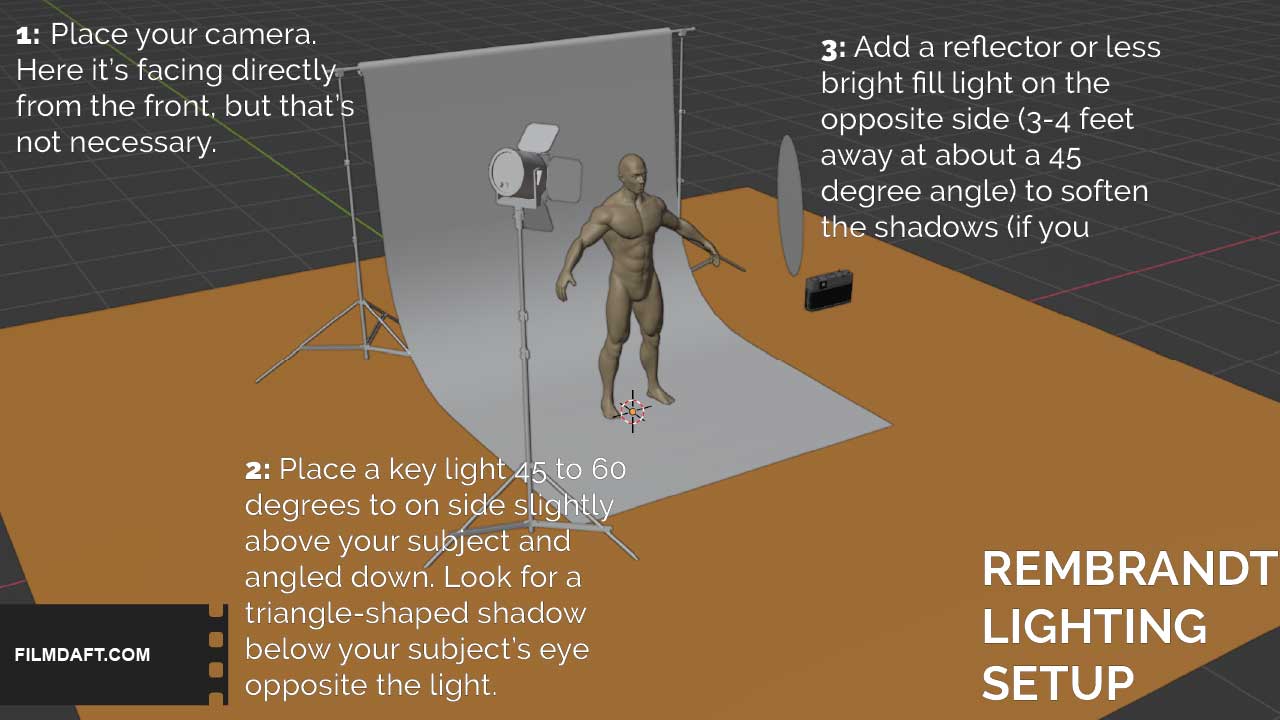
You only need a single light source to get this look, but using a reflector or fill light is great if you want to soften the shadows.
Step-by-Step: Setting Up Rembrandt Lighting
- Start with a single hard light source at head height. Turn off other lights so the shadows are clear.
- Place the light to the side of the subject so their face is in split lighting (one half lit, one half in shadow).
- Slowly move the light towards the camera until the nose shadow connects with the cheek shadow. It’s usually about a 45 to 60-degree angle. This forms the Rembrandt triangle under the eye.
- Adjust the height of the light: too high makes the triangle long and deep, too low makes it disappear. Aim for a small, balanced triangle.
- Take a test shot. If the shadow is too harsh, add a reflector or a second light to fill the dark side slightly.
- Keep the subject still. Even small head movements can turn Rembrandt into loop lighting or break the triangle.
- For softer results, use a softbox or other type of diffuser. The triangle will be less defined, but the principle is the same.
Read about the use of Rembrandt lighting in film.
Why Use Rembrandt Lighting in Photography?
This lighting style gives portraits a dramatic, sculpted look with almost no gear. It’s great for headshots, low-key setups, and film-style portraits.
If your subject has a round or full face, the shadows help define structure. It also works well in small spaces or with limited lighting because you only need one light and a bit of control. When you want a clean, moody contrast that still shows the eyes, this is a go-to setup.
Rembrandt Lighting vs Loop, Split, and Butterfly Lighting
Rembrandt lighting isn’t the only classic portrait style, but it offers more depth than most.
- Loop lighting creates a soft nose shadow that doesn’t touch the cheek, so you don’t get the triangle.
- Split lighting divides the face in half, lighting one side and leaving the other fully in shadow. It’s more intense and less forgiving.
- Butterfly lighting, also called Paramount lighting, shines from the front and above, casting a soft butterfly-shaped shadow under the nose. That one flattens the face more and works best for symmetrical features.
Compared to those styles, Rembrandt lighting offers the best balance between mood and detail.
Summing Up
Rembrandt lighting is a one-light portrait setup that creates a small triangle of light on the shadowed cheek. It’s easy to set up, looks cinematic, and gives your portraits depth. If you want a strong mood with simple tools, this setup delivers every time.
Read Next: Want to level up your photography skills?
Explore our Photography section for guides on lighting, composition, camera settings, and creative techniques across genres like portrait, landscape, and street.
Whether you’re shooting on a mirrorless camera or your phone, you’ll find sharp, practical tips to take more intentional and creative photos.
Also check out our Visual Composition section, with deep dives into framing, color psychology, and visual art history—key tools for any photographer thinking like an image-maker.
