

Published: September 5, 2025 | Last Updated: September 19, 2025

What is Split lighting? Definition & Meaning
Split lighting (aka hatchet lighting) is a portrait lighting setup where half of the subject’s face is lit and the other half is in shadow. It is also called side lighting, hatchet lighting, or Hollywood lighting. The name comes from the sharp division of light and dark across the face. Split lighting is commonly used for dramatic and moody portraits where you want a strong sense of depth and contrast.
Step‑by‑Step Setup for Split Lighting Portraits
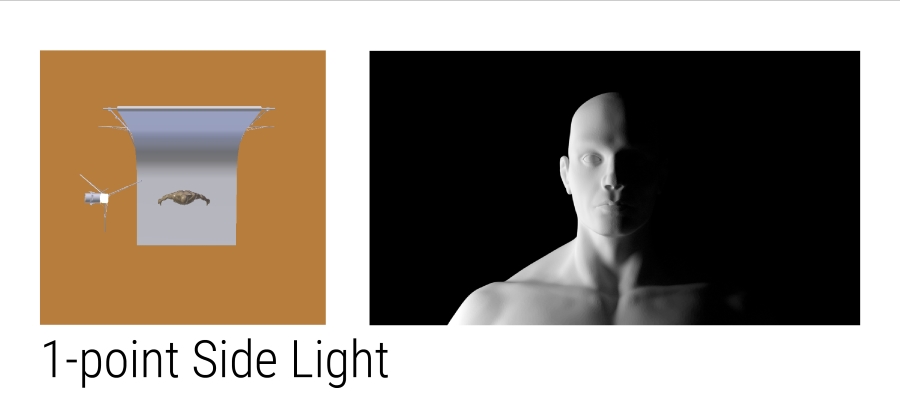
To achieve classic split lighting, you need precise placement of the light source. Follow these steps for a controlled setup:
- Position your subject facing the camera, keeping their head neutral or slightly angled.
- Place your key light directly to one side at a 90‑degree angle, at face level, or slightly above.
- Use a single light source, such as a window (works best, for example, in the strong low winter sun), LED panel, strobe, or flash.
- Adjust distance for desired contrast: closer lights create harsher shadows, while farther lights soften them.
- Optionally, use a softbox or other diffuser to control light softness.
- Ensure at least one eye has a catchlight to maintain vitality in the portrait.
Effects and Uses of Split Lighting for Dramatic Portraits
Split lighting produces contrasty and moody images. It conveys intensity, mystery, or strength, depending on the subject and context, and is great in low-key lighting setups.
You can use it to slim wider faces by hiding one half and to highlight facial textures such as skin detail or wrinkles. This makes it effective for character portraits, editorial fashion shoots, and black-and-white photography that emphasizes depth and emotion.
Overall, split lighting adds a strong visual impact and narrative tone to your portraits.
Best Situations to Use Split Lighting for Portrait Photography

Split lighting adds depth and mood by dividing the face into light and shadow. It works well when you want a dramatic or emotional look. Use it to create mystery, show toughness, or highlight character.
Black-and-white portraits often benefit from this setup because it brings out texture and structure. It’s also useful when you want to slim the face or shape features. Whenever you need strong focus or atmosphere, split lighting is a solid choice.
Related Portrait Lighting Styles Compared to Split Lighting
To know when to use split lighting, it helps to compare it to other styles.
- Loop lighting creates a soft shadow on one cheek. It’s subtle and less intense.
- Rembrandt lighting adds a triangle of light under the eye, giving the face more depth without being too harsh.
- Butterfly lighting shines straight down from above, making an even, glamorous look with a shadow under the nose.
Each setup has a different mood, and split lighting stands out when you want something bold and dramatic.
Summing Up
Split lighting is a simple setup with a strong visual effect. Light positioned at 90° divides the face between light and shadow, adding drama, structure, and emotional depth. You can use natural or artificial light, controlling distance, modifiers, and background to fine-tune the mood. This technique works whenever you want portraits that feel intense, focused, and visually striking.
Read Next: Want to level up your photography skills?
Explore our Photography section for guides on lighting, composition, camera settings, and creative techniques across genres like portrait, landscape, and street.
Whether you’re shooting on a mirrorless camera or your phone, you’ll find sharp, practical tips to take more intentional and creative photos.
Also check out our Visual Composition section, with deep dives into framing, color psychology, and visual art history—key tools for any photographer thinking like an image-maker.
