

Published: November 14, 2025 | Last Updated: July 3, 2026

What is Breaking the third wall? Definition & Meaning
Breaking the third wall is when a character acknowledges the medium they’re in (like the camera or the show’s format) without directly talking to you as the viewer. The term comes from online discussions and is often used to describe scenes where characters react to the rules or structure of the story. It’s not an official film term like “breaking the fourth wall,” but it’s helpful when you want to describe moments that remind you this is a show or a film. This article explains where the idea comes from, how it works, and how it differs from breaking the fourth wall.
What Does Breaking the Third Wall Really Mean?
Before we look at examples, it helps to understand where the term comes from.
“Third wall” isn’t used in professional screenwriting or directing guides, but it’s becoming more common in online film talk. Most of the time, it’s used to describe moments where a character seems aware of how the scene is being made (like through the script, the camera, or the setup) but stays inside the world of the story.
The “third wall” originally referred to one of the physical walls on a TV set, usually the side or back wall in a three-walled room built for filming. The fourth wall is the imaginary barrier between the characters and the camera.
Think of it like this: when someone breaks the fourth wall, they talk to you. When someone breaks the third wall, they might glance at the camera, call out a predictable moment, or act like they know the rules of their own genre, but they stay in character. It’s a softer, more indirect kind of awareness.
Why and How Is the Third Wall Broken?
These moments are usually subtle, but they shift how you watch the scene. They make you notice the script, the camera, or the editing without completely stepping outside the world. Here’s how they show up, and why they’re used.
Common Techniques Used to Break the Third Wall
Third wall moments don’t involve direct address. Instead, they reveal that the character is reacting to how the scene is being filmed or written, even if they never say it out loud.
- A character glances at the camera without speaking, like they know it’s there.
- Someone makes a joke that only works if they’re in a movie or show, like pointing out how dramatic a moment feels.
- The scene highlights editing or genre rules, like repeating a line in a different scene to show a pattern.
Why Creators Use the Third Wall
Third wall breaks let creators play with tone and structure while keeping the character grounded in the scene. They can feel clever or surprising, but the story still moves forward like normal.
- To joke about predictable setups, repeated plot twists, or common scenes in a genre, without leaving the character’s world.
- To show characters reacting like they know they’re in a show, without directly saying it.
- To invite the viewer into the joke or reference, while keeping the scene believable.
Examples of Breaking the Third Wall
These scenes suggest that something is off, but never fully break the world. The character stays in the scene, but their behavior reveals that they’re close to noticing how it all works.
- In The Office (2005–2013, NBC), characters often look at the hidden camera crew. They’re not talking to you, but they’re reacting to being filmed.
- In horror movies, a character might say, “We shouldn’t split up,” as if they know what always happens in scenes like that.
- In Community (2009–2015, NBC), characters often reference TV formulas, like bottle episodes, without stepping out of the story.
What Is Breaking the Fourth Wall?
Now that we’ve looked at the third wall, it’s important to understand how it differs from the fourth wall. This one is more direct and more familiar.
This technique comes from theatre (especially Bertolt Brecht was famous for it), where actors perform behind three walls and imagine a fourth wall facing the audience. In film and TV, the fourth wall is the camera, and breaking it means looking into the lens and speaking to you on purpose.
How the 3rd and 4th walls of a Movie World Connect to Diegesis
Third wall moments still happen inside the world of the story (what’s called diegesis), but they stretch its limits by making characters act like they sense they’re being filmed.
Breaking the fourth wall is a clear break in diegesis: a character acknowledges you, the viewer.
Breaking the third wall is a bending of diegesis: the character doesn’t fully leave their world, but they react in a way that presses against the boundary (like noticing the camera, referencing genre tropes, or sensing something artificial).
Case Story: Scream vs. Scary Movie
Both Scream (1996, Dimension Films) and Scary Movie (2000, Miramax) use horror movie clichés and horror tropes as part of their story, but they use different meta techniques to do it. This makes them a good pair to compare if you want to understand the difference between meta-commentary, breaking the third wall, and breaking the fourth.
Case Study: Scream vs. Scary Movie
Scream (1996, Dimension Films) is often called a meta-horror film because its characters talk about the rules of horror movies, aka horror tropes. But they don’t know they’re in a movie, i.e., they believe everything is real. The story stays fully inside the diegesis. That means it doesn’t break the third wall nor the fourth. It’s self-aware, but only at the script level.
Scary Movie (2000, Miramax) takes those same horror clichés and goes further. In one scene, Drew Becker (Carmen Electra) runs in slow motion through water in her underwear, striking dramatic poses as if she knows the camera is watching, but she never speaks to you. That’s a clear example of breaking the third wall.
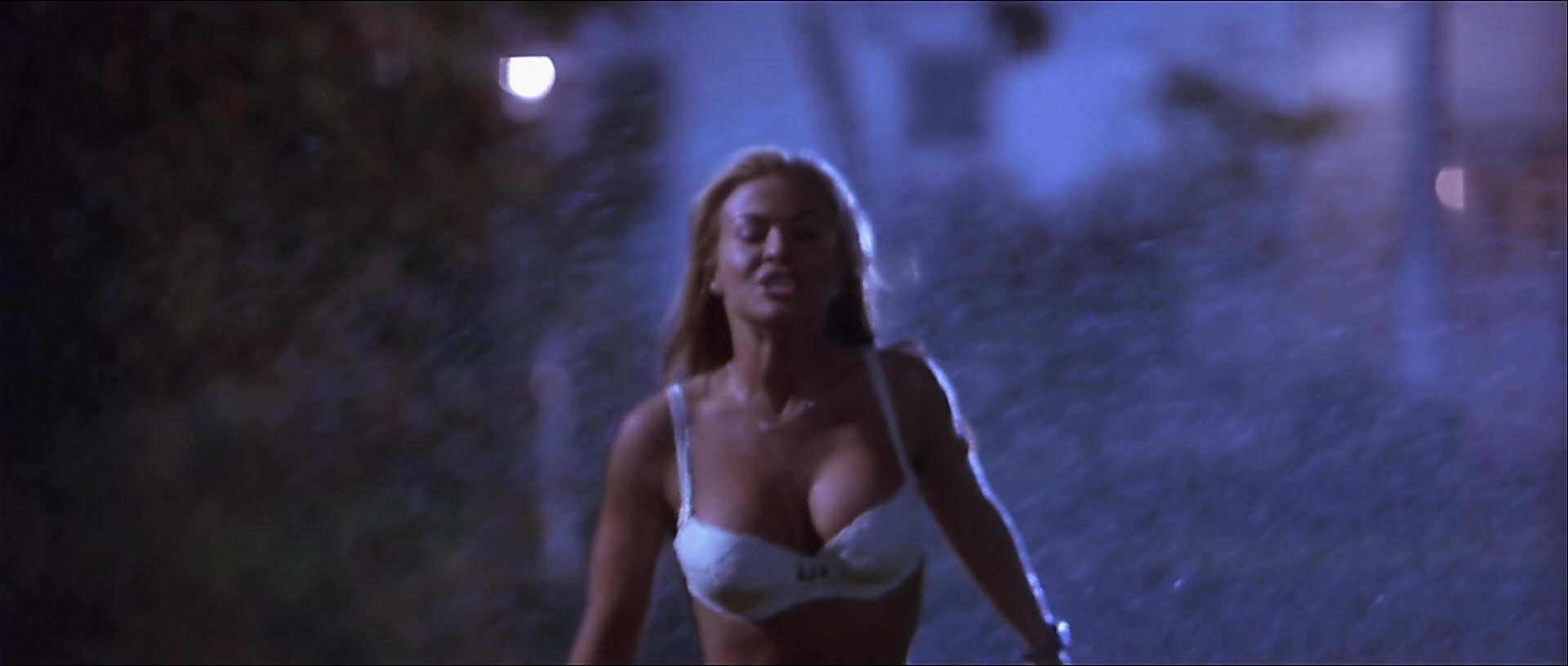
In another scene, the camera bumps into Cindy (Anna Faris), and she pushes it away with her hand. That’s breaking the fourth wall; she’s acknowledging the camera as an object and interacting with it directly:
Scream stays inside the story while referencing movie logic. Scary Movie constantly points to the camera, the editing, and the viewer, breaking both the third and fourth walls.
Summing Up
Breaking the third wall happens when a character shows signs that they know they’re in a film (like reacting to the camera or story format), without speaking to you. Breaking the fourth wall is more direct: a character talks to the camera or calls out the audience. Both make the film feel more self-aware, but the third wall keeps the illusion intact. If you’re using the term “third wall,” just be clear about what you mean, since it’s not a standard term yet.
Breaking the Third Wall FAQ
What does breaking the third wall mean?
It is when a character shows awareness of the medium they are in — reacting to the camera, the editing, or the fact that they are in a film — without directly speaking to the audience. It “bends” the illusion rather than fully breaking it.
What is the difference between the third wall and the fourth wall?
Breaking the fourth wall means a character directly addresses the audience, like Deadpool or Ferris Bueller talking to the camera. Breaking the third wall is subtler: the character acknowledges the medium or format but never speaks to you directly.
Is “breaking the third wall” a real term?
It is a relatively new and not-yet-standardized term that grew out of online film discussion. It is fine to use, but it helps to explain what you mean, since some people use “third wall” and “fourth wall” interchangeably.
What are examples of breaking the third wall?
Self-aware horror such as Scream, whose characters know the “rules” of horror movies, or moments where a character reacts to the camera or the story’s structure without addressing the viewer directly.
Why do filmmakers break the third wall?
For humor, meta-commentary on genre or filmmaking, and to make the audience more aware of the story as a constructed piece of media — often heightening irony or self-reference.
Read Next: Curious how film theory shapes the way we watch movies?
Start with the Film Theory section to break down realism, formalism, structuralism, and more — with examples from iconic films.
If you want studying film theory I recommend starting with The FilmDaft overview of film theory discourses to break down realism, formalism, structuralism, and more — with examples from iconic films.
Then explore the full Film History, Theory & Genre collection to see how movements, styles, and storytelling traditions have evolved.
Whether you’re into Soviet montage or 2000s genre mashups, there’s something here to sharpen your understanding.
