

Published: May 18, 2024 | Last Updated: December 11, 2025

What is an On-camera microphone? Definition & Meaning
An on-camera microphone is a highly directional microphone designed to pick up sound waves from sources in front of it. Moving slightly to the shotgun barrel’s left or right while talking, the mic will start picking up less sound.
As you probably have already guessed, shotgun mics are ideal for YouTube videos, interviews, speeches, narrations, and vlogging. They don’t pick up noise from the surrounding areas, which is a great advantage.
On-camera microphones vs. Shotgun Microphones
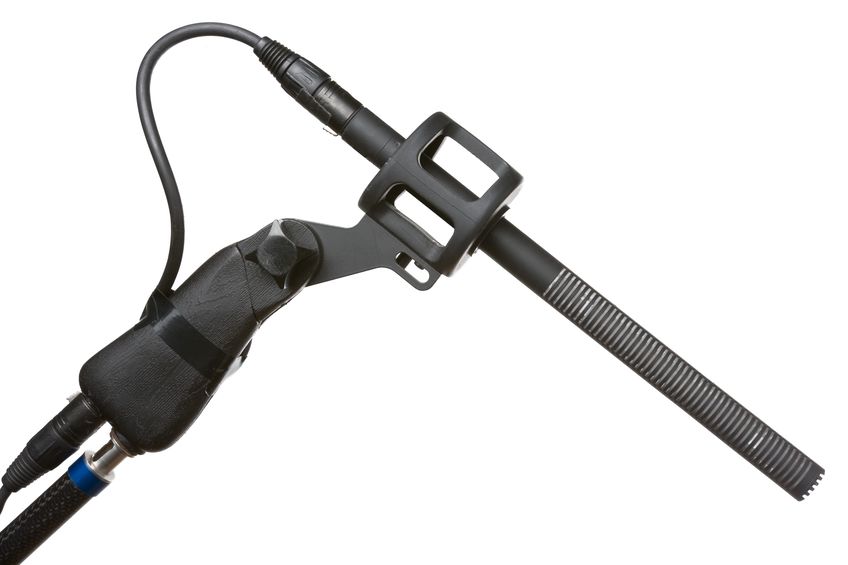
There’s a slight difference between a true shotgun mic and shotgun-style on-camera microphones. Most of the mics in this article will be of the latter type.
There are three major differences:
- the microphone pick-up / polar pattern
- the microphone directionality and length
- mounting
- how the microphone is powered
Traditional shotgun microphones have a directional polar pattern, meaning they only pick up sounds directly in front of the microphone. They are often also longer than on-camera microphones. There’s a relationship between the length of the microphone, the polar pattern, and the directionality of the shotgun mic. Long microphones are more directional than shorter ones.
Long shotgun microphones are also better at picking up distant sounds than shorter ones. That’s why you often see long shotgun mics at live events such as football matches. Professional shotgun microphones also have low self-noise and high sensitivity, which is another reason why they’ve become the industry standard.
Challenges with traditional shotgun microphones
Industry-standard shotgun microphones are often put on a boom arm close to the subject. That’s why you often have a sound guy with a boom arm that controls the movement and position of the mic for the best audio recording possible. This ensures an excellent signal-to-noise ratio; the mic doesn’t pick up much ambient noise.
If you’re a solo video shooter, this isn’t possible. Instead, you can put the microphone on a stand close to the subject. This can work wonders for interviews, but not for moving subjects. If you want to get more background in the frame, you can’t have the microphone very close, or it will appear in the footage.
The last challenge with traditional shotgun microphones is that they often need 48V Phantom Power from an external device. If your camera supports this, you’re good to go. If not, you need an external recording device, such as a Zoom recorder. This may also mean you need to sync the scratch audio from your camera and the shotgun mic in post-production.
Enter on-camera shotgun microphones.
Why on-camera microphones are great for the one-person filmmaker
On-camera shotgun-style microphones solve many of these issues but create some new ones.
The main reason to get an on-camera microphone is if you’re shooting the video yourself – as a wedding videographer, vlogger, journalist, or one-man videographer.
Read the FilmDaft beginner’s guide to wedding videography.
An on-camera microphone is one of the best options for video production if you’re a single person running all the tasks. It’s especially effective if you combine it with a lav mic—I’ll explain this in more detail later in this article.
Most on-camera mics pick up sound in a wider pattern than a true shotgun microphone and are more forgiving regarding where you stand in front of the mic.
However, this also means they pick up more background noise from the natural environment or room. So, if you’re in a noisy environment, you’d want to combine them with a lav mic close to the body.
They are often mounted into the hot shoe of compact digital cameras or a cold shoe on a camera cage. You can just as easily put a traditional shotgun microphone on your camera. But you’d rarely see an on-camera microphone designed to be attached to your camera on a boom pole.
Some on-camera shotgun condenser microphones need power. But unlike traditional shotgun microphones, these have an internal battery, removing the need for an external unit supplying phantom power.
Microphone Polar Patterns

Microphone polar patterns refers to the direction from which a mic is designed to pick up sound. There are multiple types of mics available with various polar patterns. For example:
Cardioid mics
Cardioid microphones are designed to pick up all sounds from the front and some from the left and right areas of the microphone. Their pick-up pattern resembles a heart turned upside down. On-camera microphones are sometimes cardioid and sometimes super-cardioid.
Super-cardioid mics
Super-cardioid microphones are also known as unidirectional microphones because they have a unidirectional pattern. Super-cardioids are commonly used in shotgun microphones as they only pick up sound from the front and very little from the sides and back.
Some advanced shotgun mics don’t pick sounds from the sides, only from the front. A super-cardioid pattern is also known as a hyper-cardioid or lobar polar pattern.
Bidirectional mics
Bidirectional microphones pick up sound from both sides – front and back or left and right. Shotgun mics aren’t bidirectional.
Omnidirectional mics
Omnidirectional microphones are designed to pick up sound waves from any direction. They are great when filming moving targets and are often used in lapel mics, so the microphone can be placed on your talent in many different places and still pick up sound. You rarely see omnidirectional shotgun mics.
Frequency Response
A microphone’s frequency response refers to the sound range it picks up in terms of hertz. For example, most shotgun mics pick up sound in the 20Hz—20kHz range, which defines the absolute limits of what most humans can hear.
Before you obsess about frequency response, remember that human hearing is most sensitive in the 2000 – 5000 Hz frequency range. And many adults can’t hear anything above 16kHz.
The fundamental frequencies of human speech usually lie between 100Hz-3kHz, with harmonics ranging up to 17kHz. So, if a microphone “only” has a frequency response of 40Hz-16kHz, it doesn’t mean it is a bad microphone.
If you want to read more about frequency response and microphones, here’s a great guide by the microphone company Shure.
High-pass filters
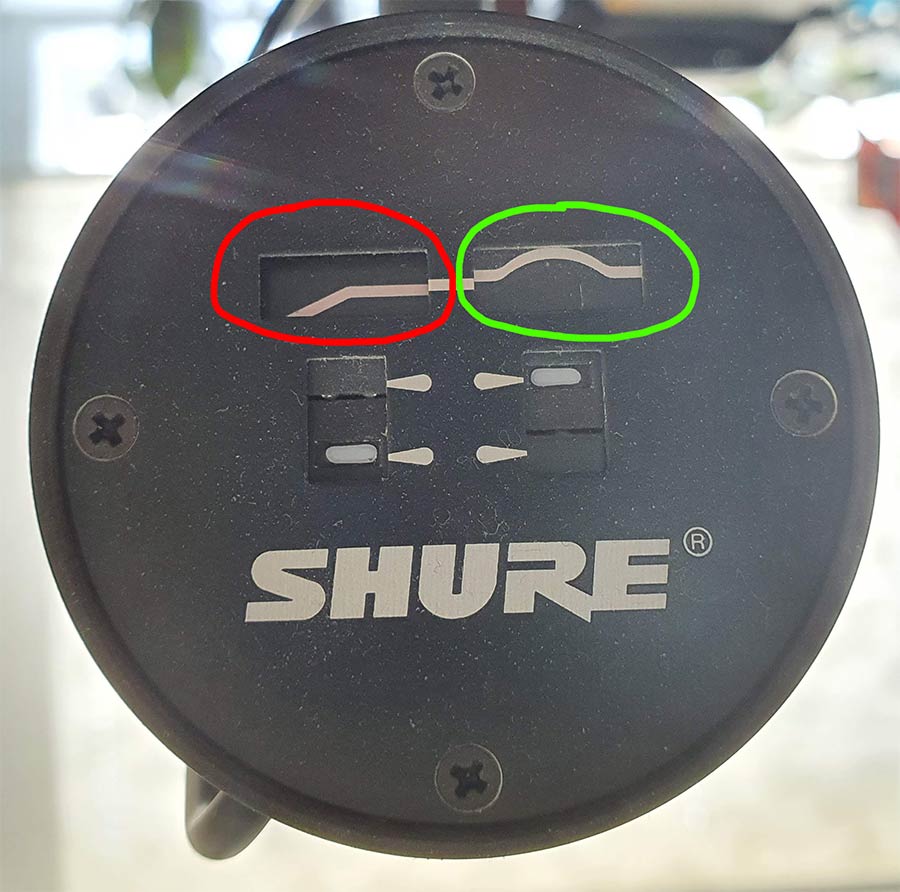
The red circle depicts the high-pass filter curve, and the green circle depicts a mid-range filter. The microphone here is the Shure SM7B, which isn’t an on-camera mic, but it depicts the filters well and easily.
Some on-camera microphones have a low-cut, a.k.a. high-pass filter, which cuts out sounds below a certain frequency, leaving only the higher frequencies.
For example, some shotgun mics can come with a high-pass filter at 90 Hz. The filter lets the higher sounds pass (higher than 90 Hz) and rolls off sounds below 90 Hz.
By “rolling off,” I don’t mean they entirely cut out all frequencies below 90 Hz. Instead, they decrease the volume of those frequencies by a set number of decibels per octave, fx 6dB, 12dB, or 24 dB.
High-pass filters are useful for cutting out low-frequency noise, such as handling noises, a low hum from traffic, and air-conditioning.
Power Option
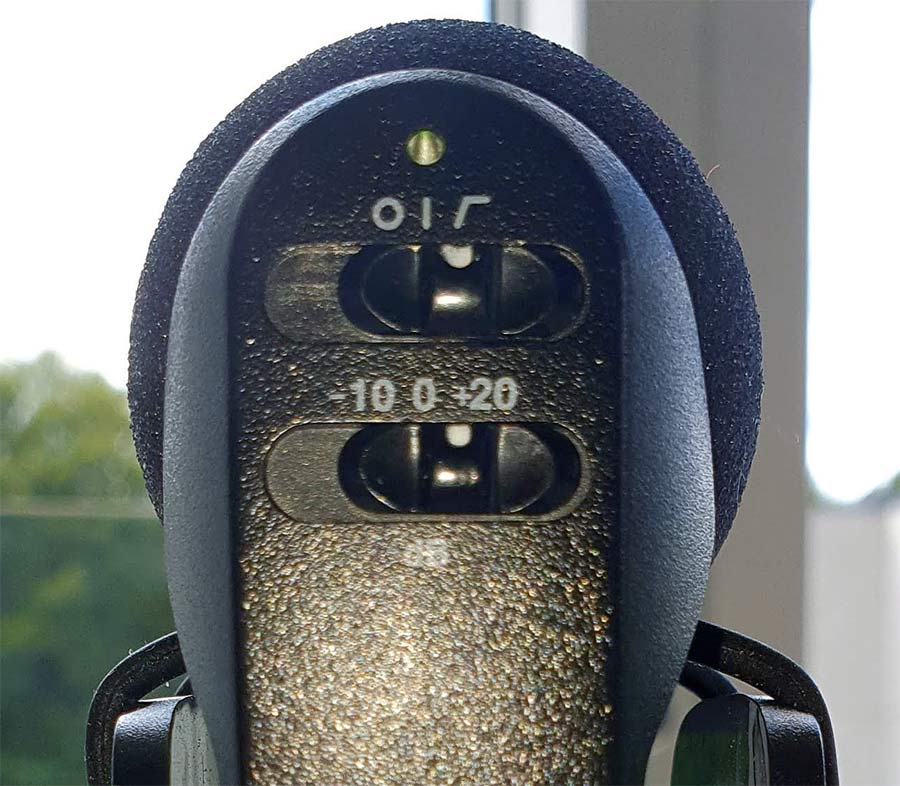
Your microphone must be attached to a camera, but it doesn’t work out of the blue. It also needs a small source of electricity.
Some mics draw power from your DSLR camera when connected. This can be either from the 3.5mm microphone input or the hot shoe on your camera. You don’t have to do anything but plug them in and get busy filming videos.
However, make sure that you keep an eye on your DSLR’s battery level since it will be drained slightly faster now.
Other microphones have internal batteries, but the type of battery power differs from microphone to microphone. Some have rechargeable lithium-ion batteries, while others have AA, AAA, or 9-volt batteries, which can be replaced when they die.
While rechargeable batteries are nice, they might not be the best choice if you’re recording for long periods because you can’t simply switch out the battery.
If you run out of power, you must recharge the battery during a shoot. Some microphones, though, will allow you to recharge from a power bank, so that might be a solution—if you remember to bring one!
I prefer microphones with batteries that I can switch out if needed. If I forget to bring one (fx a single AA battery), I can buy them anywhere, from the gas station to the supermarket.
Some microphones can be powered in multiple ways. This doesn’t make the mic dependent on only one power source, so you have one less thing to worry about.
Shock Mounting System

When recording video footage, you aim to minimize the surrounding noise and handle noises as much as possible.
If you accidentally bump into your microphone stand or hold your camera while you walk and talk, e.g., vlogging, you don’t want your microphone to pick up any of those noises.
The solution is to use a shock mount. This accessory keeps the mic stable on top of your camera, and any vibrations, noise, and rumble are minimized.
It works by essentially suspending the microphone in some rubber bands. This vastly minimizes any handling noise.
Accessories
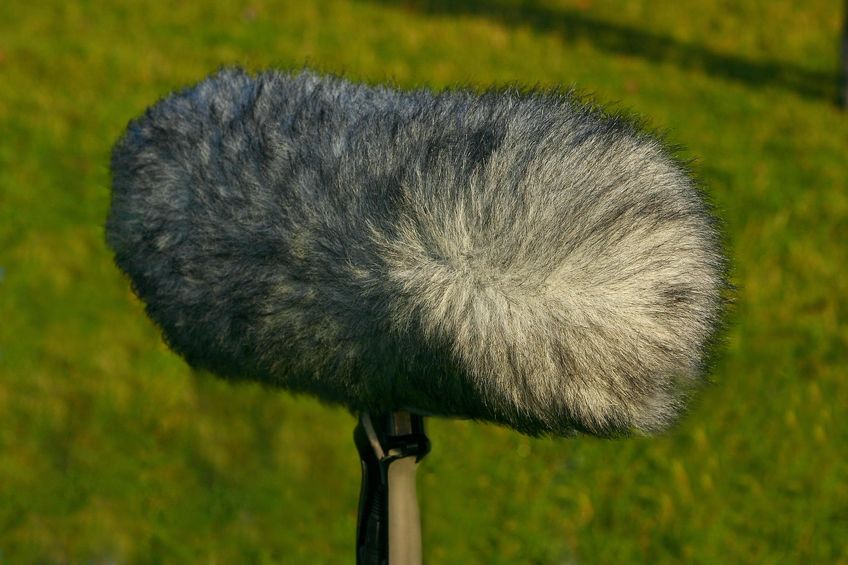
An on-camera shotgun mic is rarely sold alone. It also includes accessories such as a cable (usually 3.5mm) to connect it to your DSLR, a travel case, and a foam windscreen.
The foam windscreen is designed to minimize wind noise and vocal plosives (such as ‘p,’ ‘t,’ and ‘b’) for accurate, crisp sound quality.
If you’re filming outside in strong winds, you should also get a “dead cat.” A dead cat is a furry shield. You can put it on the foam windscreen for extra protection from high winds.
Make sure that you find out what’s in the box before paying.
You should also get more information about the warranty period. Most manufacturers offer a warranty period of 1 or 2 years, which is reassuring.
You might like this on Recommended On-Camera Microphones
Pro Tip: Use a lav mic in combination with an on-camera shotgun mic
I suggest combining a Lavalier microphone with an on-camera microphone for the best quality possible.
That way, you get the best of two worlds: a close mic and a room mic.
The Lavalier microphone is placed on the subject’s body, so you pick up speech but not much of the room.
The shotgun microphone is placed on your camera and pointed at the subject. This method gives you more room (but also more noise).
You use the shotgun microphone as an alternative to the built-in microphones of your camera.
Read Next: Want better audio in your film or video projects?
Explore techniques, tools, and workflows in the Sound, Audio & Music section for filmmakers.
From voice recording and field audio to scoring and mixing—this is where sound gets cinematic.
