Published: June 3, 2024 | Last Updated: October 31, 2025

What is a tracking shot in film? Definition & Meaning
A tracking shot is a continuous shot in which the camera moves alongside the subject it is recording. It can follow the subject from side to side, forward, backward, up or down, or even around the subject.
The term comes from the early days of cinema, when mounting a camera on a dolly on a track was the only way to ensure smooth movement. Because of this, today, we understand a tracking shot as a shot that follows, aka “tracks” a character or object through a scene. Of course, this can be achieved today through other means, like Steadicams and gimbals.
First, here’s a short video summary showing you some examples and functions of tracking shots in film. I’ll get into many more examples and explain the types and ways these are created today:
Tracking Shot Directions
The most basic tracking shots are the backward, forward, and lateral (from side to side, aka trucking – this is also called a crab shot). The latter can create a nice parallax effect, with things in the foreground moving faster than in the middle and background.
These can be combined with other camera movements, and with FPV drones, you can get some amazing action-tracking shot sequences, which I’ll get back to.
But to start things off, here’s a running sequence from Rocky II (1979). We see several basic tracking shots, from backward to lateral, and even an upward tilting shot.
Camera Movement List
Ways to Create a Tracking Shot
To create a tracking shot, you need to move your camera! Key things to consider are how much freedom the camera should have and from which angles you intend to capture the scene.
Equipment can vary from a dolly to Steadicams, jib arms, and drone cameras. The choice of equipment depends on the shooting location’s desired effect, budget, and physical constraints.
Handheld Tracking Shot
Yep, you can create a tracking shot with just your camera. A handheld shot involves the camera operator holding the camera without stabilizing equipment. This results in a more shaky and raw aesthetic, often used to convey urgency or realism.
Example: The Bourne Ultimatum (2007)—The chase scenes through Morocco use several tracking shots – from handheld to cable – to enhance the sense of chaos and immediacy.
Dolly Tracking Shot
If you want to create a traditional dolly shot that tracks a subject, you need a dolly. Dollys are still used for smooth, linear motion but don’t offer much wiggle room.
Example: Stanley Kubrick used a dolly to create his tracking shots in his early films. For example, the scene above from A Clockwork Orange (1971) uses a backward tracking shot on a dolly to follow the nurse through the hospital hallways. That was before he introduced and pioneered the new invention called a Steadicam in The Shining in 1980. Speaking of which…
Steadicam or Gimbal Tracking Shot
A Steadicam is a stabilizer that allows you to create smooth movements while shooting handheld. It allows for more fluid and versatile movements, especially in complex environments.
Example: Quentin Tarantino’s Pulp Fiction (1994) uses a Steadicam tracking shot to follow Vincent as he walks through Jack Rabbit Slim’s, giving us a sense of the vibrant setting. It lets us take in the scene and scout for any dangers to Mia as Vincent does, giving us a sense of his analytical, observant character.
Crane Tracking Shot
You can mount the camera on a boom arm to capture high-angle tracking shots, like those found on a crane or jib. This technique provides a bird’s-eye view and can transition smoothly from high to low angles. The vertical motion is called pedestal. Cranes and jibs can be stationary or mounted on a car. Likewise, most dollies have a boom arm.
Vehicle-Mounted Tracking Shot
A vehicle-mounted shot involves attaching the camera to a moving vehicle, such as a car or motorcycle, to track subjects on the move. This method is ideal for capturing high-speed action scenes.
Example: Check out the insane tracking shots in Mad Max: Fury Road (2015). The high-octane chase sequences are captured using vehicle-mounted cameras combined with rigs and jibs to capture the action from unique perspectives.
Cablecam Tracking Shot
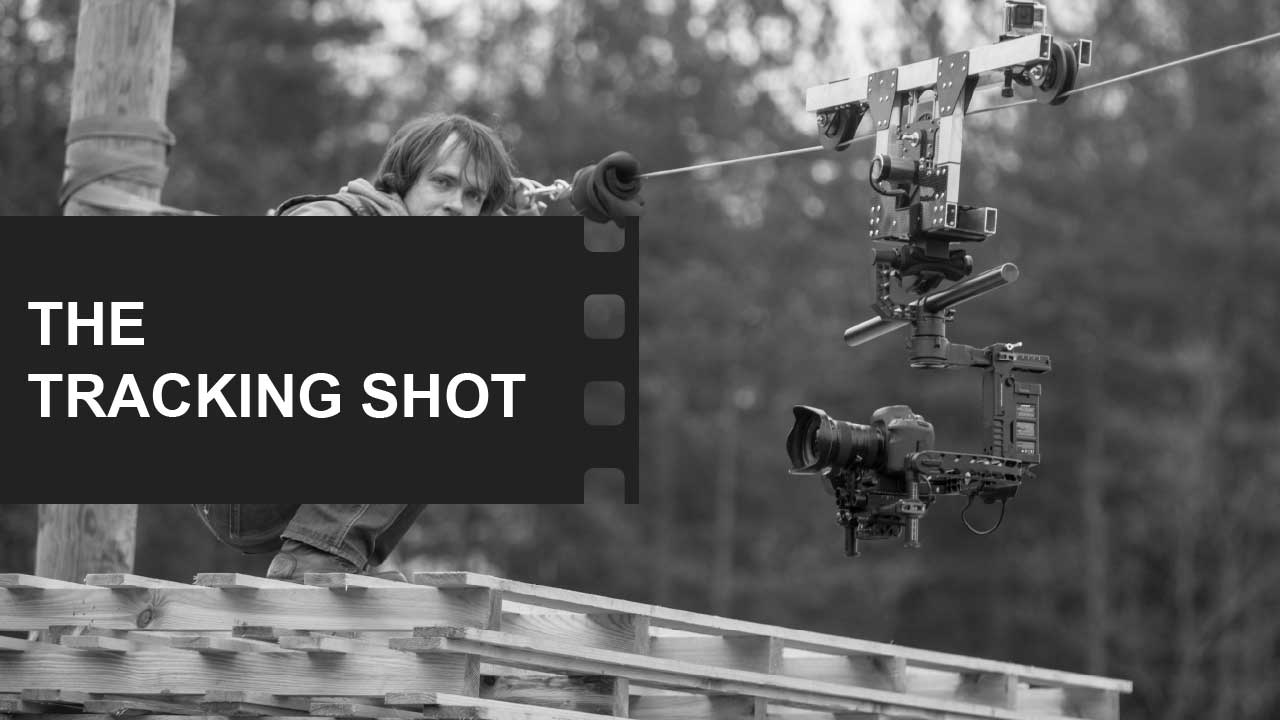
A cablecam shot uses a camera suspended on cables to move through the air. This technique is often employed in sports broadcasting and action scenes to cover large areas seamlessly.
Drone Tracking Shot
Drones are great for providing aerial tracking shots, offering a birds-eye perspective that shows more of the environment. This is great for car scenes or scenes where someone is pursuing another and can reveal more of our hero’s perilous environment, making him or her seem small and in danger.
Example: Here’s a nice compilation of FPV drone tracking shots from the Netflix movie Red Notice (2021).
Summing Up
Tracking shots, from the classic dolly shot, where the camera can move on tracks to create a smooth floating motion, to fast-paced FPV drone shots that create action, are effective ways to guide our eyes through a scene or immerse us in the action.
Luckily, you don’t need an insanely expensive car rig or jib to get a great tracking shot today. Gimbals, consumer drones, or sliders can achieve similar effects. Even cable cams have become affordable (probably due to the popularity of drones). Heck, you can even mount a GoPro to a skateboard and create a somewhat smooth tracking shot – or shoot it handheld.
Read Next: Want to master how camera movement affects tone and pacing?
New to camera language? Start with our Camera Shots & Angles FAQ for quick answers and visual breakdowns.
Then explore all camera movement techniques — from tracking shots and whip pans to handheld, Steadicam, and crane setups.
Or return to the Cinematography section to dive into lenses, lighting, and visual composition.