

Published: August 27, 2025 | Last Updated: December 9, 2025

What is A sound designer? Definition & Meaning
A sound designer is a technical and creative professional who records, edits, and manipulates sound for film, video games, theatre, and live events. You gather raw sounds, create new ones, and blend them to match the story, mood, and style of each scene. This includes everything from footsteps and weather to drones and machines. This is all part of the umbrella term Sound Design.
Sound Designer Responsibilities: What You Actually Do
A sound designer’s job includes many tasks across planning, recording, editing, and syncing sound. You don’t just create effects, but shape the full sound environment of a film, game, or TV show.

Here are the core responsibilities most sound designers handle during a project:
- Record ambient sounds and collect Foley effects or other custom noises. If a movie needs a futuristic helicopter, you might combine propeller sounds with synth tones to create it.
- Search and manage sound libraries to find or organize sound effects that support the story.
- Meet with directors, producers, and composers to define the soundscape.
- Use audio plug-ins to process, layer, and manipulate sounds using pitch shift, reverb, looping, or delays.
- Sync effects with action and dialogue, cue sounds at precise visual moments, and balance all audio layers.
- Design or remix music tracks in collaboration with a composer or editor.
- Set up and monitor audio equipment for live performances, and train others to run cue systems.
- Plan sound system layouts to cover three-dimensional space with balanced clarity.
- Use interactive tools like Wwise, FMOD, or game engines to design reactive sound in video games.
Read my interview with Danish sound designer Peter Albrechtsen.
How Layering Sound Design Creates Emotion and Mood
A common task for any sound designer is to design how sounds work together in and around a movie’s diegesis. A horror alleyway might blend wind, creaking signs, and distant voices to build tension.
In a comedy, the same space might stay quiet to focus on dialogue. You plan these soundscapes with a timeline or cue sheet, making sure each element supports the mood of the scene.
Foley Sound Effects: How Practical Sounds Add Realism
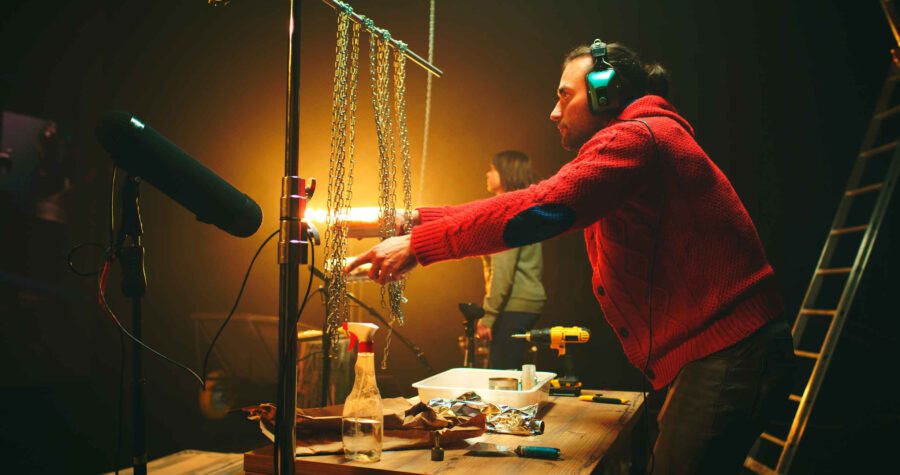
Foley artists recreate sounds in sync with the picture using props. You collaborate with them to add realistic detail, like footsteps, cloth movement, or object impacts.
You might also be interested in What are Diegetic and Non-Diegetic Sounds in Film?
The recordings are then edited and layered into the mix to blend in seamlessly yet effectively. It’s your job to make sure those layers feel like they belong in the scene.
Sound Design for Film and TV: Supporting Story Through Audio
In film and TV, you design both background and featured sounds. That includes ambient noise, specific sound cues, and music transitions.
You edit dialogue, manage Foley, and decide how sounds will interact with the visuals.
Sound Design in Video Games: Tools, Timing, and Player Interaction
In video games, sounds react to the player. Footsteps need to change depending on the surface. Weapons need to sound different based on distance or environment.
You use interactive tools like Wwise or FMOD to build these effects. You also implement transitions for in-game music and layer different versions of the same sound to avoid repetition.
Spatial Audio in Games and VR: How 3D Sound Improves Immersion
Spatial or 3D audio allows you to place sounds around the player, such as above, behind, or to the side. You use surround mixing tools to simulate this movement.
For example, if a spaceship flies overhead, spatial panning moves the sound across the top speaker channels. This kind of design is used in VR games, immersive theatre, or Dolby Atmos film mixes.
Live Sound Design for Theatre and Performance Events
In theatre or live shows, your job starts with reading the script and planning a sound plot. You decide when and where sounds occur, reinforce actor voices, and specify speaker placement.
During rehearsals, you refine timing and train the stage manager or operator on cue execution. You monitor sound levels during the performance and adjust as needed.
Sound Design in Post-Production: Syncing, Editing, and Mixing
Once the picture is locked, you join post-production to sync, refine, and mix audio. You work with the supervising sound editor and re-recording mixer to blend effects, dialogue, and music.
For many films, this is where the final mood and rhythm are shaped, even if the audience is never directly aware of it.
Read my interview with Danish sound designer Michael Manky.
Where Sound Designers Work and What They Get Paid
Sound designers work in film studios, game companies, live touring productions, animation, TV, and theatre. Many freelance and take contract work.
Some work full-time in-house for large companies or venues.
Salaries range from $20,000 for entry-level positions to $100,000+ for experienced pros. Union rates in film/TV are about $60/hour. Theatre designers in the UK often start around £18,000, with top roles reaching £40,000 or more.
Essential Skills for Becoming a Sound Designer
To succeed in sound design, you need both technical and creative skills. You must understand how sound works, how to use editing software, and how to tell a story through audio. These are some of the most important skills you’ll use in this career:
- Audio recording and mixing knowledge, including field and studio mic techniques
- Experience with Pro Tools, Reaper, Ableton Live, Wwise, FMOD, or similar tools
- Understanding of acoustics, space, and speaker placement
- Time management, cue building, and creative planning
- Strong communication with directors and crew
- Rhythmic and musical instinct (especially when editing to picture)
- Ability to troubleshoot under pressure (especially in live setups)
Working with Directors, Actors, and Teams in Sound Design
You work closely with directors to understand the emotional and narrative goals of each scene.
- In film, you work with the editor, composer, and mixers.
- In theatre, you coordinate with stage managers, scenic designers, and lighting to integrate cues.
- In games, you interface with programmers to implement and trigger audio events based on player interaction.
Good collaboration keeps everything running smoothly from rehearsal to final mix.
How to Become a Sound Designer: Education, Tools, and Career Path
You don’t need a degree, but training helps. Many sound designers start by learning audio software on their own and working on indie projects or student films.
Others study sound at film schools or take online courses. Experience and a strong portfolio matter more than formal education.
Step-by-Step Guide to Starting a Career in Sound Design
If you’re just getting started, you don’t need to know everything. Start small, learn by doing, and build up your experience. Here’s a basic step-by-step path you can follow if you want to become a sound designer:
- Learn a DAW like Pro Tools or Reaper
- Practice recording and editing your own sounds
- Edit sound for shorts, podcasts, theatre, or YouTube videos
- Create a reel that shows a range of sounds and styles
- Take entry-level jobs or internships in post-audio or production
- Learn Wwise or FMOD for games, or QLab for theatre
- Keep learning and build a strong personal sound library
Summing Up
A sound designer creates and manages the audio landscape of a project using recording, editing, and layering techniques to support story and emotion. Whether you’re working on a film, a game, or a live show, your job is to help the viewer or player feel immersed, even if they never notice the sound directly. With a mix of tech skills, artistic instincts, and communication, sound design offers a creative career that puts you at the heart of every moment.
Read Next: Want better audio in your film or video projects?
Explore techniques, tools, and workflows in the Sound, Audio & Music section for filmmakers.
From voice recording and field audio to scoring and mixing—this is where sound gets cinematic.
