

Published: September 9, 2025

What is A klieg light? Definition & Meaning
A klieg light is a powerful carbon arc lamp used especially in motion‑picture studios. It creates an intense, focused beam by directing an electrical arc between carbon rods. The light is then focused through lenses like Fresnel or ellipsoidal types. The Kliegl Brothers invented it in the early 1900s and named it the Klieglight.
How Klieg Lights Work: Parts and Process
The klieg light produces its beam by sending an electric current across two carbon rods. This arc generates a white-hot flame that acts as the main light source. A metal reflector (typically nickel or rhodium-plated copper) redirects that light forward. Then, a lens system focuses the beam into a narrow, powerful spotlight.
These lights were built for intensity and control. Here’s what each part does:
- Carbon rods burn under high voltage to produce the arc. They wear down quickly and need frequent replacement, sometimes every two hours.
- Reflector bounces light forward using a precisely shaped, polished surface to maximize output.
- Lens system sharpens the beam. Common options included plano-convex lenses or Fresnel lenses for added control.
- Power supply came from large gas-powered generators capable of delivering up to 16,500 watts.
- Housing was made from steel or aluminum to contain heat and shield the operator from sparks or glare.
This setup allowed directors to light scenes that standard incandescent bulbs couldn’t reach. You could shoot at night, indoors, or through fog with full exposure.
Why the Klieg Light Was a Game Changer
The light was bright enough to overcome film limitations at the time. It lets crews light scenes that would otherwise be too dark. That changed what you could film, at night or indoors.
The term “Klieg light” became shorthand for any bright studio spotlight. Over time, it grew to mean ellipsoidal reflector spots or any intense arc light.
History in Brief
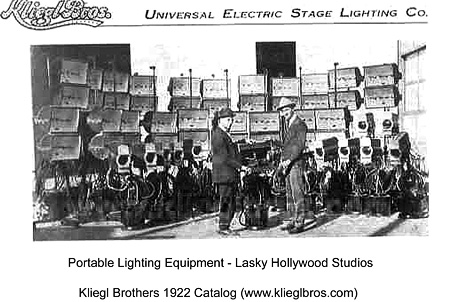
The Kliegl Brothers (John and Anton Kliegl) founded their company in 1896. They introduced the first Klieglight, an arc floodlight, in 1911, listing it in their 1913 catalog.
In 1933 and 1936, they used “Klieglight” to brand new ellipsoidal incandescent spotlights.
Arc-based klieg lights fell out of favor when sound came to films after 1927. The flicker and sputter from arcs interfered with audio. Filmmakers switched to quieter, more stable incandescent lights, such as Fresnel lamps.
Health, Safety, and Challenges
The arc gave off UV radiation. Actors got “Klieg eye,” which means they got eye inflammation, dryness, and redness. It was so common that it became a term in show‑business slang.
They burned hot. Operators needed gloves and protection. Carbon rods had to be replaced frequently. They used too much energy. They generated glare and heat.
Legacy and Modern Use
You don’t see carbon‑arc kliegs on modern film sets. But the name survives. It refers to old‑school spotlighting. Today, people replicate the look using HMIs or LEDs for safer, more efficient beams.
Meanwhile, giant “klieg” style beams still sweep the sky at premieres or events. Their power and drama remain.
Summing Up
The klieg light defined early film lighting. It gave you abundant, direct light. It shaped mood and exposure. You could shoot dark scenes with clarity. Though arc lights faded, their influence endures. The name still means “bright spotlight.”
Read Next: Want to explore how lighting transforms the mood of a scene?
Browse all lighting articles, from hard and soft light to color temperature, contrast, and key light setups.
Or return to the Cinematography section for lenses, framing, and camera movement techniques.