

Published: February 26, 2026 | Last Updated: July 4, 2026

Overview
Cognitive film theory studies how the spectator understands a film moment by moment. It emerged in the late 1980s through theorists such as David Bordwell and Noël Carroll, who rejected psychoanalytic models in favour of the viewer as an active, rational perceiver. It focuses on the viewing tasks the spectator performs while watching: noticing cues, building a sense of space, forming expectations, updating beliefs, and tracking what is at stake in a scene.
The central question is simple and academic at the same time: how does film form guide comprehension and emotion? Students meet this approach in courses on narration, spectatorship, and interpretation because it offers a method for moving from evidence to claim. The method begins with what the film shows and when it shows it, then explains how that structure can guide the spectator’s mental work.
What is Cognitive film theory? Definition & Meaning
Cognitive film theory is not one single model. It is a family of approaches that share a commitment to explaining film experience through perception, attention, inference, and emotion. The shared goal is not to guess what is “inside” the spectator’s mind. The goal is to explain how film form makes some viewing routes easier to follow than others.
In other words, cognitive film theory is a theory tradition that explains how film form guides the spectator’s comprehension and emotion through cues placed in image, sound, performance, and editing order.
Where it sits: It belongs to a broader “theory of viewing” landscape that includes psychoanalytic, ideological, feminist, and apparatus approaches. Cognitive theorists tend to focus on scene-level mechanisms, such as attention guidance and inference, before moving to larger interpretive claims.
Key terms: A cue is a prompt that steers noticing or interpretation (framing emphasis, a reaction shot, a sound highlight, a repeated object). A schema is a learned expectation the spectator brings to the film (genre patterns, everyday cause and effect, familiar scene types). An inference is a conclusion built from cues plus schemas.
Evidence standard: Evidence comes from what is visible or audible and from information order. A strong cognitive claim can point to specific cues and show how their timing invites a specific kind of inference or evaluation.
Scope and limits: The approach can describe shared viewing pressures without claiming identical reactions for every spectator. It also has limits. It can become thin when it ignores cultural history, institutions of viewing, or power relations that help train what “seems obvious” on screen.
This positioning matters because it clarifies what cognitive analysis counts as proof. The analysis starts from film form and treats meaning as something built through a guided sequence of attention, inference, and evaluation. When the analysis moves to theme or ideology, it still needs to show how the spectator is led there through cues and information control.
It also matters because cognitive film theory is used in two common ways in scholarship. One use is narration and comprehension, where the focus is restricted knowledge, prediction, and payoff. Another use is emotion and engagement, where the focus is how alignment, sympathy, and judgment are built through narration, performance, and style.
Historical Background
Cognitive film theory emerged most visibly in the 1980s, partly in response to the dominance of psychoanalytic and poststructuralist film theory in the 1970s. That earlier climate often framed spectatorship through unconscious desire, identification, and broad claims about how cinema positions the spectator. Laura Mulvey’s analysis of visual pleasure and the gaze and Christian Metz’s psychoanalytic account of cinema are two classic reference points in that tradition (Mulvey 1975; Metz 1982).
Against that background, cognitive-oriented scholars argued for a different standard: concepts that stay close to what films do, plus arguments that track how the spectator can reasonably move from cue to inference. David Bordwell’s work on narration is central here because it describes narration as information management, where the film controls what the spectator knows, when the spectator knows it, and how certain that knowledge feels (Bordwell 1985). A closely related move appears in Noël Carroll’s critique of what he saw as vague and non-testable “theory fashion,” where strong claims were made without clear standards of evidence (Carroll 1988).
The Classical Hollywood Cinema is important for cognitive work, even though it is also a film history book. It maps a stable set of classical norms in storytelling and style, which helps explain why many spectators can follow Hollywood narration with low confusion. Those norms become part of the viewing “training” that makes certain cues easy to read in real time (Bordwell, Staiger, and Thompson 1985).
Making Meaning matters because it turns the cognitive question toward criticism and interpretation. Bordwell argues that critics often move from cues to claims through learned routines. He distinguishes common “kinds” of meaning critics look for, and he shows how interpretation can become a rhetorical practice with predictable moves rather than a free-form search for hidden messages (Bordwell 1989).
Mystifying Movies matters because it clarifies the polemical edge of early cognitive debate. Carroll argues that film theory needs clearer reasoning and tighter definitions, and he challenges approaches that rely on analogy, sweeping claims, or concepts that cannot be tested against film form. In practice, the book is a defense of argument standards as much as it is a critique of specific schools (Carroll 1988).
For a compact academic map of the field’s major texts and internal divisions, see the Oxford Bibliographies entry on cognitive film theory. For a focused scholarly appraisal of what cognitive film theory contributed and where it struggled, see Plantinga’s overview essay in Cinémas (Plantinga 2002). Oxford Bibliographies: Cognitive Film Theory. Plantinga 2002 PDF (Cinémas).
Core Mechanism: How the Theory Works
Cognitive film theory explains film viewing as guided mental work. The film offers cues. The spectator uses those cues to build a working model of the scene: where people are, what they want, what they know, what might happen next, and what outcomes seem likely. The method stays concrete because each step should be traceable to something the film does in image or sound.
A useful way to describe the mechanism is to separate four linked tasks. First, the film steers attention, often through framing emphasis, movement, and sound highlights. A rack focus can redirect attention inside a single shot, so the spectator re-ranks what matters in the frame in real time. See rack focus shot for the technique-level version.
Second, the film supports spatial and causal comprehension. Classical continuity patterns reduce confusion about where bodies are and how actions connect across cuts. A match on action works because the spectator can treat two shots as one continuous movement, which keeps the scene model stable. See continuity editing and match on action cut.
Third, narration guides inference by controlling access to information. Restricted narration can align the spectator with one character’s knowledge, while unrestricted narration can let the spectator know more than the characters do. That difference changes prediction, suspense, and moral judgment. See narrator types in film and literature and point of view in film.
Fourth, the film organizes emotion through appraisal. Appraisal is the spectator’s evaluation of stakes, risk, likely outcome, and responsibility. This is why cognitive scholarship on emotion often overlaps with work on character engagement. Murray Smith explains engagement as structured through the spectator’s access to characters and through the judgments the film invites (Smith 1995). Carl Plantinga and Torben Grodal develop related accounts of how films elicit and pattern feeling through narration and style (Plantinga 2009; Grodal 1997).
Across these tasks, the unit of analysis is often the scene. A cognitive claim should be able to answer four questions in order: What cue is present? How does that cue guide attention or inference? Why does that guidance matter for comprehension or emotion? Where in the scene does the effect become visible, meaning where does the spectator’s prediction or evaluation shift?
What to Look For (Checklist Section)
This checklist is designed for close scene analysis. It keeps your notes tied to cues you can point to, so your interpretation has a visible chain of reasoning.
- Information timing: Write down what you learn first, what you learn later, and which details arrive as corrections.
- Restriction level: Note whether the scene keeps you inside one character’s knowledge or gives you wider access.
- Attention steering: Mark the moments that demand focus, such as a held reaction shot, a sound drop, a sudden music cue, or a strong framing emphasis.
- Space and access: Describe who can see whom, what is offscreen, and which exits or obstacles matter in the scene.
- Prediction points: Identify the beats that invite you to guess what will happen next, then note how the scene confirms or frustrates that guess.
- Appraisal cues: Note what the scene frames as the stakes, what counts as danger, and what counts as relief.
- Editing clarity: Track whether cutting makes action easy to follow or forces you to work harder, and connect that choice to what the scene wants you to focus on.
- Schema activation: Name the scene type the film leans on, such as an interrogation, a reveal, a trap, or a meeting with hidden rules.
After you take notes, convert them into a causal claim. A strong pattern is: “Cue X arrives before cue Y, which leads the spectator to assume Z, so the later moment reads as confirmation or correction.” That structure keeps your analysis grounded in sequence rather than in general mood words.
If a scene is hard to explain, one common reason is cue order. A scene that delays a key spatial cue or delays a key motive cue forces the spectator to guess more than the film can support. Your analysis can diagnose that problem by pointing to the missing cue and showing where the confusion begins.
Micro-Analysis of Clarice Starling’s first meeting with Hannibal Lecter in The Silence of the Lambs (1991)
Clarice Starling’s first meeting with Hannibal Lecter in The Silence of the Lambs (1991) is a good test case for cognitive analysis because the sequence builds tension through cue patterning rather than through plot facts alone. The spectator’s fear develops through guided attention, graded expectation, and a shift in what kind of threat feels present.
The corridor approach repeats a clear structure: Clarice moves forward, a new inmate becomes visible, and the spectator updates threat appraisal. The long corridor framing keeps the spectator oriented and pushes attention toward what will appear next. The repeated reveal pattern trains an expectation that each new figure will disrupt Clarice’s control of the situation. The spectator’s mental work is prediction and update, built from repetition and escalation.
When Lecter is revealed, the cue system shifts. He is still, centered, and clearly visible. The staging reduces uncertainty about where to look, so the spectator can focus on evaluation. The earlier corridor pattern has built an expectation of instability. Lecter’s composure becomes an attention cue because it breaks the pattern the scene has established. The threat stops reading as chaotic and starts reading as controlled.
The conversation reinforces that shift by using shot timing and reaction emphasis to keep attention on small changes in expression and pause length. The spectator does not need new story information to feel tension. The tension comes from appraisal: Lecter’s self-control and precision change the spectator’s forecast of outcome and humiliation risk. The form builds fear by guiding what the spectator can predict at each step, then refusing easy reassurance.
Additional Film Examples
Shorter examples help show what cognitive analysis can explain across different narration styles. The approach works best when the analysis stays anchored in cues and in the spectator tasks those cues support, even when the film is complex or ambiguous.
Memento (2000) turns comprehension into the main dramatic pressure. The film repeatedly gives the spectator a local situation while withholding the earlier causes that would normally explain it. Notes, tattoos, and photographs become explicit inference tools inside the story world.
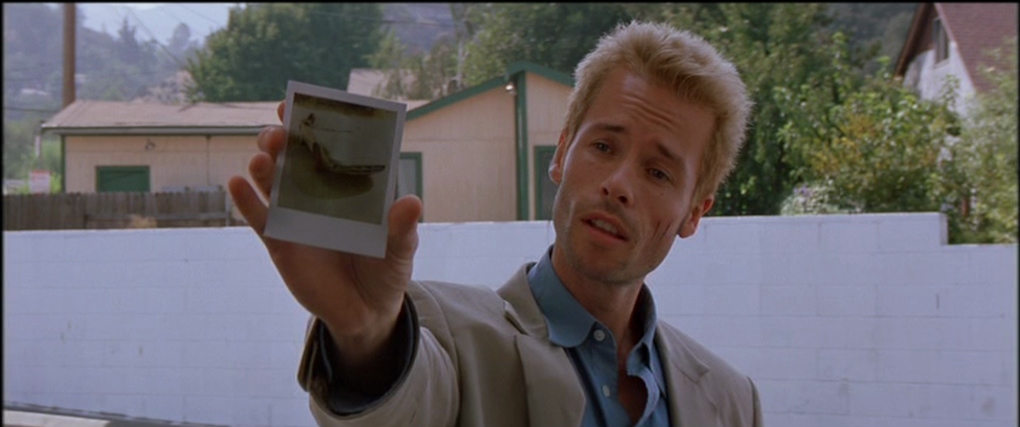
We, as spectators, form a hypothesis about motive and sequence, then revise it when later scenes change which cues are reliable. This is narration as controlled uncertainty, where comprehension and judgment are continuously rebuilt (Bordwell 1985).
Rear Window (1954) shows how restricted access can create suspense through inference under limitation. The spectator learns the courtyard through repeated observation, then learns to treat small movements as clues.
The film also teaches a second lesson: looking can be wrong. Suspense grows because the spectator’s predictions are always based on partial access, and the film keeps testing the line between evidence and noise.
Jaws (1975) shows how emotion can be guided when the threat is mostly unseen. Music, pacing, and repeated “approach” cues invite prediction before the film confirms danger.
The spectator’s fear is built through delayed confirmation, where expectation rises faster than information. For a technique-level bridge into this mechanism, see suspense in film.
Common Misconceptions
One misconception is that cognitive film theory requires neuroscience or lab experiments. Some cognitive media research uses experiments, but much cognitive film scholarship is a close-reading method that explains viewing tasks through film form. The key requirement is not laboratory measurement. The key requirement is a clear chain from cue to inference to appraisal.
A second misconception is that cognitive approaches treat spectators as cold problem-solvers. Many cognitive theorists treat emotion as part of comprehension because evaluation shapes what feels important. Work on character engagement shows how films guide alignment, sympathy, and moral judgment through controlled access and emphasis (Smith 1995; Plantinga 2009). A practical bridge term here is empathy, since empathy can describe understanding a character’s state without demanding agreement with that character.
A third misconception is that cognitive film theory only fits classical Hollywood clarity. Cognitive analysis can also explain modernist fragmentation and puzzle narration. The difference is that the analysis must describe how the film signals uncertainty and how it teaches the spectator what kind of inference work is expected in that film.
A fourth misconception is that cognitive analysis bans interpretation. It does not. It asks the critic to earn interpretation by showing how the spectator is guided toward it through form. Interpretation becomes stronger when it is built on a visible account of narration, emphasis, and timing.
Key Debates and Scholarly Criticism
One major debate is about method and evidence. Supporters argue that cognitive approaches produce tighter claims because they specify a spectator task and tie it to cue patterns that can be checked in the scene. Critics argue that “plausible viewing” can slide into overconfidence, especially when claims about perception or emotion are presented as general truths without historical or cultural qualification. Plantinga’s appraisal of cognitivism is useful here because it treats the tradition as valuable while still pressing for clearer standards and clearer limits (Plantinga 2002).
A second debate concerns ideology, difference, and institutions of viewing. Psychoanalytic and ideological traditions often argue that spectatorship cannot be explained adequately without accounts of desire, power, and social positioning. From that angle, cognitive models can become too focused on comprehension while neglecting how gender, race, class, and exhibition contexts help train what “reads as normal” on screen. Mulvey’s work remains a central reference point for this critique because it links cinematic looking to gendered power and pleasure (Mulvey 1975).
Cognitive scholars respond in two common ways. One response is to argue that ideology critique still needs a mechanism account of how cues guide attention and judgment, since ideology does not enter the spectator’s experience without a route through form. Another response is to build more historically grounded cognitive analysis that treats schemas as learned and culturally shaped rather than universal.
A third debate concerns emotion models. Some cognitive accounts emphasize appraisal and narrative context, while other accounts place more weight on embodied response, arousal, and affective patterning through style (Grodal 1997; Plantinga 2009). This disagreement matters because it changes what counts as primary evidence. One analysis may emphasize stakes and moral judgment, while another may emphasize sound, rhythm, and sensation as the first driver of feeling.
These debates connect to the broader “post-theory” argument that film studies benefits from mid-level theories that match claims to evidence types. The goal is not to end theory. The goal is to build theories that say clearly what they explain, what they do not explain, and what counts as proof (Bordwell and Carroll 1996).
Quick Contrast With Related Theories
Psychoanalytic film theory often centers questions about desire, identification, and the way cinema can position the spectator through looking, fantasy, and unconscious structures. Its evidence often includes broad patterns of representation and claims about how the cinematic setup can support specific forms of identification (Metz 1982; Mulvey 1975).
Cognitive film theory more often centers questions about attention, inference, comprehension, and appraisal. Its evidence standard stays close to cues and information order, especially at the scene level. For a nearby framework that also focuses on spectatorship and positioning but uses a different conceptual vocabulary and history, see apparatus theory.
Why It Still Matters
Cognitive film theory still matters because it trains a mechanism-based style of analysis that many students need for academic writing. The method helps replace general statements with evidence-first explanation. Instead of saying a scene is tense, the analysis can show how tension is built through restricted knowledge, prediction points, and delayed confirmation.
The approach also remains useful for contemporary viewing because spectators still perform the same basic tasks across platforms. Viewers still track space, infer intention, and evaluate stakes, even when the viewing situation shifts from cinema to streaming. At the same time, the limits remain clear. Cognitive models become thin when they ignore historical context, cultural difference, and institutions of viewing that help form schemas and expectations.
In practice, the strongest student work often uses cognitive method as a foundation. It explains how the film guides attention and inference first, then connects that mechanism to larger interpretive claims about character, genre, ideology, or ethics.
Summing Up
Cognitive film theory explains film viewing as guided mental work. Films place cues in image, sound, performance, and editing order. Spectators use those cues to build a model of the scene, predict outcomes, and evaluate stakes, which helps explain both comprehension and emotion.
The approach also sits in active debate with psychoanalytic and ideological traditions. That debate is useful for students because it forces a clearer match between question, method, and evidence. Cognitive film theory offers strong tools for scene-level explanation, while other frameworks press questions about desire, power, and history that require different kinds of evidence.
Read Next: Curious how film theory shapes the way we watch movies?
Start with the Film Theory section to break down realism, formalism, structuralism, and more — with examples from iconic films.
If you want studying film theory I recommend starting with The FilmDaft overview of film theory discourses to break down realism, formalism, structuralism, and more — with examples from iconic films.
Then explore the full Film History, Theory & Genre collection to see how movements, styles, and storytelling traditions have evolved.
Whether you’re into Soviet montage or 2000s genre mashups, there’s something here to sharpen your understanding.
Cognitive Film Theory FAQ
What is cognitive film theory?
An approach that studies how viewers actively make sense of a film — noticing cues, following the story, and forming and testing expectations — using ideas from cognitive psychology rather than the unconscious.
Who founded cognitive film theory?
David Bordwell and Noël Carroll, in the late 1980s, along with Edward Branigan. Later figures include Torben Grodal and Murray Smith.
How does cognitive film theory differ from psychoanalytic theory?
Psychoanalytic theory sees the viewer as shaped by unconscious desire, while cognitive theory sees an active, rational spectator consciously building meaning from the film’s cues.
What is the “active spectator”?
Bordwell’s idea that the viewer is like an architect, constantly gathering cues and forming hypotheses to make the film make sense — a process that continues even after the film ends.
What does cognitive film theory say about emotion?
Theorists like Torben Grodal and Murray Smith argue that emotion is part of understanding a film: we align with characters, simulate their situations, and respond to structure — not just to unconscious triggers.
References
The references below use Chicago Author-Date style and include primary cognitive texts, major debate collections, and peer-reviewed scholarship on cognition and emotion in film.
- Anderson, Joseph D. 1996. The Reality of Illusion: An Ecological Approach to Cognitive Film Theory. Carbondale: Southern Illinois University Press.
- Bordwell, David. 1985. Narration in the Fiction Film. Madison: University of Wisconsin Press.
- Bordwell, David. 1989. Making Meaning: Inference and Rhetoric in the Interpretation of Cinema. Cambridge, MA: Harvard University Press.
- Bordwell, David, Janet Staiger, and Kristin Thompson. 1985. The Classical Hollywood Cinema: Film Style and Mode of Production to 1960. New York: Columbia University Press.
- Bordwell, David, and Noël Carroll, eds. 1996. Post-Theory: Reconstructing Film Studies. Madison: University of Wisconsin Press.
- Carroll, Noël. 1988. Mystifying Movies: Fads and Fallacies in Contemporary Film Theory. New York: Columbia University Press.
- Grodal, Torben Kragh. 1997. Moving Pictures: A New Theory of Film Genres, Feelings, and Cognition. Oxford: Clarendon Press.
- Metz, Christian. 1982. The Imaginary Signifier: Psychoanalysis and the Cinema. Translated by Celia Britton, Annwyl Williams, Ben Brewster, and Alfred Guzzetti. Bloomington: Indiana University Press.
- Mulvey, Laura. 1975. “Visual Pleasure and Narrative Cinema.” Screen 16 (3): 6–18.
- Nannicelli, Ted, and Paul Taberham, eds. 2014. Cognitive Media Theory. New York: Routledge.
- Plantinga, Carl. 2002. “Cognitive Film Theory: An Insider’s Appraisal.” Cinémas 12 (2): 15–37.
- Plantinga, Carl. 2006. “Cognitive Theory in Film Studies: Three Recent Books.” College Literature 33 (1): 215–224.
- Plantinga, Carl. 2009. Moving Viewers: American Film and the Spectator’s Experience. Berkeley: University of California Press.
- Smith, Murray. 1995. Engaging Characters: Fiction, Emotion, and the Cinema. Oxford: Clarendon Press.
