Published: October 15, 2025 | Last Updated: January 5, 2026

What is Stream of consciousness in Writing? Definition & Meaning
Stream of consciousness is a writing technique that shows a character’s thoughts in real time, often in a loose, flowing, and unfiltered style. Writing this way mimics how people actually think. Thoughts come in fragments, with repetition, emotion, and shifting focus. Stream of consciousness can feel intimate because you stay close to a character’s private mind. It can also feel confusing if the passage has no clear anchors. The goal is a mental flow that feels real while you still understand where the character is and what is happening around them.
Definition and Scope
Stream of consciousness is about how a mind moves, not only what a character thinks. The technique matters most when you show association, interruption, and drift in a way that matches the character’s mental rhythm.
What it can include
A stream can carry inner speech, sensory impressions, stray memories, unfinished logic, and repeated phrases. A character can think in full sentences for a moment, then drop into fragments when stress rises or attention breaks.
Where the term “stream of consciousness” comes from (Bain → James → Sinclair)
The phrase stream of consciousness didn’t begin as a literary label. It started as a psychological metaphor and only later became a critical term for modernist fiction.
Alexander Bain (1855): the earliest printed use
Scottish philosopher and psychologist Alexander Bain used the phrase in The Senses and the Intellect (1855), describing how sensations from different senses can run together in “one common stream of consciousness.”
William James (1890): popularizes the metaphor
The expression is most commonly associated with William James, who developed the “stream” image in The Principles of Psychology (1890). James argues that consciousness doesn’t feel neatly segmented. In his words, it “does not appear to itself as chopped up in bits … it flows,” and a “river” or “stream” is the most natural metaphor for it.
May Sinclair (1918): the first major literary application
The leap from psychology to literary criticism is usually credited to the novelist and critic May Sinclair. In April 1918, writing in The Egoist, Sinclair applied the term to Dorothy Richardson’s Pilgrimage, helping establish “stream of consciousness” as a way to describe modernist narrative technique.
Interestingly, Richardson herself reportedly called it a “lamentably ill-chosen metaphor”, a reminder that the label is critical shorthand, not a strict rulebook for how minds work on the page.
Building Blocks of Stream of Consciousness: What to Look for and Use
Stream of consciousness has recognizable signals. You do not need every signal at once, but you do need a sense that the prose follows attention shifts as they happen.
- Associative leaps that jump because of a private link, such as a sound that triggers a memory.
- Sensory intrusion where light, heat, pressure, or noise interrupts a thought mid-line.
- Fragmented syntax that drops subjects, shortens clauses, or breaks sentences to match speed.
- Repetition where a word, image, or fear returns because the character cannot let it go.
- Time drift where the present triggers a flash of the past, and the narration returns without formal setup.
Direct vs. indirect stream of consciousness
Most writers control how raw the stream feels. You can push close to unfiltered thought, or you can keep grammar steadier while the association chain stays active.
| Approach | On-page effect | A strong use case |
|---|---|---|
| Direct stream | More fragments, fewer clean transitions, and heavier reliance on sensation and repetition. | Panic, obsession, intoxication, insomnia, grief spikes. |
| Indirect stream | More grammatical control, with thoughts that still pivot through association and drift. | Long stretches of daily life, reflective walks, quiet tension. |
Stream of Consciousness vs. Nearby Techniques
Several techniques can put you inside a character’s inner life. The differences matter because they change how much structure you keep and how much explanation you provide.
| Technique | What you experience | What it usually prioritizes |
|---|---|---|
| Stream of consciousness | A moving chain of thought, sensation, and association, with time drift and repetition. | Attention shifts and mental texture. |
| Internal monologue | Private thought in clearer sentences, often closer to inner speech than raw attention. | Clarity of reasoning and decision-making. |
| Free indirect discourse | Third-person narration that carries the character’s phrasing and bias. | Character voice with stable grammar. |
| Voice-over (film) | A spoken inner voice layered over image and action. | Access to thought while the scene stays visual. |
A quick test helps when you edit. If the passage reads like a clean speech, it usually sits closer to an internal monologue. If the line order follows attention shifts, interruptions, and associative links, it sits closer to stream of consciousness.
How to Write It Without Losing Clarity
Stream of consciousness reads best when you control it on purpose. You can keep the raw feel and still guide the reader through the moment with simple anchors and repeatable checks.
A practical workflow
The steps below work for fiction drafts and for planning a film version of the same mental effect.
- Choose a present anchor. Pick a concrete detail that stays in the present, such as a buzzing light, a vibrating phone, or a hand on a door handle.
- Choose a trigger. Pick the first thing that pushes the mind off course, such as a sound, a smell, or a line of dialogue.
- Choose a loop. Decide what the mind returns to, such as a fear, a craving, a shame trigger, or a missing detail the character keeps replaying.
- Write the association chain. Let each line connect to the next through a private link. Keep the links legible through repeated words, repeated images, or repeated sounds.
- Do an orientation pass. Add small reminders of place and action so you never lose the body in the room.
A short example passage
This original passage shows how an anchor and a loop can keep a stream readable while the mind still jumps.
The phone vibrates again. It rattles the mug. The spoon clicks, and the click turns into last night for half a second, then the hallway light, then the message I refuse to open. The kettle ticks. I count the ticks. I miss one. I miss another. I should answer. My hand moves toward the screen, and my hand stops, and my chest tightens like I did something wrong already.
How to translate it into a screenplay page
Screenplays need clean readability because the page coordinates production. You can still plan a stream-of-consciousness effect with clear action, clear sound cues, and simple voice-over placement.
These FilmDaft pages help you keep the page professional while you plan subjective moments: action lines, sound effects formatting, and pre-lap.
How Film Creates a Stream-of-Consciousness Effect
Film cannot place inner text on the page in the same way a novel can. Film translates thought into craft choices that guide what you see, what you hear, and how time connects across cuts.
| Mental effect | Film craft choices that often create it | Useful FilmDaft references |
|---|---|---|
| Association jump | Cut from one object or sound to a memory that shares a link; keep the link consistent across the cut. | jump cut, montage |
| Continuity of thought across locations | Carry audio over the cut so one mental thread stays alive while the image changes. | sound bridge, sound design |
| Sensory overload | Stack close-ups, textured Foley, harsh ambience, and rhythmic edits so the body leads the experience. | Foley, diegetic vs. non-diegetic sound |
| Subjective filtering | Hold close to what the character notices; limit information the character ignores; let framing bias the scene. | subjective cinema, point of view |
How stream of consciousness works in practice (quick breakdowns)
“Stream of consciousness” isn’t just a character thinking. It’s a way of structuring perception—letting attention, association, and sensation control what comes next, even when that produces fragments, loops, and sudden jumps.
Film Examples Explained at Scene Level
These films show three different ways to express inner flow on screen. Each example names the craft move, explains how it works in the scene, and explains why it reads as stream of consciousness.
Eternal Sunshine of the Spotless Mind (2004, Focus Features)
The film creates a stream-of-consciousness feeling by letting emotional association rewrite space. As Joel’s memories are erased, scenes don’t just cut from one memory to the next; the locations themselves break down or transform mid-moment. The world behaves like a mind under pressure: doors open into the wrong room, faces blur, sets collapse, and chronology becomes secondary to the character’s desperate attempt to hold onto feeling.
If you want a single “SoC in film” micro-example: the story’s memory-escape sequences work because the film follows where Joel’s attention runs, not where a plot outline says the camera “should” go.

Michel Gondry turns memory into a location you move through. Joel lies under a machine during the procedure, and the film cuts into his memories with transitions that feel like mental drift. A room can shift mid-action, and a detail can vanish while Joel still reacts to it.
The anchor stays consistent: Joel’s attempt to hold on to Clementine. The scene logic follows that emotional goal. The film keeps his reaction readable through performance and framing, and the sound often carries continuity even when space does not.
Requiem for a Dream (2000, Artisan Entertainment)
Here, the “stream” is largely built from rhythm: rapid, repeated editing patterns and sensory punctuation that mimic compulsive thought loops. The film’s famous quick-cut consumption sequences (often called “hip-hop montage”) turn physical actions into a mental refrain: desire → ritual → spike → crash. Over time, the repetition stops feeling stylish and starts feeling trapped, like a mind stuck replaying the same urge with less and less control.
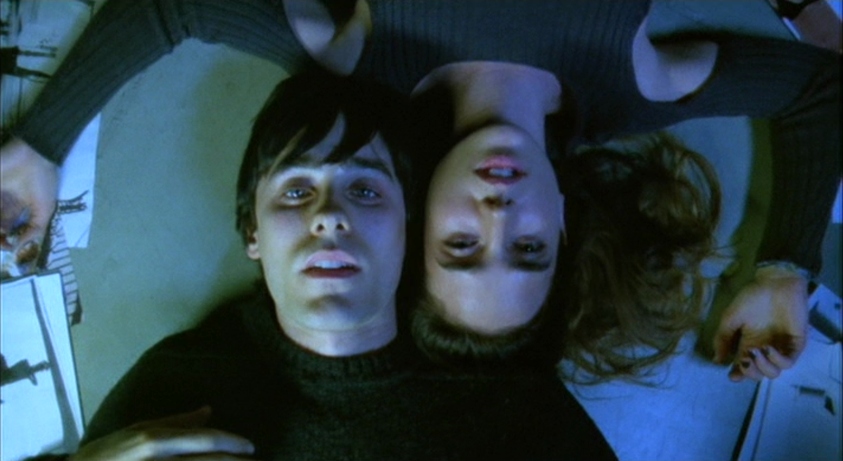
Darren Aronofsky builds inner experience through repetition and rhythm. The film repeats short patterns of shots and sounds during drug use. The repeats create a loop that feels compulsive, and the loop grows harsher as the characters lose control.
The technique works because the pattern is consistent. The edit rhythm becomes a mental signature. When the pattern speeds up, your body reads the stress before any character explains it.
Taxi Driver (1976, Columbia Pictures)
Martin Scorsese uses a diary-style voice-over to keep you close to Travis Bickle’s private narration as he drives through the city. The voice repeats judgments and fixations, and the repetition becomes a loop that narrows how Travis sees the world.
The film supports the inner voice through subjective filtering. Scenes often hold on to Travis’s gaze, and his reactions, and the city becomes a constant pressure around him. The result feels like a mind circling the same ideas while the outside world keeps moving.
Literature Examples You Can Recognize
Modernist fiction made stream of consciousness widely known because it treated inner life as primary narrative material. These examples show different levels of grammatical control while the association chain stays active.
Mrs Dalloway (1925) by Virginia Woolf
Woolf’s signature move is the soft pivot: a present-moment detail (a sound in the street, a social glance, a passing object) tilts the narration into memory or emotion without announcing the switch. The effect feels continuous (like walking through a city while your mind keeps drifting into private history) because Woolf lets the trigger (the sensory cue) stay visible even as the character’s thoughts wander.
Virginia Woolf stays close to perception while she keeps the physical world present. Clarissa walks through London, and small triggers open memories and private emotions. The street remains a steady anchor, so the mind can drift without losing location.
The video below is a compact way to see how Woolf links present detail to inner drift through quick pivots in attention.
Ulysses (1922) by James Joyce
Joyce often pushes the technique into maximal “mind-simulation.” Instead of tidy transitions, thoughts arrive as associative chain reactions: a word or image sparks another, which sparks another, with fewer guardrails from conventional punctuation or explanatory narration. The result can feel breathless, funny, anxious, and intimate, because the prose is engineered to mimic attention bouncing faster than logic can tidy it.
James Joyce pushes closer to direct immersion. The prose can run long, shift tone mid-thought, and lean on association more than explanation. The famous final section follows a private chain of memory, desire, and self-argument with minimal formal breaks.
The audio below gives you a useful feel for Joyce’s cadence and how his language stays close to thought rhythm.
The Sound and the Fury (1929) by William Faulkner
Faulkner frequently makes time feel unstable on purpose. A character’s consciousness moves through the present while memory interrupts like a force, collapsing years into a single paragraph. The disorientation isn’t a bug; it’s the point: the reader experiences how trauma, obsession, or grief can make the mind relive rather than merely “remember.”
William Faulkner uses time drift and sensory triggers to reflect a mind that does not organize experience in a stable timeline. Present details can snap into memory with little warning. The method becomes clearer when you track repeated triggers and return points.
The video below offers a quick overview of how Faulkner uses perception and time drift as a structural tool.
Takeaway: In prose, stream of consciousness often comes from sentence logic and associative drift. In film, it usually comes from subjective structure: editing, sound, rhythm, and the way space/time behave according to a character’s inner state.
Common Problems and Practical Fixes
Stream of consciousness usually fails for the same structural reasons. Each fix below keeps the voice subjective while you keep orientation and cause-and-effect legible.
| Problem | Why it happens | A practical fix | Revision check |
|---|---|---|---|
| The passage feels random | The association links are hidden, and the line order has no repeatable pattern. | Add a loop that returns through repeated words, repeated images, or repeated sounds. | Underline the repeated element. If you cannot find one, the passage needs a stronger loop. |
| You lose place and action | The stream leaves the room and never returns to a concrete present detail. | Add a present anchor that returns every few lines. | Circle the anchor. If it appears once, add at least two more returns. |
| The voice turns into explanation | The character summarizes feelings instead of reacting in real time. | Replace summary with sensation and immediate reaction. Keep the diction specific to the character. | Mark abstract words. Replace them with concrete perception or a specific fear. |
| Time drift becomes confusing | Memory shifts arrive without a clear trigger. | Attach each shift to a trigger, such as a sound, smell, or repeated phrase. | Note the trigger at each shift. If the trigger is missing, add one. |
| The passage stalls the scene | The inner flow has no deadline or interruption. | Attach the stream to an external pressure, such as a knock, a timer, a train arrival, or a phone buzz. | Identify the pressure in one sentence. If it does not exist, add one. |
Summing Up
Stream of consciousness follows attention as it moves through thought, sensation, memory, and association. On the page, you control the technique through anchors, loops, and syntax choices. On screen, you translate it into voice-over, sound design, and edit logic that follows association.
Read Next: Want to dig deeper into screenwriting?
Start with the Screenwriter’s Toolkit on literary devices vs. elements – a deep resource covering every major literary device and element used in writing.
Then explore our collection of practical writing techniques covering dialogue, structure, and pacing.
Or jump into the free screenwriting course to start your first draft today.
You can also head back to the Screenwriting section for more tools, theory, and breakdowns.