

Published: April 14, 2025 | Last Updated: January 15, 2026

What is RHETORIC? Definition & Meaning
Rhetoric is the art of persuasive communication (spoken or written) designed to influence, inform, or motivate. It appeals to logic (logos), emotion (pathos), and credibility (ethos). Originally developed in ancient Greece, rhetoric is still used in politics, advertising, law, media, and everyday conversation to shape opinion and move people to act.
Where rhetoric comes from
Rhetoric dates back to ancient Greece, where it evolved as a civic skill during the rise of democracy. Philosophers like Aristotle and Plato debated their ethics and power. Aristotle broke it into three primary appeals: ethos (credibility), logos (logic), and pathos (emotion).
At its core, rhetoric was about public speaking—used to argue in court, sway voters, or defend ideas in philosophical debate. It wasn’t just about style. It was about winning an audience.
The three types of rhetorical appeals
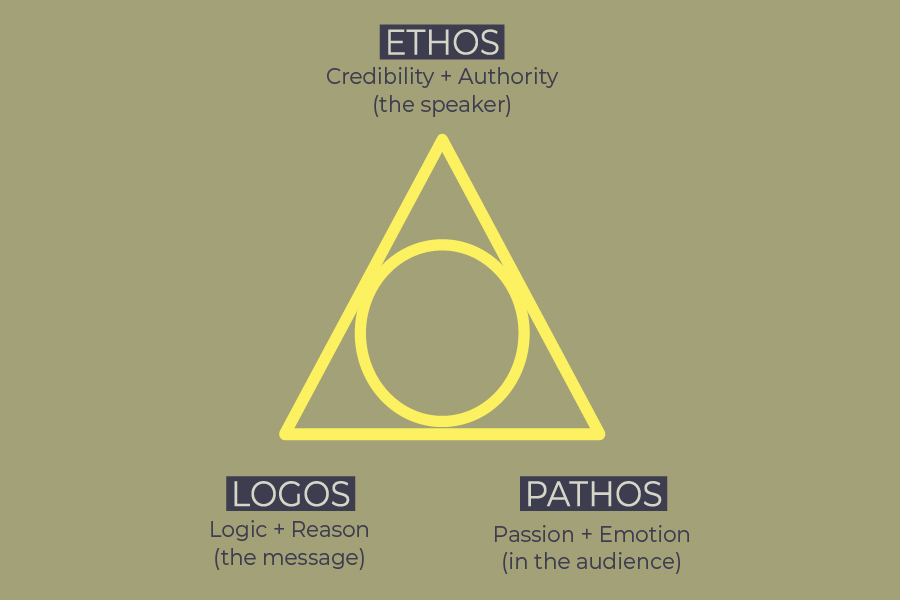
Ethos (credibility)
Ethos is how a speaker builds trust. It can come from experience, tone, or authority. If the audience believes the speaker is qualified or honest, they’re more likely to listen. For example, a doctor speaking on healthcare reform carries more weight than a random blogger.
Logos (logic)
Logos is the use of facts, data, and clear reasoning. Think of courtroom arguments or scientific debates—when ideas are structured and evidence-driven, they appeal to logic. Logos is effective because it gives people something concrete to hold onto.
Pathos (emotion)
Pathos appeals to feelings—fear, joy, anger, empathy. It’s the most powerful and the most volatile. When Martin Luther King Jr. repeats, “I have a dream,” he’s using pathos to create hope and urgency. When an ad shows a suffering child to raise donations, that’s pathos, too. I’ve covered how he also deliberately used anaphora to drive the point home.
Rhetorical Toolkit: How Arguments Actually Work
Understanding rhetoric isn’t just about knowing ethos, pathos, and logos. Effective arguments also depend on context, timing, and technique. This toolkit shows the most important concepts writers, speakers, and storytellers actually use.
Kairos (Timing and Opportunity)
Kairos refers to when an argument is made — the right moment, mood, or cultural situation.
Example:
- A climate documentary released immediately after a natural disaster gains emotional urgency.
- The same message released years later may feel abstract or ineffective.
Why it matters:
Even strong arguments fail if the timing is wrong. Great rhetoric meets the audience when they’re most receptive.
The Rhetorical Situation
Every argument exists within a rhetorical situation, made up of three elements:
- Exigence: The problem or issue that demands a response
- Audience: Who the argument is for (and what they value)
- Constraints: Limitations like time, format, culture, or expectations
Example:
A film trailer must persuade in under three minutes (constraint), target a specific demographic (audience), and respond to market competition (exigence).
Why it matters:
Ignoring any one of these leads to arguments that feel tone-deaf or ineffective.
Common Rhetorical Devices
These are practical tools that shape how language sounds and sticks.
Anaphora (Repetition at the Start)
Repeating a phrase at the beginning of successive clauses.
We will fight on the beaches. We will fight on the landing grounds.
Effect: Builds rhythm, emphasis, and emotional momentum.
Antithesis (Contrasting Ideas)
Placing opposing ideas side by side.
This is not the end. It is the beginning.
Effect: Sharpens meaning through contrast.
Parallelism (Balanced Structure)
Using the same grammatical structure repeatedly.
To laugh together, to fear together, to hope together.
Effect: Makes arguments feel deliberate, elegant, and memorable.
How rhetoric is used today
Modern rhetoric appears everywhere, from TikTok videos to presidential debates. It’s the backbone of public relations, political campaigns, brand messaging, and activist speeches. When politicians say “We must act now,” they use pathos. When an expert says “Studies show…,” that’s logos. And when a speaker reminds us of their record, they lean on ethos.
Rhetoric doesn’t always mean manipulation. It’s a neutral tool. But when used carelessly or dishonestly, it can shape misinformation. That’s why understanding how it works matters.
Rhetoric in Action: Micro-Annotated Examples
Below are short examples broken down to show how rhetoric works — not just what it is.
Example 1: Emotional Appeal (Pathos)
Quote:
“If we fail, future generations will pay the price.”
Label: Pathos
Why it works: It shifts the stakes from the present to innocent future victims, triggering responsibility and fear.
When it fails: If overused, it can feel manipulative or alarmist without evidence.
Example 2: Credibility (Ethos)
Quote:
I’ve spent 20 years working in emergency medicine.
Label: Ethos
Why it works: Establishes authority and lived experience.
When it fails: If the expertise isn’t relevant to the claim being made.
Example 3: Logic (Logos)
Quote:
If production costs drop and demand rises, prices will increase.
Label: Logos
Why it works: Follows a recognizable cause-and-effect structure.
When it fails: If assumptions are hidden or unsupported.
Examples of great rhetorical speeches
Martin Luther King Jr. — “I Have a Dream”
King uses all three appeals: ethos, which refers to his moral authority as a minister; logos, which refers to the Constitution and justice; and pathos, which involves vivid imagery and emotional repetition. The result is a speech that still moves people decades later.
Susan B. Anthony — “On Women’s Right to Vote”
After being arrested for voting in 1872, Anthony made her case using logos and ethos. She quoted the Constitution and argued that denying women the vote violated their citizen rights. The speech became a landmark moment in suffrage history.
When Rhetoric Becomes Manipulation
Rhetoric isn’t inherently good or bad — but it can be misused. Recognizing weak or dishonest arguments is just as important as crafting strong ones.
Common Manipulative Patterns
- Oversimplification: Reducing complex issues to false binaries
- Emotional overload: Using fear or outrage without evidence
- False authority: Citing unnamed “experts” or irrelevant credentials
Basic Logical Fallacies to Watch For
- Straw Man: Misrepresenting an opponent’s argument
- Ad Hominem: Attacking the person instead of the claim
- False Cause: Assuming correlation equals causation
Why this matters:
Spotting these patterns helps audiences resist persuasion that sounds convincing but lacks substance.
How Rhetoric Shapes Film, Trailers, and Marketing
Rhetoric is everywhere in visual storytelling — especially in how films are pitched, framed, and sold.
Screenwriting
- Ethos: A morally grounded protagonist earns audience trust
- Pathos: Stakes are framed around loss, love, or identity
- Logos: Cause-and-effect plotting makes character choices feel earned
See also How to Use the Rhetorical Appeals in Your Script for Film and Advertising
Example:
A character’s sacrifice feels meaningful because the script logically builds the consequences of not acting.
Film Trailers
Trailers are compressed rhetorical arguments:
- Exigence: “Why this film matters now”
- Kairos: Release timing tied to culture, seasons, or events
- Pathos: Music cues, pacing, and visual contrast
Example:
Slow piano covers in trailers reframe action films as emotional dramas.
Film Marketing & Posters
- Antithesis: Light vs. dark imagery
- Parallelism: Repeated taglines across platforms
- Visual rhetoric: Color, framing, and symbolism guide interpretation
A single poster can function as a complete argument about tone, genre, and audience.
Why rhetoric still matters
Every debate, pitch, essay, ad, screenplay, or video script uses rhetoric—whether you realize it or not. The better you understand persuasion, the less likely you are to be manipulated. You’ll also write and speak more clearly.
Rhetoric sharpens thought. It forces you to consider who you’re speaking to, what they care about, and how best to reach them. In that sense, it’s less about arguing and more about understanding.
Summing up
Rhetoric is the art of persuasion through speech and writing. Whether you’re appealing to logic, emotion, or credibility, the goal is to connect, convince, and communicate with purpose. From ancient philosophers to modern movements, rhetoric shapes how ideas spread—and how history turns.
Read Next: Want your dialogue to sound less flat?
Head to our Dialogue section for tips on writing natural conversations, crafting subtext, and using voice to make each character feel distinct.
For more screenwriting tools, visit the Screenwriting archive for structure, formatting, and concept guides that support every stage of your script.
Further Reading and Sources
For readers who want to go deeper into rhetoric and argumentation:
- Aristotle, Rhetoric — MIT Classics (W. Rhys Roberts translation)
- Purdue Online Writing Lab – Rhetoric and Argumentation — Using Rhetorical Strategies for Persuasion (Ethos/Pathos/Logos)
- Harvard College Writing Center – Rhetorical Analysis — Writing Resources (Harvard College Writing Center)
- University of North Carolina Writing Center – Argument — Argument (UNC Writing Center)
- Stanford Encyclopedia of Philosophy – Rhetoric — Aristotle’s Rhetoric (Stanford Encyclopedia of Philosophy)
