

Published: October 10, 2025 | Last Updated: July 4, 2026

What is Hypophora? Definition & Meaning
Hypophora is a rhetorical device where a speaker or writer asks a question and then immediately answers it. You’ll find it in narration, speeches, dialogue, and character monologues. The word hypophora comes from the Greek hypophora, meaning “carrying under” or “proposing and replying.”
Why Writers Use Hypophora

Why would a speaker ask a question they already intend to answer? Because it helps control the conversation (pun intended!). Hypophora anticipates what others are thinking and provides the answer before doubt can form.
It also shapes pacing. A sharp question followed by a clear answer gives the audience a mental pause before redirecting their focus. The pattern becomes familiar and easy to follow.
In speeches or narration (such as voiceovers), hypophora is often used to transition between ideas or emphasize a shift in logic.
Writers also use hypophora to simulate thought. It can make a character sound reflective, persuasive, or deliberate, especially when the answer seems spontaneous or revealing.
Difference from Rhetorical Questions
Don’t confuse hypophora with a rhetorical question. A rhetorical question is asked without expecting an answer. Hypophora includes the answer directly after the question.
Below, I’ve found three examples from The Dark Knight (2008) that shows the difference.
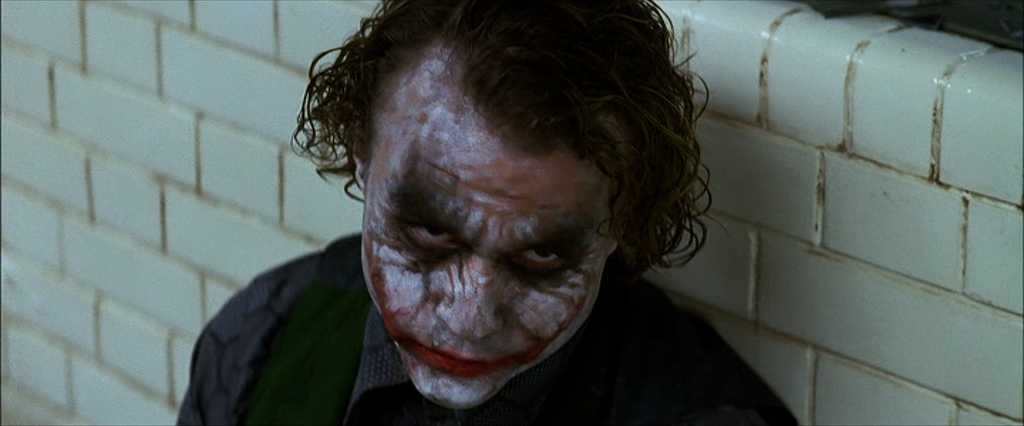
Example (rhetorical question): “Why so serious?” — Joker, in The Dark Knight (2008)
Example (hypophora): “You know what I noticed? Nobody panics when things go ‘according to plan.’ Even if the plan is horrifying.” — Joker, in The Dark Knight (2008)
Example of both in one sentence: “Do I really look like a guy with a plan?” — a rhetorical question. Then follows with, “You know what I am? I’m a dog chasing cars.” — a hypophora, where he answers his own question. — Joker, in The Dark Knight (2008)
Historical and Literary Examples
Hypophora isn’t limited to film. It has a long tradition in speeches, plays, and literature. Speakers use it to frame big ideas, lead the audience toward a conclusion, or control the rhythm of their argument. These classic examples show how the device works in public discourse and dramatic writing.
Winston Churchill: “You ask, what is our aim? I can answer in one word: Victory. Victory at all costs—Victory in spite of all terror—Victory, however long and hard the road may be…” — Speech to House of Commons, 13 May 1940
Martin Luther King Jr.: “There are those who are asking the devotees of civil rights, ‘When will you be satisfied?’ We can never be satisfied as long as the Negro is the victim of the unspeakable horrors of police brutality.” — I Have a Dream (1963)
Shakespeare, Henry IV, Part 1: “What is honour? A word. What is in that word honour? What is that honour? Air. A trim reckoning! Who hath it? He that died o’ Wednesday.” — Act V, Scene I
How to Use Hypophora in Screenwriting
In scripts, hypophora can reveal logic or emotion. It fits best in scenes where a character is working through a thought, either aloud or in voiceover. It’s often used in detective reasoning, political speeches, or internal narration.
For example: “Why did she run? Because she knew I’d find out the truth.” This kind of phrasing lets the character guide the viewer’s understanding without resorting to exposition or backstory.
Use it when you want clarity or control. The question focuses attention. The answer provides closure.
Hypophora and Anthypophora
Classical rhetoricians like Quintilian used hypophora to describe a speaker who raises a question and then answers it to clarify a point.
While some prefer to call the answer portion anthypophora, most modern usage treats hypophora as the full question‑answer device.
Summing Up
Hypophora is a question followed by a direct answer. It helps characters explain logic, reveal thought, and guide the audience. In film, literature, and speeches, it adds clarity and rhythm when used with purpose.
Hypophora FAQ
What is hypophora?
A rhetorical device in which a speaker raises a question and then immediately answers it themselves, often within the same breath.
What is an example of hypophora?
“Why should we invest in renewable energy? Because it is sustainable and cuts emissions.” The speaker poses the question and answers it directly.
What is the difference between hypophora and a rhetorical question?
A rhetorical question is left unanswered — its answer is only implied — while hypophora is answered directly by the speaker.
What is anthypophora?
Strictly, anthypophora is the answer part of a hypophora (the question is the hypophora). In practice, the two terms are often used interchangeably.
Why do writers use hypophora?
To guide the audience’s thinking, anticipate their questions, and control the flow of an argument — useful in speeches, essays, and film monologues.
Read Next: Want to dig deeper into screenwriting?
Start with the Screenwriter’s Toolkit on literary devices vs. elements – a deep resource covering every major literary device and element used in writing.
Then explore our collection of practical writing techniques covering dialogue, structure, and pacing.
Or jump into the free screenwriting course to start your first draft today.
You can also head back to the Screenwriting section for more tools, theory, and breakdowns.
