
Published: April 23, 2026

Italian director and screenwriter Federico Fellini never studied psychology, but he spent decades in Jungian analysis, and the collaboration shaped everything he made. His dream sequences do not look like Freudian symptoms or surrealist provocations. They look like remembered dreams: specific, emotionally coherent, visually strange in ways that feel true to how the dreaming mind actually works. Getting that quality onto film required a set of production and directorial techniques that are worth understanding on their own terms.
Fellini’s Dream Sequences: Style, Technique, and Meaning
Fellini’s dream sequences are the passages in his films where the boundary between conscious experience and unconscious imagery dissolves, producing scenes that follow a different logic from the narrative surrounding them. They appear throughout his career but reach their fullest development in 8½ (1963) and Amarcord (1973), where they are not interruptions to the story but its emotional core. Fellini built these sequences through a combination of controlled production design, unconventional casting, and a rehearsal approach that allowed space for the unexpected. The result is not surrealism in the conventional sense: Fellini was not a surrealist and did not work by automatism or chance. His films are a carefully constructed language for depicting the interior life.
His method could be described as “autobiographical mythmaking”: using the materials of personal memory and unconscious imagery to construct a cinema that transcends private reference and becomes universally legible. The craft question is how Fellini achieved that universality from materials so specific to his own experience.
8½: The Architecture of a Director’s Inner World
8½ is Fellini’s most explicitly self-referential film and the one where his dream technique is most fully developed. The film’s protagonist, Guido Anselmi, is a film director who cannot make his film. His waking life is a series of meetings, obligations, and creative anxieties. His dream life is an elaborate, ritually charged space where the women and figures from his past recur in transformed form. The film moves between these two registers without warning, and the transitions are the technique.
The Opening Dream
The film begins in a dream. Guido is trapped in a car in a traffic jam, the air thickening with smoke. He floats upward through the sunroof, rises above the cars and roads, and into open sky, then is yanked back by a rope attached to his ankle, held by a figure on the beach below. He wakes in a health spa. The sequence is only a few minutes long, but it establishes the film’s central metaphor (the creative mind escaping and being recalled) and introduces its visual grammar.
Cinematographer Gianni Di Venanzo shot the dream sequences in 8½ with a different visual texture from the waking scenes, using softer lighting and a slightly different depth of field. The effect is subtle: you do not immediately register that you are in a dream, but the image feels different from what surrounds it. By the time the sequences become more explicitly oneiric, you have already learned to read the visual register. This is teaching us grammar before asking us to use it.
The Harem Sequence
The film’s most extended dream is the harem sequence, in which Guido imagines all the women in his life living together in harmonious submission to his desires. The sequence begins as wish fulfillment and gradually reveals its anxiety: the women eventually revolt, Guido is forced upstairs with a whip, and the fantasy collapses into its own critique. Fellini stages this as spectacle, using the full resources of Cinecittà studios to build an environment of scale and colour that contrasts with the naturalistic locations of the waking sequences.
The mise-en-scène here is deliberately artificial: the set looks like a set, the lighting is theatrical, the costumes are exaggerated. Fellini is not trying to convince you that this is real. He is staging a psychodrama, and the theatrical artifice signals that you are watching a performance of the unconscious rather than a representation of external reality. This distinction matters: Fellini’s dreams are not illusions designed to deceive the viewer but constructions designed to be legible as constructions.
The Final Parade

The film ends with Guido resolving his creative block by accepting the chaos of his inner life and imagining all the figures from his past joining hands in a circular parade on a beach. This sequence shifts registers entirely: from the psychological drama of the harem and the anxious realism of the spa scenes to something closer to a vision. Nino Rota’s music shifts into a circus march, the lighting opens up, and the film achieves a moment of integration that its protagonist has been seeking throughout.
What makes this ending work is that Fellini earns it through the film’s structure. The parade is not imposed from outside as a resolution. It emerges from the visual logic the film has established: the beach location recurs, the figures recur, and the music recurs in transformed form. The non-diegetic score has been building toward this key since the opening dream, and when it arrives, the emotional release is prepared for, even if its specific form is surprising.
Amarcord: Memory as Dream
Amarcord (the title is Romagnolo dialect for “I remember”) operates on a different premise from 8½. Where 8½ stages the interior life of a specific individual, Amarcord stages the collective memory of a community: the Adriatic village of Borgo San Giuliano in the 1930s, thinly disguised as Rimini, where Fellini grew up. The film is structured as a series of episodes connected by season and memory rather than by narrative causality, and its most striking sequences operate at the border between remembered event and imaginative reconstruction.
The Peacock in the Snow
Midway through the film, during the winter episode, a peacock appears in the main square and spreads its tail in the snow. No explanation is offered for why a peacock is in the square. No character reacts with surprise. The peacock is simply there, its extravagant plumage improbably vivid against the grey and white of the winter scene, and then it is gone. This is Fellini’s memory working: the peacock probably did appear in the square once, in the kind of unlikely real event that lodges in a child’s memory precisely because it makes no sense. By reproducing it without explanation, Fellini recreates the texture of that memory rather than its meaning.
Cinematographer Giuseppe Rotunno, who shot Amarcord, lit the peacock scene to emphasize the colour contrast between the bird and the snow. The production design kept the square simple and grey so that the peacock’s colours read as an intrusion rather than a background. This is controlled spectacle: every visual element in the frame exists to make the peacock more improbable and therefore more memorable.
The Ocean Liner
The film’s most celebrated sequence has the entire village rowing out into the fog to watch a vast ocean liner pass through the harbour. The liner is impossibly large for the harbour, its lights blazing in the darkness, its horn a sound from another world. The villagers watch in silence. Then it is gone. The sequence operates as pure image: no dialogue, no narrative function, just the experience of something overwhelmingly large and beautiful appearing briefly and vanishing.
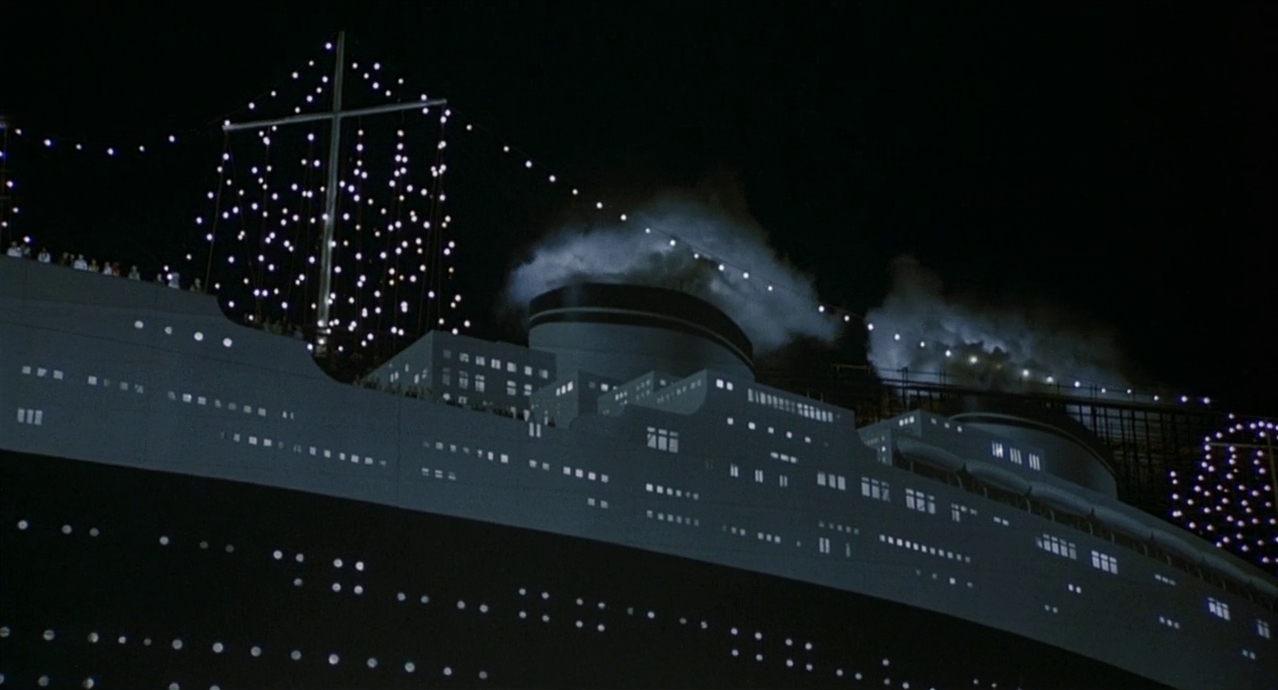
Fellini built the ocean liner as a forced-perspective model, lit from below and photographed through fog machines to create the impression of scale. The technique is essentially the same as what Mario Bava was doing in Italian horror cinema with miniatures and atmospheric effects. But where Bava used these tricks to create dread, Fellini uses them to create awe. The sensation of encountering something beyond normal scale is common to both; what differs is the emotional valence the filmmaker assigns to that sensation.
How Fellini Built His Dream Sequences
Fellini worked almost exclusively at Cinecittà studios throughout his mature career, and the choice was deliberate. Location shooting would have anchored his films in the specificity of real places. Studio shooting gave him control over every visual element in the frame, which was essential for sequences where the visual environment needed to express interior states rather than document exterior ones. His production designer, Danilo Donati (on Amarcord and later films), built sets that were simultaneously specific and archetypal: they look like real places while also looking like the idea of those places, as memories look when you return to them years later.
Casting for Psychological Resonance
Fellini cast his films through an elaborate process of interviews and screen tests that was partly practical and partly intuitive. He was looking for faces that carried some quality he recognised, often unable to articulate exactly what. The result is a repertory of performers whose physical presence carries an almost archetypal weight: Anouk Aimée’s cool intelligence, Sandra Milo’s earthy warmth, the specifically Italian faces of the Amarcord villagers. In the dream sequences, these faces recur in transformed contexts, carrying their established qualities into situations where those qualities produce unexpected effects.
Nino Rota and Musical Memory
Fellini’s collaboration with composer Nino Rota was essential to the dream sequences’ emotional coherence. Rota’s scores, particularly for 8½ and Amarcord, work through a principle of musical memory: themes introduced in waking sequences recur in transformed form in the dream passages, so the music itself enacts the relationship between conscious experience and unconscious processing. When the circus march returns at the end of 8½ in its full orchestral version, you recognise it without being able to say exactly where you heard it before, which is precisely how memory works in dreams.
Summing Up
Fellini built cinema’s most convincing and emotionally resonant dream sequences not by abandoning craft but by applying it to a different kind of problem. The techniques he used, controlled production design, theatrical lighting, musical leitmotifs, and casting for psychological resonance, are the same techniques available to any filmmaker. What he brought to them was a specific understanding of how memory and dreams actually feel from the inside, developed through decades of Jungian analysis, and an ability to translate that understanding into visual terms that other people could recognise as their own. That is the craft lesson: dreams in cinema work not when they look weird but when they feel true.
Read Next: Want to see theory in action?
Explore our full Film History, Theory & Genre hub to learn how movements, styles, and structure have shaped screen culture.
Then dive into our Case Studies & Analysis section for close reads of iconic films, scenes, and techniques—broken down with high school-friendly examples you can use in class or on set.
References
- Bondanella, Peter. 1992. The Cinema of Federico Fellini. Princeton: Princeton University Press.
- Kezich, Tullio. 2006. Federico Fellini: His Life and Work. New York: Faber and Faber.
- Marcus, Millicent. 1986. Italian Film in the Light of Neorealism. Princeton: Princeton University Press.
- Burke, Frank. 1996. Fellini’s Films: From Postwar to Postmodern. New York: Twayne.
- Bondanella, Peter. 2001. Italian Cinema: From Neorealism to the Present. 3rd ed. New York: Continuum.
- Fava, Claudio F., and Aldo Vigano. 1984. The Films of Federico Fellini. Secaucus, NJ: Citadel Press.
