

Published: March 1, 2026 | Last Updated: July 3, 2026

Overview
Ecocriticism in film studies is the critical analysis of how cinema represents, constructs, and participates in the natural environment. It asks a central question: what does this film do with the nonhuman world? The field — often called ecocinema studies — was shaped by scholars such as Sean Cubitt, Adrian Ivakhiv, Stephen Rust, and Salma Monani. That question covers far more than whether a film has green themes. It includes the visual language of landscape, the ecological ethics encoded in narrative, the physical resources consumed to make the film itself, and the cultural assumptions that shape how viewers understand nature, animals, and the planet.
You will encounter ecocriticism as a sub-field of film theory that emerged from literary ecocriticism in the 1990s and grew quickly into its own disciplinary field in the early 2000s. It sits alongside other political and cultural theories — feminist, Marxist, postcolonial — and often intersects with them. If you are studying films that deal with climate, land, species, environment, or industrial harm, ecocriticism gives you a rigorous set of tools for that analysis.
What is Ecocriticism as film theory? Definition & Meaning
Ecocriticism in film studies is the study of how cinema mediates the relationship between human culture and the nonhuman world. It examines how films represent landscapes, animals, ecosystems, and environmental crisis; how production practices produce ecological costs; and how the ideological content of films reinforces or challenges anthropocentrism — the assumption that human beings are the primary measure of value in the world.
Ecocriticism is not the same as environmental advocacy, though ecocritics often care deeply about the environment. The theory operates as an analytical method: it reads films for how they construct nature, not simply for whether they depict it accurately. A Hollywood disaster film and a slow art-cinema landscape study are both available for ecocritical reading, even though they differ enormously in ambition and form.
Key terms you need to know going in: anthropocentrism (placing humans at the center of meaning and moral concern); nonhuman (a preferred term for animals, plants, ecosystems, and material forces, used to avoid the implication that “human” is the default standard); and ecocinema, which refers both to films that foreground ecological concern and to film scholarship that uses an ecological analytical frame.
Historical Background
Ecocriticism as a named discipline originates in literary studies. Joseph Meeker introduced the concept he called “literary ecology” in The Comedy of Survival (1972), and the term “ecocriticism” itself was coined by William H. Rueckert in a 1978 essay on literature and ecology. The Association for the Study of Literature and Environment (ASLE) was founded in 1992 and began publishing the journal ISLE: Interdisciplinary Studies in Literature and Environment, which remains one of the primary venues for ecocritical scholarship. The landmark anthology edited by Cheryll Glotfelty and Harold Fromm, The Ecocriticism Reader (1996), consolidated the field in literary studies.
Ecocriticism enters film studies
Film scholars were slower to adopt the framework. Throughout the 1990s, environmental concerns in cinema were addressed mainly through reception studies and documentary criticism rather than systematic theoretical work.
Scott MacDonald, a film theorist with a background in literary ecocriticism, published several influential articles in the early 2000s and coined the term “ecocinema” in a 2004 essay, identifying experimental and avant-garde cinema as models for an ecologically attentive mode of spectatorship.
Pat Brereton’s Hollywood Utopia: Ecology in Contemporary American Cinema (2005) was among the first book-length studies to apply ecological thinking to mainstream film.
Sean Cubitt’s EcoMedia (2005) took a broader perspective, examining how media technologies both represent and participate in ecological systems, from wildlife documentary to Hollywood blockbuster.
The field crystallized in 2010 and 2013 with two foundational anthologies. Paula Willoquet-Maricondi edited Framing the World: Explorations in Ecocriticism and Film (2010), which brought together essays on ecocinema as activist practice, environmental justice, animal representation, and what the volume called “eco-auteurs.”
Stephen Rust, Salma Monani, and Sean Cubitt then co-edited Ecocinema Theory and Practice (2013), the first collection published in the prestigious AFI Film Readers series, marking ecocinema’s arrival as an established sub-field within academic film studies. A second expanded volume appeared in 2022, reflecting how substantially the field had grown in the intervening decade.
Core Mechanism: How Ecocritical Analysis Works
Ecocritical film analysis operates on at least two levels simultaneously: the textual and the material. Understanding both is essential to applying the theory with precision.
Ecocriticism readings at the textual level
At the textual level, an ecocritical reading examines how the film constructs nature through formal choices. This means tracking what happens to the nonhuman world within the frame, the edit, and the sound design. It asks whether landscapes appear as settings for human action or as active presences with their own weight and logic. It asks how animals are depicted — as spectacle, resource, symbol, or as something with genuine autonomy.
When a film consistently shoots nature from above, in a control-room aerial overview, it encodes a managerial relationship between human observer and land. When a film allows environmental sounds to dominate the mix without scoring them over with orchestral emotion, it opens a different sensory relationship between viewer and place. These are formal choices with ideological consequences.
Ecocriticism readings at the material level
At the material level, ecocriticism asks about the film as a physical object and industrial practice. Every film consumes energy: fuel for production vehicles, electricity for lights and monitors, materials for sets, infrastructure for distribution.
Nadia Bozak’s The Cinematic Footprint: Lights, Camera, Natural Resources (2012) traced what she called the “hydrocarbon imagination” in cinema — the deep entanglement of film history with fossil fuel energy (Bozak 2012).
Sean Cubitt extended this line of thinking in Finite Media: Environmental Implications of Digital Technologies (2017), arguing that digital media production carries its own enormous ecological costs in mining, manufacturing, and electronic waste (Cubitt 2017). This materialist strand of ecocriticism means that the environmental analysis of a film does not stop at the screen.
Together, these two levels — textual and material — give ecocriticism its distinctive scope. The theory refuses to treat cinema as a purely symbolic practice floating free of physical consequence. Films are made of the world, and they act on the world. Ecocriticism is the framework that makes both of those facts visible simultaneously.
What to Look For When Analyzing a Film Ecocritically
Before building an ecocritical argument, you need to train your attention on specific formal and thematic features across the film. This checklist is a starting point for close observation. Apply it to a short sequence of three to five minutes before scaling to the whole film. Working small keeps the evidence specific and prevents the analysis from drifting into vague thematic summary.
- Landscape framing: Does the film shoot nature from above (overview, control) or at eye-level and below (immersion, equality)? Does the frame contain the environment or let it exceed the frame?
- Nonhuman presence: Are animals, plants, or ecosystems treated as background or as presences with their own logic and duration on screen?
- Sound design: Does natural sound — wind, water, animal calls — come through clearly, or does orchestral scoring cover it? What does the film choose to hear?
- Narrative function of nature: Does the natural world serve human plot goals (resource, threat, backdrop, metaphor), or does it generate story logic of its own?
- Anthropocentrism: From whose perspective does the film organize its environmental concern? Is the nonhuman world understood through human emotional projection, or on its own terms?
- Duration and pacing: Does the film allow nonhuman time — the slow growth of a plant, the patience of an animal — to exist without narrative urgency, or does it always subordinate environment to human action?
- Environmental justice: Who bears the cost of ecological harm in the story? Does the film link environmental damage to race, class, or colonial history?
- Production context: What do you know about where and how the film was made? Does the production history complicate or enrich the on-screen environmental content?
Once you have worked through these observations on a specific sequence, the task is to turn your notes into an argument. Choose one or two of the strongest patterns you have noticed and build a claim around them.
A good ecocritical analysis paragraph moves from a specific formal observation — the way the camera holds on the river for thirty seconds without cutting — to a mechanism (this duration disrupts narrative urgency and grants the river its own temporal presence) and then to an implication for ideology or ethics (the film resists the tendency to see nature only as a setting for human feeling). That is the structure: observation, mechanism, implication.
Micro-Analysis: Princess Mononoke and the Ecology of Conflict
Hayao Miyazaki’s Princess Mononoke (1997) offers an unusually rich text for ecocritical analysis because it refuses to position the natural and the industrial worlds in simple moral opposition.

The film is set in late Muromachi Japan and follows Ashitaka, a young man afflicted by a curse from a dying boar god consumed by demonic rage. The rage, it turns out, originates from an iron ball fired by humans from Irontown, a fortified smelting settlement built and run by Lady Eboshi.
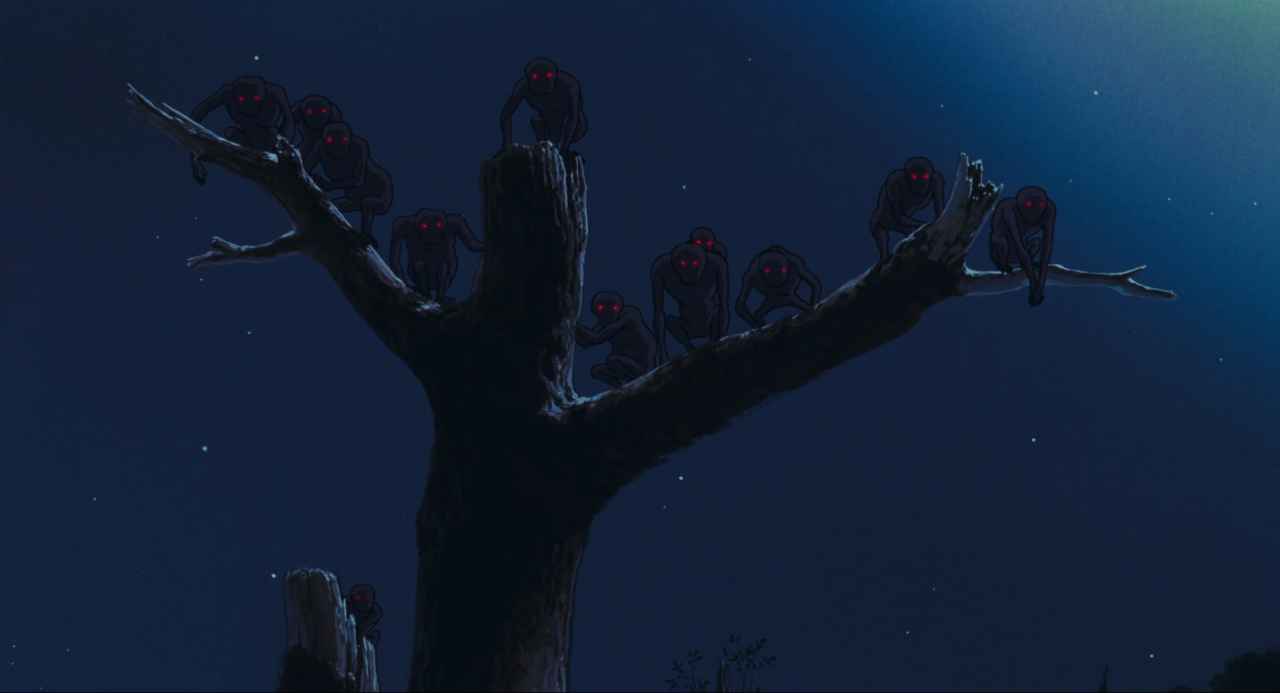
What makes the film ecocritically significant is how it distributes ecological agency. The forest is not simply a beautiful wilderness threatened by human greed. The forest gods are genuinely terrifying — the boar god who curses Ashitaka is driven to frenzy before it dies. The wolves and the wolf-raised human child San, are violent and relentless. The forest itself is organized around the Deer God, a figure whose power over life and death is both nourishing and devastating.

Ecocriticism trained in the tradition of deep ecology, which identifies the nonhuman world with benevolent natural wisdom, would find Princess Mononoke unsettling, because the film grants the nonhuman world genuine menace as well as beauty.
Miyazaki also refuses to make Lady Eboshi a villain in the conventional sense. Irontown shelters lepers and former sex workers, people excluded from the human social order, and it does so through the industrial transformation of the forest. The film makes the ecological destruction of Irontown visible — the stripped hillsides, the polluted rivers, the dying gods — while also showing who benefits from that destruction.

This is where ecocriticism connects to questions of environmental justice: the film asks the viewer to hold the ecological cost and the social benefit in tension simultaneously, without resolving the contradiction into a moral lesson. Adrian Ivakhiv’s process-relational approach to ecocinema, developed in Ecologies of the Moving Image (2013), is particularly useful here. Ivakhiv reads films in terms of the relations between geomorphic (landscape), anthropomorphic (character), and cosmomorphic (metaphysical) registers (Ivakhiv 2013). In Princess Mononoke, all three registers are fully active and pulling against each other.
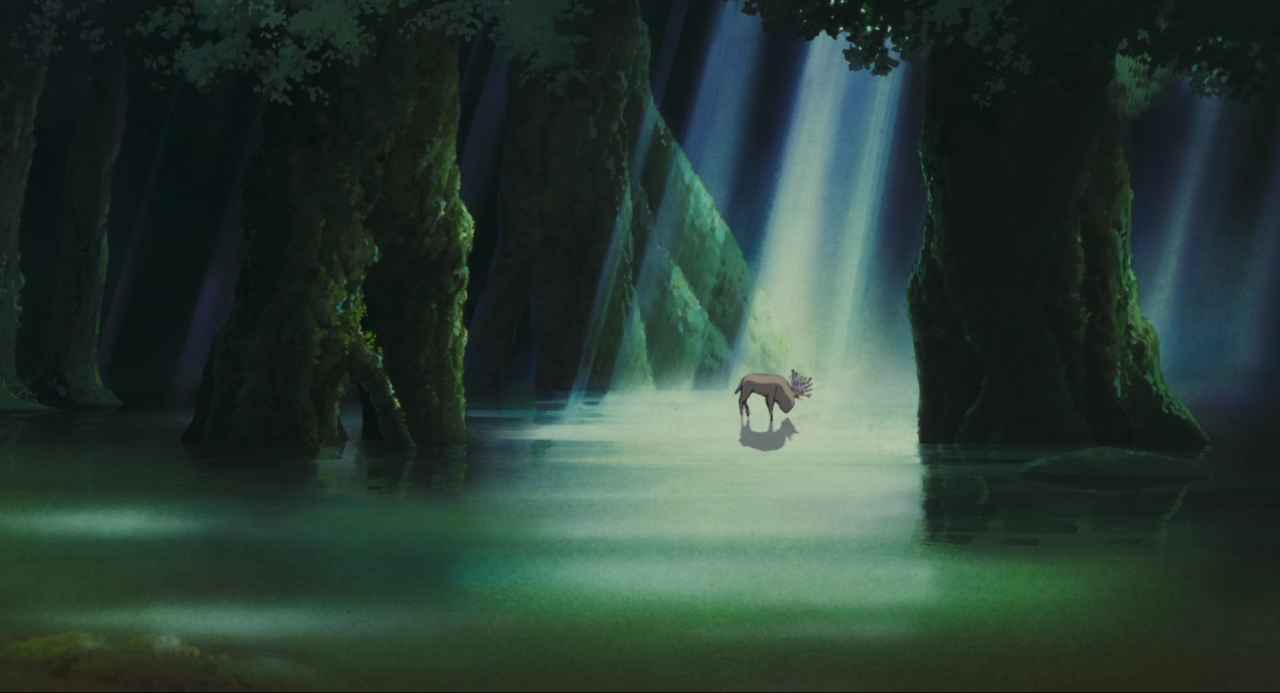
At the formal level, Miyazaki’s animation style grants the forest a visual density and specificity that resists the pastoral conventions of much Western nature imagery. The forest floor is cluttered, wet, and ambiguous. Light filters through the canopy in ways that feel ecologically observed rather than idealized. The forest god moves through the landscape with a genuinely strange gait — neither threatening nor peaceful, but simply other. This formal strangeness is the film doing what ecocritics call de-anthropomorphizing: giving nonhuman presence a form that does not map onto human emotional categories.
Additional Film Examples
Andrei Tarkovsky’s Stalker (1979) is one of the most discussed films in ecocinema scholarship precisely because its relationship to the natural world is indirect and phenomenologically strange. The Zone — a forbidden area of mysterious transformation — is not coded as a natural preserve threatened by industry. It is something stranger: a space where normal human categories of safe and dangerous, living and dead, meaningful and arbitrary, have broken down.
Ivakhiv’s extended analysis of Stalker, which appeared in a longer version of an essay later integrated into his book, reads the Zone as a site of what he calls “geomorphic” encounter — a confrontation with the landscape as an active, unknowable force that cannot be managed through narrative or argument. The film does not produce environmental messaging in any recognizable sense. It produces an experience of the world’s illegibility that is, for ecocinema scholars, itself a form of ecological ethics.
Werner Herzog’s Grizzly Man (2005)
Werner Herzog’s Grizzly Man (2005) is a documentary ecocinema study of a different kind. The film draws on footage shot by Timothy Treadwell, an amateur conservationist who lived among grizzly bears in Alaska for thirteen summers before being killed by one. Herzog’s commentary is famously non-pastoral: he refuses Treadwell’s belief in a loving mutual connection between himself and the bears, and in several key moments Herzog insists that he sees nothing in the bears’ eyes but “the blank stare of a creature whose habitat is violence and where animals are nothing but victims of a horrible battle.”
This is not standard environmentalist sentiment, and it makes Grizzly Man ecocritically interesting as a film that stages the confrontation between a human idealization of nature and the nonhuman world’s refusal of that idealization. Pat Brereton’s essay on the film in Ecocinema Theory and Practice addresses how Herzog’s own authorial voice produces a form of ecological realism that complicates easy identification with Treadwell’s project.
Apichatpong Weerasethakul’s Uncle Boonmee Who Can Recall His Past Lives (2010)
Apichatpong Weerasethakul’s Uncle Boonmee Who Can Recall His Past Lives (2010) is often cited in discussions of slow cinema and ecocriticism. The film moves with a deliberateness that refuses narrative urgency, and it integrates the Thai jungle, spirits, animals, and human memory into a single continuous fabric. Boundaries between the living and the dead, between human and animal forms, are permeable throughout.
This permeability is not metaphorical ornamentation. It reflects a cosmological framework drawn from Buddhist and animist traditions in which the nonhuman world is not a backdrop but an interpenetrating presence. Ecocritics working in the tradition of material ecocriticism, which emphasizes the agency of matter and the porousness of human-nonhuman boundaries, find Weerasethakul’s cinema a particularly strong example of what they call a de-anthropocentric aesthetic.
Approaches Within Ecocriticism
Ecocriticism is not a single theory but a field organized around several distinct and sometimes competing approaches. Understanding the main ones will help you choose the right analytical tools for a given film.
Textual or representational ecocriticism
Textual or representational ecocriticism focuses on what films depict: how they represent nature, what ideological positions they encode in their nature imagery, and whether they challenge or reproduce anthropocentrism. This is the most common entry-level approach and the one most accessible to close film analysis. It draws on the tradition of ideological criticism and asks: what assumptions about the human-nature relationship does this film naturalize?
Materialist ecocriticism
Materialist ecocriticism shifts attention from representation to production. Scholars working in this mode, including Cubitt and Bozak, examine the physical resources consumed by filmmaking — energy, water, rare earth minerals, fossil fuels — and the environmental cost of global film distribution and digital infrastructure. This approach can produce a genuinely unsettling argument: that a film with progressive environmental content was itself produced through environmentally destructive practices.
Postcolonial ecocriticism
Postcolonial ecocriticism is one of the most important developments in the field over the past two decades. It traces the relationship between colonial land appropriation and ecological destruction, and it asks whose environmental concerns get to count as legitimate.
Rob Nixon’s concept of “slow violence,” developed in Slow Violence and the Environmentalism of the Poor (2011), has been especially influential. Nixon defines slow violence as “a violence that occurs gradually and out of sight, a violence of delayed destruction that is dispersed across time and space” — destruction largely invisible to media cultures oriented toward dramatic, spectacular events (Nixon 2011).
Toxic waste dumping, groundwater contamination, deforestation — these unfold over decades and rarely produce the visual urgency that drives media attention. Postcolonial ecocriticism applied to film asks how cinema represents or fails to represent this slow violence, and whose suffering tends to be rendered visible or invisible in the process.
Ecofeminism
Ecofeminism in film studies connects the domination of nature to the domination of women, arguing that both are organized by the same logic of hierarchical dualism. Val Plumwood’s Feminism and the Mastery of Nature (1993) showed how Western rationalism constructs culture/nature, male/female, and reason/emotion as paired hierarchies in which the second term is always devalued (Plumwood 1993).
Carol J. Adams extended this to animal consumption in The Sexual Politics of Meat (1990). In film, ecofeminist analysis examines how narratives of penetration, control, and exploitation are applied simultaneously to landscapes and to women’s bodies — and looks for counter-examples that imagine a different relationship to both.
Slow cinema and ecocriticism
Slow cinema and ecocriticism is a more recent conversation within the field. Slow cinema — associated with directors like Weerasethakul, James Benning, Béla Tarr, and Carlos Reygadas — uses extended duration, long takes, minimal dialogue, and unhurried observation of landscape and environment. Ecocritics have argued that this formal mode itself constitutes an ecological stance: it trains the viewer to attend to nonhuman time, to resist the narrative compression that makes nature a backdrop, and to experience the world without the urgency of human plot logic. Scott MacDonald’s original definition of ecocinema as films that “model patience and mindfulness” drew on this tradition of observational cinema (MacDonald 2004).
Common Misconceptions
A very common mistake is to assume that ecocriticism only applies to films that are explicitly about the environment. This conflates the subject matter of a film with the analytical method. In fact, ecocriticism can be applied to any film, because all films have some relationship to the nonhuman world — even films set entirely in interiors make assumptions about the human-nature relationship through their use of space, materials, and framing. A thriller set in an urban landscape can be read ecocritically for how it treats urban ecology, what relationship it encodes between human-built environments and the living world, and who bears the cost of the city’s resource consumption.
Ecocriticism doesn’t equal green messaging
A second misconception is that ecocriticism is essentially a form of environmental advocacy or green messaging. This confuses the political commitments of many ecocritics with the analytical method itself. The method is designed to examine what films do, not only to celebrate films that promote environmental awareness.
Ecocriticism can produce a deeply critical reading of a film marketed as environmentally progressive, and it can find genuine ecological complexity in genre films that seem commercially mainstream. The confusion tends to arise because ecocritical scholars, like feminist and postcolonial scholars, often care about what they study. But caring about the environment does not mean the theory reduces to cheerleading for green content.
It’s not about being pro-nature or anti-nature
Third, students sometimes assume that the analysis ends with identifying whether a film is “pro-nature” or “anti-nature.” This is too blunt a distinction to produce serious analysis. Films like Princess Mononoke or Herzog’s Encounters at the End of the World (2007) resist easy classification because they hold contradictory environmental positions in productive tension. The strength of ecocritical analysis is its capacity to map that tension rather than resolve it.
Key Debates and Scholarly Criticism
One of the central debates in ecocriticism concerns the relationship between aesthetic pleasure and environmental politics. Writing in Ecocinema Theory and Practice, David Ingram diagnosed what he called a “schizophrenia” in eco-film criticism (Rust, Monani, and Cubitt 2013). The field is caught between two pulls: admiration for formally complex, aesthetically rich films — a James Benning long-take study of an industrial landscape, for example — and the activist desire to reach the largest possible audience with environmental messaging.
Do natural disaster movies shift public opinion on climate change?
A Roland Emmerich disaster film like The Day After Tomorrow (2004) reaches vastly more people than any art-cinema ecocinema work, and some ecocritics have argued that its spectacle of climate catastrophe, however scientifically distorted, does more to shift public affect on climate change than any number of formally rigorous experimental films.
Other scholars push back against this argument, contending that popular genre spectacle neutralizes environmental anxiety by packaging it as entertainment, producing a cathartic release rather than a call to action. The debate has not been resolved, and it remains one of the liveliest areas of ongoing disagreement in the field.
Is Ecocriticism too Western-oriented?
A second substantial line of criticism comes from scholars who argue that early ecocriticism was too focused on Western, largely American and European cinema, and that its foundational concepts — wilderness, pristine nature, deep ecology — were themselves products of a specifically Anglo-American tradition of environmental thought that had limited relevance outside that context.
Postcolonial ecocritics, including those working on what became the Transnational Ecocinema anthology (2013) edited by Pietari Kääpä and Tommy Gustafsson, argued that the field needed to engage seriously with national cinemas from the Global South, with indigenous filmmaking traditions, and with how ecological crisis and colonial history are structurally connected rather than parallel concerns.
This critique has reshaped the field substantially. Contemporary ecocinema scholarship is much more attentive to transnational contexts, indigenous knowledge systems, and the political economy of who gets to define what counts as an environmental crisis worth representing.
Quick Contrast: Ecocriticism and Postcolonial Theory
Ecocriticism and postcolonial theory are adjacent frameworks that share significant intellectual territory but begin from different questions.
Postcolonial theory asks, primarily, about the cultural, political, and representational legacy of European colonialism: how does colonial history continue to organize representation, identity, and power in cinema? Its central unit of analysis is the relationship between colonizer and colonized, center and margin, and its evidence tends to be drawn from narrative structure, character representation, and the politics of who gets to tell which stories.
Ecocriticism asks about the relationship between human culture and the nonhuman world, and its central analytical interest is in how that relationship is constructed, managed, or challenged in film form. Its evidence is more likely to include framing, duration, sound design, and the treatment of landscape as well as narrative.
Where they productively converge is precisely in postcolonial ecocriticism: the recognition that the exploitation of land and the exploitation of colonized peoples are not separate histories but the same history. Nixon’s slow violence, the environmental destruction of extractive industries in the Global South, the erasure of indigenous relationships to land — these are ecocritical concerns that cannot be addressed without the analytical tools of postcolonial theory. The most interesting scholarship in the field today tends to work in the space between both frameworks rather than treating them as alternatives.
Why Ecocriticism Still Matters
Ecocriticism is well-positioned in film studies at the current moment for several reasons that have nothing to do with academic fashion. The ecological crises now reshaping global conditions — climate change, biodiversity loss, toxic contamination, resource depletion — are producing a genuinely new body of cinema in response, from cli-fi genre films to experimental documentary to indigenous media-making. Scholars and students need analytical frameworks adequate to that body of work, and ecocriticism is, so far, the most developed framework available.
The theory is also genuinely productive across a wide range of film types and periods. It works on Hollywood blockbusters, art cinema, documentary, animation, experimental film, and national cinema traditions. It connects formal analysis — what the camera does — to questions of ideology, ethics, and political economy. That range makes it unusually flexible as a teaching tool.
Its limits are real and worth acknowledging. Ecocriticism can slide into a moralism that judges films against a predetermined standard of ecological virtue rather than reading them carefully. It is at its weakest when it becomes a checklist for pro-environment content rather than an analytical method for reading form.
It also risks producing a kind of wilderness romanticism that ignores urban ecology, working-class environmental experience, and the environmental costs of everyday life in ways that skew toward a middle-class, often Western conception of what the natural world looks like. The best ecocriticism today addresses those tendencies directly, and the field is more sophisticated and more politically accountable than it was two decades ago.
Summing Up
Ecocriticism in film studies asks what cinema does with the nonhuman world. It emerged from literary ecocriticism in the 1990s and became an established film studies sub-field by the early 2010s, consolidated by the anthologies of Willoquet-Maricondi (2010) and Rust, Monani, and Cubitt (2013). The theory operates on two levels simultaneously: textual analysis of how formal choices construct the human-nature relationship, and materialist analysis of the ecological costs embedded in film production itself.
Its five main strands — representational, materialist, postcolonial, ecofeminist, and slow-cinema approaches — each ask different questions and draw on different evidence. Applied with precision rather than reduced to green-content scoring, ecocriticism is among the most politically urgent and formally attentive analytical tools in contemporary film studies.
Read Next: Curious how film theory shapes the way we watch movies?
Start with the Film Theory section to break down realism, formalism, structuralism, and more — with examples from iconic films.
If you want studying film theory I recommend starting with The FilmDaft overview of film theory discourses to break down realism, formalism, structuralism, and more — with examples from iconic films.
Then explore the full Film History, Theory & Genre collection to see how movements, styles, and storytelling traditions have evolved.
Whether you’re into Soviet montage or 2000s genre mashups, there’s something here to sharpen your understanding.
Starter Readings
If you are new to ecocriticism, these five texts give you the clearest entry points into the field, arranged roughly from introductory to specialist.
Rust, Monani, and Cubitt, eds. — Ecocinema Theory and Practice (2013). The standard anthology for the field. Essays cover everything from wildlife documentary to avant-garde landscape film, and each comes with a further-reading list.
Willoquet-Maricondi, ed. — Framing the World (2010). Strong on the activist and justice dimensions of ecocinema. The introduction is one of the clearest short overviews of the field’s scope and stakes.
Nixon, Rob — Slow Violence and the Environmentalism of the Poor (2011). Essential for postcolonial ecocriticism. The concept of slow violence is now used across the field and beyond it.
Ivakhiv, Adrian J. — Ecologies of the Moving Image (2013). The most theoretically ambitious single-author study. Difficult in places, but the process-relational framework it develops is genuinely useful for formal analysis.
Cubitt, Sean — EcoMedia (2005). The earliest major book-length treatment of ecology and media. Good for understanding how the field positioned itself at the beginning.
Ecocriticism in Film FAQ
What is ecocriticism in film?
The study of how films represent nature and the environment — what a film does with the nonhuman world, and how cinema shapes our relationship with it.
What is ecocinema?
A branch of ecocriticism examining cinema’s environmental dimensions. Scholars argue that any film — not just nature documentaries — can be read ecocritically for its view of the natural world.
Who are the key ecocinema scholars?
Sean Cubitt and Adrian Ivakhiv, along with Stephen Rust and Salma Monani, editors of Ecocinema Theory and Practice.
What are examples of ecocritical films?
Documentaries like An Inconvenient Truth, but also fiction such as Princess Mononoke, Avatar, and Children of Men, which carry environmental themes even when they are not overtly “green.”
How do you do an ecocritical reading of a film?
Look at how the film frames landscape and animals, whether nature is background or an active force, what it implies about consumption and human dominance, and whose environmental interests it serves.
References
- Adams, Carol J., and Lori Gruen, eds. 2014. Ecofeminism: Feminist Intersections with Other Animals and the Earth. New York: Bloomsbury.
- Bozak, Nadia. 2012. The Cinematic Footprint: Lights, Camera, Natural Resources. New Brunswick: Rutgers University Press.
- Cubitt, Sean. 2005. EcoMedia. Amsterdam: Rodopi.
- Cubitt, Sean. 2017. Finite Media: Environmental Implications of Digital Technologies. Durham: Duke University Press.
- Ivakhiv, Adrian J. 2013. Ecologies of the Moving Image: Cinema, Affect, Nature. Waterloo: Wilfrid Laurier University Press.
- Kääpä, Pietari, and Tommy Gustafsson, eds. 2013. Transnational Ecocinema: Film Culture in an Era of Ecological Transformation. Bristol: Intellect Books.
- MacDonald, Scott. 2004. “Toward an Eco-Cinema.” Interdisciplinary Studies in Literature and Environment 11 (2): 107–132.
- Nixon, Rob. 2011. Slow Violence and the Environmentalism of the Poor. Cambridge: Harvard University Press.
- Plumwood, Val. 1993. Feminism and the Mastery of Nature. London: Routledge.
- Rust, Stephen, Salma Monani, and Sean Cubitt, eds. 2013. Ecocinema Theory and Practice. New York: Routledge.
- Willoquet-Maricondi, Paula, ed. 2010. Framing the World: Explorations in Ecocriticism and Film. Charlottesville: University of Virginia Press.
