

Published: April 22, 2026

A bone flies into the air. Cut. A spacecraft drifts silently through orbit. In one edit, Stanley Kubrick skipped four million years of human history, and it remains the most audacious time jump in cinema. That’s elliptical editing at its most extreme, but the technique works just as well across a single afternoon.
What Is Elliptical Editing? Definition and Meaning
Elliptical editing is a film editing technique that compresses time by cutting out the middle of an action or event, jumping from one point in time to a later point with no transition in between. The omitted period, the ellipsis, is implied rather than shown. The audience fills it in automatically, understanding that time has passed even though they never saw it pass.
It’s the opposite of slow-motion or prolonged tension. Where those techniques stretch time, elliptical editing collapses it, sometimes across seconds, sometimes across years. Used well, it’s one of the most emotionally efficient tools in cinema.
The Principle Behind the Technique
Film has always had a complicated relationship with time. Real time and screen time are different things, and the entire art of editing is partly the art of managing that difference. You can slow time down with close-ups and prolonged tension. You can speed it up with montage. And you can skip it entirely with an ellipsis.
The term comes from grammar: an ellipsis omits words that the reader can infer from context. Elliptical editing does the same thing with time. The viewer’s brain is very good at inferring what it hasn’t seen. You don’t need to show someone travelling from one city to another; a cut from an airport departure to a hotel room tells you everything. The omission is understood instantly.
David Bordwell, a film scholar and professor emeritus at the University of Wisconsin-Madison, describes this as the viewer’s ability to construct a “fabula”, the complete story, from the “syuzhet,” which is only the selected scenes the film actually shows. Elliptical editing exploits that gap aggressively. The less you show, the more the audience invests in imagining what happened in between.
The technique also affects pacing directly. Skipping over time speeds up the narrative, giving a film a sense of momentum and economy. Films that show every step of every process feel slow, even if the individual scenes are well-crafted. Films that know what to leave out feel propulsive.
Three Moments That Define the Technique
Let’s look at three good examples of elliptical editing in film.
2001: A Space Odyssey (1968): The Bone and the Satellite
Kubrick’s famous match cut is the purest example of what elliptical editing can do at its most ambitious. A prehistoric hominid throws a bone into the air. It spins. Cut to an orbiting spacecraft. The entire history of human technological development, fire, agriculture, industry, warfare, space travel, compressed into a single cut. The bone and the satellite are both tools of human violence and ingenuity; the edit makes the argument that nothing essential has changed.
What makes it work is the visual rhyme: both objects tumble in the same direction against a similarly clean background. The ellipsis is enormous, four million years, but the formal continuity between the two images makes the jump feel inevitable rather than jarring. You land in the future and immediately understand where you are.
Up (2009): The Married Life Sequence
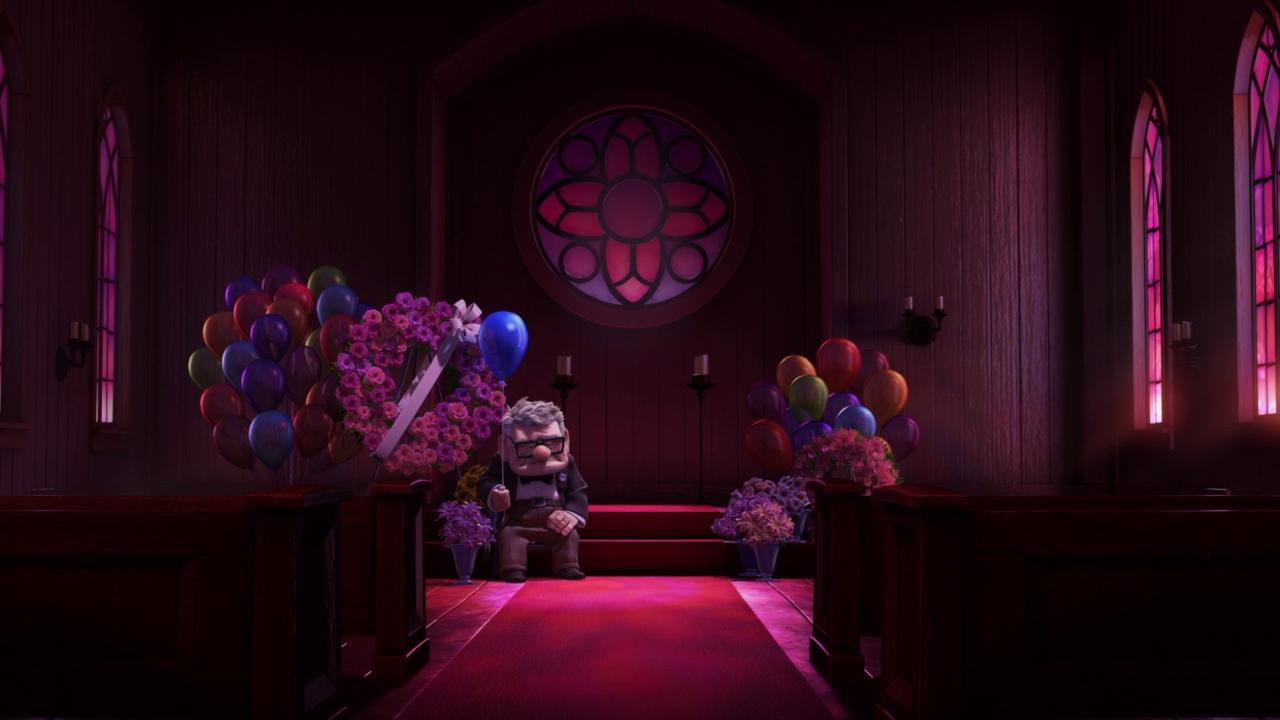
Pixar’s opening sequence uses elliptical editing to compress an entire marriage into four minutes. Carl and Ellie meet as children, fall in love, marry, build a life, face setbacks, grow old together, and Ellie dies, all without a single line of dialogue. The cuts jump across months and years, using visual shorthand (a pregnancy announcement, a hospital room, a shared chair) to tell you what happened between them without ever slowing down to show it directly.
The emotional weight of the sequence comes entirely from what’s left out. You don’t see the years of daily life, the ordinary conversations, the accumulated texture of a long marriage. You see its outline, and your brain fills it in from your own experience of time passing. The ellipses become containers for the viewer’s own feelings about love and loss. It’s one of the most affecting openings in American cinema, and it works entirely through omission.
Rocky (1976): The Training Montage
John G. Avildsen’s training sequence uses elliptical editing in a more functional but equally effective way: compressing weeks of preparation into a few minutes, showing Rocky progressing from a stumbling beginner to a fighter ready to go the distance. Each cut skips forward in time, showing a new stage of fitness, a new level of confidence.
The training montage became such a durable film convention precisely because elliptical editing makes it so efficient. You understand the passage of time, the accumulation of effort, and the character transformation without having to sit through any of it in real time. The transitions between shots do the narrative work that would otherwise require scenes.
Elliptical Editing vs. the Montage Sequence
The two techniques overlap but aren’t the same. A montage sequence compresses time through a rapid series of images, often with music carrying the emotional weight. Elliptical editing is more minimal, sometimes just a single cut that jumps forward in time, with no music or special treatment to signal the jump.
The bone-to-satellite cut in 2001 is elliptical but not a montage. The Up sequence is both: it uses elliptical editing within a montage structure. The Rocky training sequence is primarily a montage, but the individual cuts within it are elliptical. In practice, the distinction matters less than understanding what each technique is doing to time and why.
The Emotional Logic of Leaving Things Out
Elliptical editing can be purely functional. By that I mean that it gets you from A to C without wasting time on B. But the best uses of the technique do something more interesting: they make the gap itself meaningful.
When a film skips over something, it implicitly tells you that what was omitted is either too painful, too mundane, or too private to show. The Up sequence skips over the ordinary years of Carl and Ellie’s marriage, not because they weren’t important, but because ordinary happiness resists dramatic depiction, and because leaving it out forces you to imagine it yourself, which makes it more real than any scene could.
Karel Reisz, a British-Czech filmmaker and author of The Technique of Film Editing, observed that editing is fundamentally about selection: not showing what happened, but choosing what to reveal and what to withhold. Elliptical editing is the principle taken to its logical conclusion. The cut makes an argument about what matters and what doesn’t.
Using It in Your Own Work
The most common mistake with elliptical editing is not trusting the audience. Beginning filmmakers often feel obligated to show every step of a journey, every stage of a process, every link in the chain. But viewers are very good at inferring what they haven’t seen, and showing them everything removes the pleasure of inference.
Ask yourself: what is the minimum the audience needs to see in order to understand that time has passed and something has changed? Usually, it’s less than you think. A cut from a character packing their bags to the same character unpacking in a new city tells you everything about the journey without showing any of it. The gap is information.
The visual rhyme, matching some element across the two shots to bridge the ellipsis, helps enormously. Kubrick’s bone and satellite work because they share the same visual quality: a spinning object against a bright background. When the second image echoes the first, the jump in time feels motivated rather than arbitrary, and the viewer arrives in the new moment with a sense of having travelled rather than been teleported.
Summing Up
Elliptical editing is cinema’s most powerful argument for the value of leaving things out. From Kubrick’s four-million-year jump to Pixar’s silent compression of a lifetime, the technique works because viewers don’t need to see everything, but need to feel the shape of time passing, and a single well-chosen cut can do that better than any amount of footage. The gap is the point. Trust it.
Read Next: Want to sharpen your editing instincts?
Start with our breakdown of the different types of video editing and learn how each approach shapes tone and flow.
Then explore how film cuts function as visual punctuation, or how scene transitions control time, emotion, and rhythm.
Still curious? Browse the full Editing section for techniques, examples, and theory.
References
- Bordwell, David, and Kristin Thompson. 2010. Film Art: An Introduction. 9th ed. New York: McGraw-Hill.
- Murch, Walter. 2001. In the Blink of an Eye: A Perspective on Film Editing. 2nd ed. Los Angeles: Silman-James Press.
- Reisz, Karel, and Gavin Millar. 2010. The Technique of Film Editing. 2nd ed. Oxford: Focal Press.
- Eisenstein, Sergei. 1949. Film Form: Essays in Film Theory. Translated by Jay Leyda. New York: Harcourt Brace.
- Dmytryk, Edward. 1984. On Film Editing: An Introduction to the Art of Film Construction. Boston: Focal Press.
- Ondaatje, Michael. 2002. The Conversations: Walter Murch and the Art of Editing Film. New York: Knopf.
