

Published: March 9, 2025 | Last Updated: December 18, 2025

When Jim Jannard founded RED Digital Cinema in 2005, he had one goal: make high-quality digital cinema cameras affordable. At the time, shooting in 4K was a luxury reserved for big studios, but Jannard wanted to put that power into the hands of indie filmmakers.
The RED Camera Idea: Modular Cameras For Smaller Productions
The idea was simple but ambitious: build a modular camera system with raw, high-resolution capture at a price that wouldn’t bankrupt smaller productions. In 2006, at the NAB Show, RED unveiled the RED ONE, the world’s first affordable 4K cinema camera:
It didn’t take long for Hollywood to notice. Directors like Peter Jackson and Steven Soderbergh jumped on board, testing prototypes in real productions.
Jackson’s short film Crossing the Line and Soderbergh’s feature Che were among the first to prove that digital didn’t mean sacrificing quality. The RED ONE’s Mysterium 4K sensor was the key, delivering images that could match 35mm film. Plus, the REDCODE RAW format allowed storing high dynamic range footage without crazy file sizes.
From Concept to Reality: The RED ONE Era
The RED ONE (2007) wasn’t just a camera; it was a statement. Featuring the Mysterium sensor, it could shoot 4K RAW at 60 fps. Later upgrades like the Mysterium-X improved image quality even more. Cinematographers loved it because it offered the look of film with the convenience of digital.
David Fincher used it on The Girl with the Dragon Tattoo, taking advantage of the high resolution to reframe shots in post without losing quality. This flexibility was a game-changer.
The RED ONE’s success signaled a shift. No more scanning film to edit digitally—the whole process could stay digital from start to finish. By the time RED cameras were used on 25% of top-grossing digital features by 2016, the industry had changed for good.
Enter the DSMC Era: Epic and Scarlet
RED wasn’t done yet. In 2010, they introduced the Digital Stills and Motion Capture (DSMC) lineup, starting with the RED EPIC. With a new 5K sensor and modular design, it became a favorite on big productions.
Films like The Amazing Spider-Man and The Hobbit pushed the tech to its limits, capturing stunning visuals with flexible setups. The Scarlet line made 4K even more accessible, giving indie filmmakers a taste of Hollywood quality.
8K and Beyond: The Helium Era
In 2016, RED launched the Helium 8K sensor with the RED WEAPON 8K S35. This was next-level—8K at 30 fps with an insane amount of detail.
Marvel’s Guardians of the Galaxy Vol. 2 was one of the first films to use it, showing off its capability in both action and visual effects shots.
RED kept evolving with KOMODO, pushing the envelope for what crash cam could be. The Komodo quickly also became popular with run-and-gun small-scale productions (like what I do) and has become the first RED camera for many videographers and indie filmmakers.
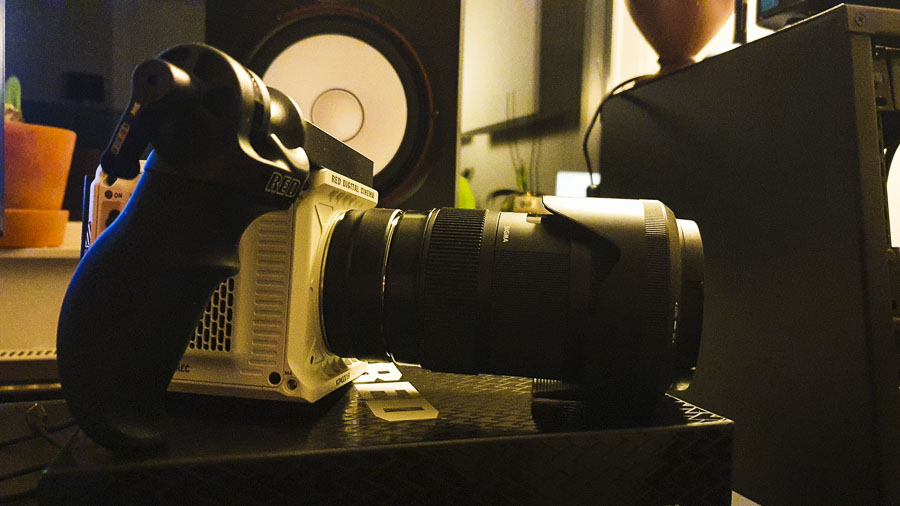
The Komodo uses Canon’s RF lenses, but it can also use EF lenses with an adapter.
After the success of the RED KOMODO, RED kept pushing the boundaries with the next generation of digital cinema cameras. First up was the KOMODO-X, which expanded on the original with a new 6K Super35 global shutter sensor. This meant sharper shadow detail and richer color depth, while also cranking up the frame rates—up to 80 fps in 6K and 120 fps in 4K. It also came with modern connectivity options like 12 G-SDI, USB-C, and built-in Wi-Fi for live streaming, making it more versatile on set.
Next came the V-RAPTOR series, which marked the beginning of RED’s DSMC3 platform. Unlike the KOMODO, the V-RAPTOR cameras are all about high resolution and speed. The V-RAPTOR 8K VV led the pack with its full-frame sensor capable of shooting 8K at up to 120 fps. This was followed by the V-RAPTOR XL 8K VV, which added internal ND filters and more I/O options for bigger productions. RED also dropped Super35 versions of the V-RAPTOR, bringing the same high-res capabilities to a smaller sensor format for those who prefer it.
Acquired by Nikon
In April 2024, Nikon acquired RED Digital Cinema, marking its entry into high-end digital filmmaking. The acquisition aimed to merge Nikon’s optical expertise with RED’s advanced digital cinema technology, potentially leading to innovative camera solutions that combine high-resolution capture with Nikon’s renowned lens systems.
Despite the ownership change, RED’s existing camera lineup remains intact, with plans to expand its capabilities under Nikon’s direction. I can’t help but wonder what this will mean for the RED brand in the future. It will probably mean the end of RED’s use of Canon mounts like the RF.
It seems this has already begun with the launch of the V-RAPTOR [X] and V-RAPTOR XL [X]. These models introduced global shutter sensors and—most notably—support for Nikon Z-mount lenses, signaling the first real integration of Nikon’s optics into RED’s cinema cameras. This partnership expanded lens compatibility and hinted at even tighter tech integration moving forward.
The Tech Behind the Magic
RED cameras aren’t just about resolution. It’s the REDCODE RAW that makes it all work. This unique compression method stores high-quality data in smaller file sizes, letting filmmakers keep every detail while maintaining manageable storage. Plus, the modular design means you can swap lenses, handles, and monitors without slowing down.
Summing Up
RED cameras didn’t just disrupt the industry—they redefined it. Hollywood blockbusters, indie films, and even NASA missions on the International Space Station have all used RED’s tech. Today, it’s not uncommon to see even small projects shot in 4K or 8K. That’s the RED effect—making pro-level production accessible to everyone.
Read Next: Want to learn more about cameras and how they shape your image?
Browse all camera-related articles, including camera types, sensors, resolution, and dynamic range.
Or return to the Cinematography section for lenses, lighting, framing, and more.
