

Published: October 15, 2025 | Last Updated: July 4, 2026

What is The golden ratio? Definition & Meaning
The golden ratio is a number (about 1.618) that helps you divide space in a way that feels naturally balanced. You’ll find it in art, design, photography, and film. It’s not a secret code or a rule you must follow. But it’s a useful tool for visual composition that can help you frame your shots, build layouts, and guide the viewer’s eye across the screen. The Greek letter φ (phi) is the standard symbol for the golden ratio.
How the Golden Ratio Works Visually

The golden ratio splits space into a 61.8% section and a 38.2% section. That comes from the number 1.618. If you place your subject about 61.8% from one side of the frame, it creates a strong visual balance. The larger side feels dominant, but not too heavy. It gives your shot a sense of flow and order.
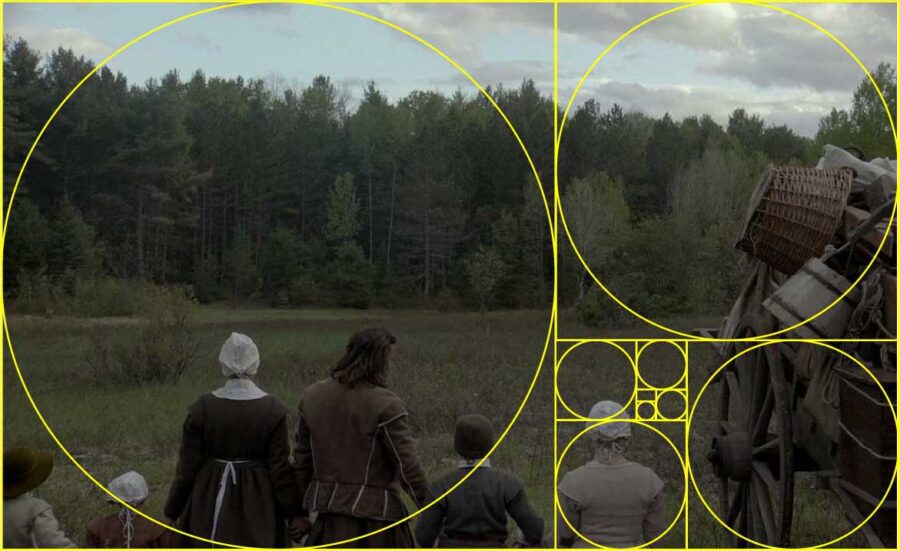
You can also use a golden spiral, which curves outward as it expands. If you place your subject where the spiral tightens, the viewer’s eye will start there and follow the curve through the rest of the image. This works especially well when leading focus from background to foreground.

Another option is to use a phi grid—a set of vertical and horizontal lines placed about 61.8% from the edges of the frame. This creates a layout based on the golden ratio and offers stronger balance than equal thirds.

Another option is to divide your frame using a golden grid, with vertical and horizontal lines placed about 61.8% from the edges. These points often feel more stable than the center or rule-of-thirds lines.
Where It Comes From
The golden ratio has been used for thousands of years. The Greek mathematician Euclid wrote about it in 300 BCE. During the Renaissance, it showed up in visual art, sculpture, and architecture, especially in a book called De divina proportione, illustrated by Leonardo da Vinci.
Today, you’ll find it in digital design, page layouts, product packaging, and film framing. But not everything beautiful follows this ratio, and not every use of it is intentional.
Using the Golden Ratio in Film
You don’t need to measure anything exactly. Most editing programs and camera tools can overlay a golden spiral or grid (see above). Use these guides to test your frame. Does the subject feel balanced at the 61.8% mark? Does the composition flow better along the spiral curve?
Editor Walter Murch once pointed out that the eyes in close-up shots often land near the golden ratio between chin and hairline. He found this pattern across many films, even when directors weren’t aiming for it. The framing just felt right.
See also Walter Murch’s Rule of Six for editing.
Common Misconceptions
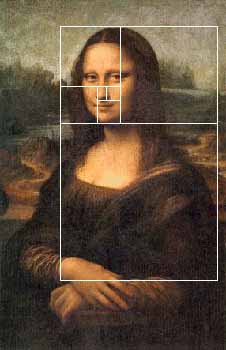
Some people claim the golden ratio shows up in the pyramids, the Parthenon, or the Mona Lisa. Others say it’s the key to facial beauty. These ideas are mostly myths. While φ appears in nature and geometry, many of the “perfect” examples fall apart when you measure them. Don’t chase the number, use the visual balance it suggests.
Summing Up
The golden ratio is a simple tool that divides space in a 1:1.618 ratio. That spacing can help your shots feel more balanced and natural. You’ll see it in spirals, grid overlays, and facial framing. Use it to test your composition, but only when it improves your image. If it doesn’t fit, leave it out.
Golden Ratio FAQ
What is the golden ratio?
A proportion of about 1.618:1 (phi) found throughout nature and art, thought to create especially harmonious, pleasing compositions.
How is the golden ratio used in film?
As a framing guide — placing key elements along the golden spiral or golden-section lines to create a natural, balanced flow through the frame.
What is the difference between the golden ratio and the rule of thirds?
The rule of thirds splits the frame into equal thirds (a simple approximation), while the golden ratio uses the 1.618 proportion for a subtler, more asymmetrical placement.
What is the golden spiral?
A spiral based on the golden ratio; composers place a focal point at its tightest curl to draw the eye there.
Is the golden ratio really more pleasing?
It is debated — many find it harmonious, but the rule of thirds is easier to use and often just as effective.
Read Next: Want to sharpen your eye for visual composition?
Start with the FilmDaft illustrated guide to visual composition or explore how mood and emotion shift with color psychology in cinematography.
Then browse all articles on framing, balance, symmetry, and spatial design — from leading lines to negative space.
Or return to the Cinematography section to explore lenses, lighting, and camera movement techniques.
