

Published: June 13, 2024 | Last Updated: December 18, 2025

What is Film gauge? Definition & Meaning
Film gauge is the width of a film strip, measured in millimeters. It affects the size and quality of the image. Common gauges include 8mm, 16mm, and 35mm, with 35mm being the standard for most movies. Smaller gauges are often used for home movies or amateur films, while larger gauges like 70mm offer higher resolution and are used for special presentations.
Why film gauge matters
A film’s image quality is directly influenced by its gauge. Larger gauges, like 35mm and 70mm, offer higher resolution, better depth of field, higher dynamic range, and richer color reproduction.
Conversely, smaller gauges such as 8mm and 16mm may exhibit more grain and lower resolution, which can be aesthetically desirable for certain artistic choices.
Cost and Practicality
The cost of film production varies significantly with film gauge. Smaller gauges are more economical, making them ideal for experimental and independent projects. Larger gauges, while more expensive, are preferred for major studio productions due to their superior quality.
The choice of gauge impacts the cost of film stock and the expenses associated with cameras, lenses, and post-production processes.
For example, 16mm made it possible to shoot handheld and be mobile, allowing for new film genres and film movements – such as Cinema verité – to emerge. In contrast, a 70mm IMAX is an entirely different beast that requires several people to operate the huge camera.
Early Film Gauges
The historical evolution of film gauges reflects advancements in technology and shifts in industry standards. Early cinema started with 19mm and 28mm gauges before settling on 35mm as the industry standard.
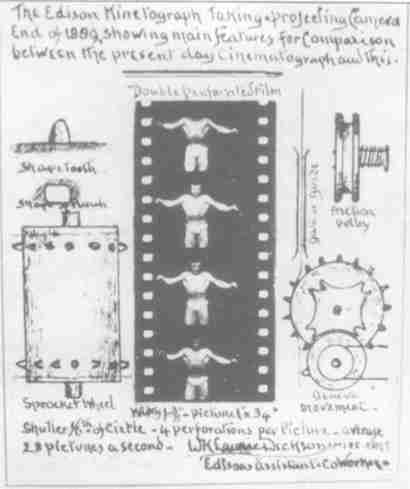
Source: William Kennedy Dickson and Thomas Edison, Public domain, via Wikimedia Commons
The film industry took off with 35mm film, introduced by Thomas Edison and William Kennedy Laurie Dickson in 1892. This gauge became the industry standard due to its balance between image quality and physical durability.
Notably, The Great Train Robbery (1903) used 35mm film, showcasing its early potential in narrative storytelling.
Even today, 35mm film is considered the standard gauge for professional filmmaking. It offers a high level of detail and color fidelity and balances quality with practicality, making it Hollywood’s most widely used film gauge.
The Rise of 16mm Film
In the 1920s, the 16mm film gauge emerged, primarily driven by the need for a more affordable and portable alternative to 35mm. Initially marketed to amateurs and educational institutions, 16mm film gained professional acceptance, especially for documentary and newsreel production.
For example, Nanook of the North (1922) was one of the pioneering documentaries shot on 16mm, highlighting its practical applications in remote locations.
The introduction of Super 16mm in 1969 enhanced this format by providing a wider image suitable for television and digital projection.
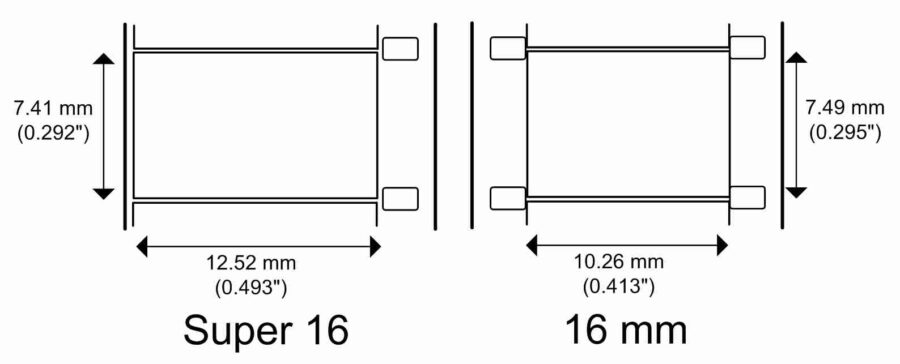
16 mm and Super 16 gauge sizes.
Source: Max Smith, Public domain, via Wikimedia Commons
The Advent of 8mm and Super 8 Film

Source: Nels Nielson, Public domain, via Wikimedia Commons
The 8mm film gauge, developed in the 1930s, further democratized filmmaking. Its compact size and ease of use made it popular among home movie enthusiasts.
However, it wasn’t until Kodak introduced the Super 8 film in 1965 that 8mm gained significant traction in professional circles. Super 8 offered improved image quality and sound recording capabilities, leading to its use in experimental films and even some low-budget features.

Source: Sergei, Public domain, via Wikimedia Commons
The Evil Dead (1981), directed by Sam Raimi, is a notable example of a film shot on Super 8, demonstrating its versatility and potential for creating compelling narratives.
The Impact of 70mm Film
70mm film, often called the “IMAX” format, provides unparalleled image resolution and widescreen capabilities. This format is used for epic films and special presentations, offering a visual experience that is both immersive and grandiose.
Due to its high production and projection costs, 70mm is less common but highly revered for special projects.
The 70mm film gauge was introduced in the mid-20th century and offered superior image clarity and a wider aspect ratio than smaller gauges.
This gauge was particularly popular for epic films and grandiose spectacles. Films like Lawrence of Arabia (1962) and 2001: A Space Odyssey (1968) use 70mm to create visually stunning, large-scale images. It’s also Christopher Nolan’s preferred gauge.
The Role of Digital in Film Gauge Evolution
The transition to digital cinematography in the late 20th and early 21st centuries marked a significant shift in the industry.
While digital formats have largely replaced traditional film stock, the influence of film gauges persists. Digital sensors are often equated to film gauges, such as full-frame sensors, similar to 35mm film.
Directors like Christopher Nolan and Quentin Tarantino continue to champion the use of traditional film, highlighting its unique aesthetic qualities.
The RED Camera company was founded to create an affordable 4K digital sensor that would mimic the qualities of analog film. Here’s a short documentary about Steven Soderbergh’s first large production, Che (2008), using RED’s prototype camera:
Notable Examples in Modern Cinema
Celluloid film has been the medium of choice for countless iconic films, contributing to the distinct aesthetic and texture that digital formats often strive to replicate.
Below, I’ve created a table with examples of movies shot on various common film stock sizes, with a description of why the gauge was chosen:
| Format | Film | Description |
|---|---|---|
| 8mm | The Evil Dead (1981) | Directed by Sam Raimi, was initially shot on 8mm for the conceptual short film Within the Woods which helped secure funding for the feature. This format was chosen for its cost-efficiency during the early stages of production. |
| Super 8mm | Super 8 (2011) | Directed by J.J. Abrams, features several scenes shot on Super 8mm to authentically replicate the home movies that are central to the film’s plot. The choice of Super 8mm emphasizes a nostalgic, grainy aesthetic. |
| 16mm | Pi (1998) | Directed by Darren Aronofsky, was shot on 16mm black-and-white reversal film using an Arriflex 16SR camera. This choice provided a gritty, high-contrast look that matched the film’s intense, psychological narrative. |
| Super 16mm | The Hurt Locker (2008) | Directed by Kathryn Bigelow, was shot on Super 16mm using Aaton XTR Prod cameras. The format allowed for a more portable and flexible shooting style, essential for the film’s dynamic war scenes. |
| 35mm | Pulp Fiction (1994) | Directed by Quentin Tarantino, was shot on 5245 (EXR 50D) 35mm on an Arriflex 35-III camera. This is a low-speed daylight-balanced stock with micro-fine grain and very high sharpness. Tarantino prefers the look of analog film stocks, and this stock gave a very clean but still organic look. |
| 70mm | 2001: A Space Odyssey (1968) | Directed by Stanley Kubrick, was shot on 65mm negative film (often referred to as 70mm in projection due to the added space for magnetic soundtracks). The use of this high-resolution format contributed to the film’s stunning visual clarity and epic scope. |
Summing Up
Film gauge refers to the width of the film strip used in cameras and projectors. It’s measured in millimeters; common sizes include 8mm, 16mm, and 35mm. The width affects the quality and resolution of the film; wider gauges generally produce better images.
So, when people talk about film gauge, they’re talking about how wide the film is, which partly impacts how good the movie looks.
Today, 8mm and 16mm film stocks are mostly used as aesthetic choices—for example, to create a sense of nostalgia or a specific gritty look.
Read Next: Want to learn more about cameras and how they shape your image?
Browse all camera-related articles, including camera types, sensors, resolution, and dynamic range.
Or return to the Cinematography section for lenses, lighting, framing, and more.
