

Published: July 28, 2025 | Last Updated: July 30, 2025

When was movies invented? The Short Answer
Movies were invented in the late 19th century, with the first successful public film screening held in Paris in 1895 by the Lumière brothers. Early motion pictures grew out of scientific experiments in photography and mechanics, combining new technology with the human desire to capture and replay movement.
The Birth of Motion Pictures
In the 1870s and 1880s, inventors in Europe and the United States worked on ways to photograph movement and display it in rapid sequence.
One key figure was Eadweard Muybridge, who used a line of cameras to capture motion in separate images. His famous 1878 experiment showed a horse in full gallop, which helped prove that all four hooves leave the ground at once.
In 1888, French inventor Louis Le Prince filmed Roundhay Garden Scene, now considered the oldest surviving motion picture.
Though only a few seconds long, it captured natural movement with a single-lens camera. Le Prince mysteriously vanished in 1890 before he could show the film publicly, and his role in early cinema was forgotten for decades.
Building on earlier ideas, Thomas Edison and his assistant William Kennedy Laurie Dickson developed the Kinetograph (a camera) and the Kinetoscope (a viewing box). These early film gizmos recorded short clips and displayed them to a single viewer.
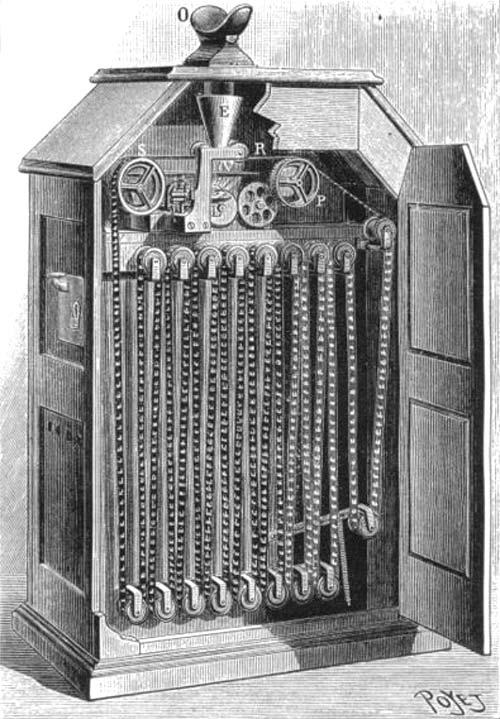
The first public demonstration of the Kinetoscope happened in 1891. By 1894, Kinetoscope parlors had opened, allowing people to pay and watch short films through individual peepholes.
The Lumière Brothers and Public Cinema

In 1895, the brothers Auguste and Louis Lumière held the first public film screening with a paying audience. The event took place on December 28 at the Salon Indien du Grand Café in Paris. They showed short, everyday scenes like a train arriving at a station and workers leaving a factory.
Their invention, the Cinématographe, could record, develop, and project film. This is widely seen as the beginning of commercial cinema.
Why France and the 1890s Matter
France played a central role because the Lumière brothers lived and worked there. Their father ran a photographic business in Lyon, and the brothers used their knowledge of cameras and chemicals to build the Cinématographe.
The 1890s were a turning point in science and mechanics. Electricity, photography, and industrial design were all advancing. Inventors across different countries were combining these tools to capture movement, but the Lumières were the first to turn it into a public art form.
What Happened Next
After 1895, other filmmakers expanded the new medium. In 1902, Georges Méliès released A Trip to the Moon, one of the first films to use fantasy and special effects.
The next year, Edwin S. Porter directed The Great Train Robbery, which used location shooting and editing to create suspense. These longer narrative films showed that movies could do more than capture real life; they could also tell fictional stories.
By 1910, film studios had opened across Europe and the United States. Dedicated movie theaters became common, and actors began to gain fame.
Silent films grew longer and more complex, using text cards and live music to guide audiences through the story.
The Introduction of Sound
In 1927, Warner Bros. released The Jazz Singer, the first feature film with synchronized spoken dialogue. It used a sound-on-disc system called Vitaphone. This marked the beginning of the sound era.
By the early 1930s, nearly all films had sound, and the movie industry had entered the modern age.
See a chronological overview and timeline of the history of film and animation.
Summing Up
Movies were invented through a gradual process of invention, photography, and exhibition across the late 19th century. Pioneers like Muybridge, Le Prince, Edison, and the Lumière brothers helped shape early cinema.
In 1895, the Lumière brothers’ screening in Paris introduced motion pictures as a shared experience. From that moment, movies grew into a global industry and a storytelling form that continues to evolve today.
Read Next: Curious how art movements shaped film?
Explore our full Visual Art Timeline to see how styles like Surrealism, Cubism, and Suprematism influenced cinema’s most experimental moments.
Or keep browsing our Film Movements & World Cinema section for more on the histories that shaped screen culture around the globe.
