
Published: February 14, 2024 | Last Updated: February 5, 2026

Overview
Definition: Onomatopoeia is a word whose sound imitates the real sound it names, like “bang,” “buzz,” or “whoosh.”
What you’ve seen before: You have seen this in subtitles, comic-style title cards, and dialogue where a character uses a sound-word to mimic a hit, crash, or sudden motion.
Example: In Scott Pilgrim vs. the World (2010, Universal), on-screen text pops up during fights to mimic impact sounds, so the words feel like hits you can “see.”
Why it matters: Onomatopoeia communicates sound fast when you do not want a long description. In a script, it can tighten action lines by pointing to the exact sound type. In sound planning and editing, it can act as a quick cue for the sound’s texture, like a sharp “snap” versus a heavy “thud.” That difference changes what you record, what you design, and how you time the cut.
- Key takeaway 1: Use onomatopoeia when the sound type matters more than a detailed explanation.
- Key takeaway 2: Pick sound-words for texture. “Clink” reads differently than “clang.”
- Key takeaway 3: Use it sparingly so it guides pacing instead of cluttering the page.
What is Onomatopoeia? Deeper Meaning and Etymology
Onomatopoeia is a literary device where the word is built to sound like the noise it names. When you say the word out loud, your mouth and timing imitate the sound, even if it is only an approximation.
The word onomatopoeia comes from Greek roots:
- onoma = name
- poiein = to make
In plain terms, the idea is “making a name” by copying a sound.
Examples of Common Onomatopoeias
Here are 12 everyday examples you will hear in dialogue, songs, and captions:
- Buzz: an insect-like vibrating sound.
- Crash: a loud collision or break.
- Ding-dong: a doorbell-like ring.
- Meow: a cat sound.
- Woof: a dog sound.
- Splash: something hitting water.
- Tick-tock: a clock-like beat.
- Sizzle: frying or scorching.
- Chirp: a small bird call.
- Bang: a sudden loud impact.
- Beep: a short electronic tone.
- Clink: light glass or metal contact.
Onomatopoeia vs. Ideophone: What’s the Difference?
Onomatopoeia imitates a real-world sound, like buzz, bang, or hiss.
Ideophone is broader. It covers vivid sensory words that can suggest sound, movement, texture, visual sparkle, or even a feeling. Many languages use ideophones constantly in everyday speech.
For example, in Japanese:
- kirakira suggests sparkle or glitter.
- dokidoki suggests a fast heartbeat.
Why it matters for film and TV
If you write or analyze global cinema, ideophones can show up in dialogue as “built-in” mood and motion. The word itself carries timing and energy, even before music or sound design does the heavy lifting.
Sound Design and Onomatopoeia in Cinema

Film can play real audio, so onomatopoeia often shifts from the page into the soundtrack. Instead of writing “bang,” you hear the gunshot. Instead of writing “crash,” you hear the glass break.
Still, sound words can help in scripts and planning. A short word can signal timing and texture without a full sentence. “SNAP” points to something sharp and fast. “THUD” points to something heavy with weight.
If you want to write sound effects in your screenplay, here’s how to do it in a readable way.
Foley artists build sounds that match or exaggerate real noise. In practice, that job often mirrors what onomatopoeia does on the page: it makes you “feel” the sound’s impact and texture.
Common foley examples:
- Bone break: snapping celery.
- Footsteps: sand-filled shoes on gravel.
- Punch impact: a wet towel slap for a deep THWACK-style hit.
Visual Onomatopoeia in Film: Comic Book Adaptations
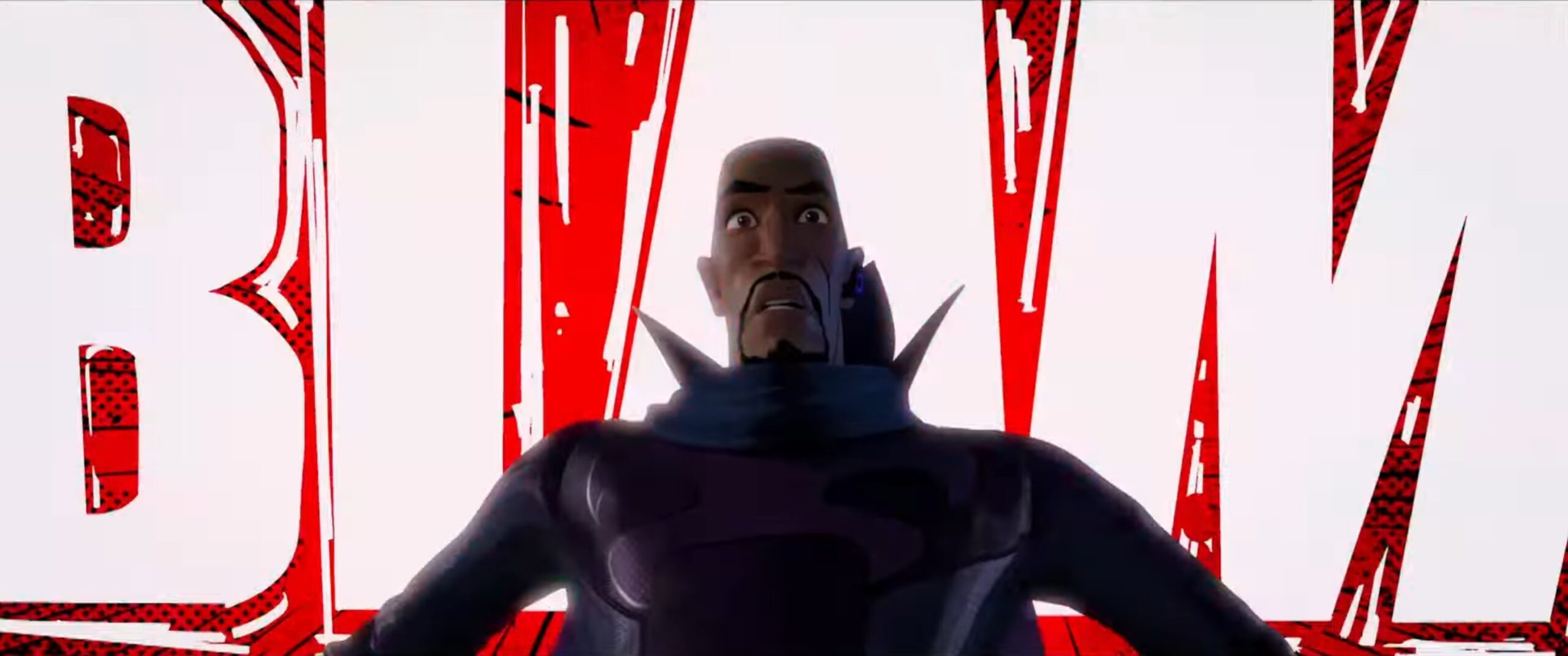
Sometimes the film shows sound as text. That is visual onomatopoeia. It comes straight from comics, where sound-words are part of the artwork.
A well-known TV example is the 1960s Batman series with Adam West, where fight scenes get punctuated by on-screen “POW,” “BAM,” and “ZAP.”
Video example: https://www.youtube.com/watch?v=chdm7xRSlho
In Batman (1989, Warner Bros.), the Joker uses a gag gun that pops a “Bang” flag. The joke works because the word replaces the sound and turns the threat into a cartoon beat.
Video example: https://www.youtube.com/watch?v=YR1GPhCdXyM
Onomatopoeia in Movie Dialogue
Onomatopoeia shows up in dialogue when a character imitates sound with a word. It can make a moment funnier, sharper, or more childish. It can also replace a longer description when a character wants to move fast.
- A character says “ding-dong” while mocking a doorbell.
- A character says “buzz” to imitate a phone vibration.
- A character says “bang” to imitate a sudden impact.
Onomatopoeia in Movie Soundtracks
Sometimes the sound-word is part of the song title or lyrics, so the onomatopoeia becomes part of the film’s meaning.
In Kill Bill: Vol. 1 (2003, Miramax), Nancy Sinatra’s “Bang Bang (My Baby Shot Me Down)” plays over the opening credits. The repeated “bang bang” phrase puts a gunshot idea into the film before you see the story unfold.
Onomatopoeia in Musicals
Musicals often stack sound-words to create rhythm you can sing. In Meet Me in St. Louis (1944, MGM), “The Trolley Song” uses sound-words for bells, motors, and brakes to make the song feel like a moving streetcar.
Video example: https://www.youtube.com/watch?v=Ln3sNwccHxI
Are Sound Effects in Movies Onomatopoeias?
This question comes up because people use onomatopoeia in two different ways: a strict language meaning and a casual film meaning.
Quick definitions
Onomatopoeia (strict): a word whose sound imitates or suggests a real sound (for example, buzz or hiss).
Sound effect (SFX): an audio element added or created to sell action, realism, or mood in a production.
Onomatopoeic spelling: a written rendering of sound in letters (for example, THWACK or BOOM).
Why people mix the terms
In film communities, people sometimes use “onomatopoeia” as shorthand for iconic sounds that have a common fan spelling. “BRAAAM” is a good example. People use the word as a label for a loud, low trailer-horn sound.
The precise view
In language and rhetoric, onomatopoeia means words, not the audio coming out of the speakers. The sound in the movie is still a sound effect.
Practical takeaway for your work
In a screenplay, a sound-word can be a fast cue for timing and texture. In the finished film, the audience hears sound design. Use “onomatopoeia” when you mean words in scripts, dialogue, captions, lyrics, or on-screen comic text.
You might also like: Why you should understand diegetic and non-diegetic sound
The Function of Onomatopoeia in Poetry
In poetry, onomatopoeia changes how a line feels in your mouth and in your head. A sharp cluster of consonants can feel like a snap. A long vowel can feel like a drone. That sound-shape can speed up the pace or slow it down.
For example, Tennyson uses tightly packed sound to suggest a living soundscape: “The moan of doves in immemorial elms, / And murmuring of innumerable bees.”
Famous Examples of Onomatopoeia in Literature
- James Joyce, Ulysses: “Clapclap. Clipclap. Clappyclap.” (a footstep-like rhythm in the line itself)
- Lewis Carroll, “Jabberwocky”: “He chortled in his joy.” (a coined word that sounds like the action)
- William Shakespeare, The Tempest: “Hark! now I hear them,—ding-dong, bell.” (a bell sound inside the language)
Onomatopoeia in Comic Books and Graphic Novels
Comics popularized onomatopoeia by turning sound into typography. A huge all-caps word can feel loud. A small, thin word can feel quiet. The look of the word becomes part of the “sound.”
- Punch impact: KRAK!
- Electric hit: ZZZT!
Case Study: Edgar Allan Poe’s “The Bells”
Poe builds entire sections around repeated sound-words and repeated rhythms. The point is not just imitation. The point is that the line itself rings, clatters, or groans as you read it.
- Light bell texture: “How they tinkle, tinkle, tinkle”
- Harsh bell texture: “How they clang, and clash, and roar!”
Summing Up
Onomatopoeia is one of the fastest ways to communicate sound on the page. It works because the word’s sound carries part of the meaning.
In film, the soundtrack usually carries the sound itself. That pushes onomatopoeia toward dialogue, lyrics, captions, and comic-style on-screen text.
When you use it with intent, it can tighten pacing, signal texture, and help you plan the sound of a moment before you ever record it.
Read Next: Curious how film theory shapes the way we watch movies?
Start with the Film Theory section to break down realism, formalism, structuralism, and more — with examples from iconic films.
If you want studying film theory I recommend starting with The FilmDaft overview of film theory discourses to break down realism, formalism, structuralism, and more — with examples from iconic films.
Then explore the full Film History, Theory & Genre collection to see how movements, styles, and storytelling traditions have evolved.
Whether you’re into Soviet montage or 2000s genre mashups, there’s something here to sharpen your understanding.
