

Published: February 7, 2024 | Last Updated: February 4, 2026

Overview
Definition: Assonance is the repeated use of the same vowel sound in nearby words.
What you’ve seen before: You hear this in film dialogue when a line feels smooth and sticky in your ear, even though it does not rhyme at the end.
Example: A character might use a cluster of long “oh” sounds, like cold, home, alone, and don’t, placed close together. You hear the shared vowel, so the line feels more musical without end rhyme.
Why it matters: Assonance lets you control how a line sits in an actor’s mouth and how it lands in your ear. You can use it to make a key phrase easier to remember. You can also tune tone, like calm, dread, or intimacy. It can tighten dialogue too, because you start choosing words for sound as well as meaning, which changes pacing and emphasis.
- Key takeaway 1: Listen for repeated vowel sounds, not matching letters on the page.
- Key takeaway 2: Use assonance to make an important line feel smoother and easier to repeat in performance.
- Key takeaway 3: Keep it subtle. Heavy assonance can make dialogue sound written instead of spoken.
Next, you’ll learn how to spot assonance fast, and how it differs from rhyme and other sound devices.
Key rule: sound, not spelling
A quick note that saves a lot of confusion: assonance is based on sound, not spelling. Two words can look similar on the page but use different vowel sounds when spoken. Two words can also look different but share the same vowel sound. If you cannot hear the vowel echo when you say the words out loud, it is not assonance.
- Looks similar, but sounds different: love/move (not assonance)
- Looks different, but sounds similar (in most accents): bed/head (assonance)
If you remember one thing: assonance = repeated vowel sounds close together.
How to Identify Assonance in a Sentence
Assonance can be subtle, so the easiest way to spot it is to listen.
A quick 5-step checklist
This checklist helps you hear the pattern instead of guessing from spelling.
- Read the sentence out loud. Go slow.
- Pay attention to stressed syllables. The repeated vowel is often easiest to hear there.
- Listen for repeated vowel sounds as pronounced (like the vowel in see, slow, or cat).
- Ignore spelling. Letters can mislead you.
- Try a swap test: replace one key word. If the echo disappears, you probably found the assonance.
Try it (original examples)
These lines are built to make the vowel repeat easy to hear.
- The creek keeps speeding.
What to listen for: the long “ee” sound repeating (as in see). - The slow road goes home.
What to listen for: the long “oh” sound repeating (as in go).
If you’re unsure, say the candidate words alone and compare the vowel sound you hear in their stressed syllables.
Assonance vs Alliteration vs Consonance
These three devices get mixed up because they all create sound patterns. They repeat different parts of a word.
- Assonance: repeats vowel sounds.
- Alliteration: repeats initial consonant sounds (the start of nearby words).
- Consonance: repeats consonant sounds in nearby words (often at the end, but it can also happen in the middle).
| Device | Repeats… | Example | Typical effect |
|---|---|---|---|
| Assonance | Vowel sounds | The slow road goes home. | Smoothness, mood, internal rhythm |
| Alliteration | Starting consonant sounds | Bold birds beat branches. | Punch, speed, memorability |
| Consonance | Consonant sounds (often end sounds) | The black rock truck. | Texture, cohesion, emphasis |
Key takeaway: If the repeating sound is a vowel, it’s assonance. If it’s a starting consonant, it’s alliteration. Repeated consonant sounds elsewhere are consonance.
Difference Between Assonance and Rhyme
Assonance and rhyme are related, but they are not the same thing.
What rhyme is
Rhyme usually matches a word’s ending sound (often a vowel plus the following consonant), especially at the ends of lines. For example: night/light.
What assonance is
Assonance matches vowel sounds and can happen anywhere in a line, not just at the end.
- The tide rises while I write.
What to listen for: the /aɪ/ sound (as in my) repeating: tide, rises, while, write.
How they can work together
Assonance can support internal rhyme and slant rhyme. Repeated vowels make partial sound matches feel tighter, even when the consonants do not match perfectly.
Rule of thumb: If the endings match, you’re in rhyme territory. If the vowels echo without matching endings, it’s assonance.
Function and Effect of Assonance in Writing
Assonance changes how a line sounds, so it changes how it feels when you read it or hear it spoken.
- Creates internal rhythm: the repeated vowel sets a beat inside the sentence, so the line flows without end rhyme.
- Pulls key words together: when the same vowel returns on the stressed beats, your ear links those words as a unit.
- Changes pacing: long vowels (like “oh” and “ee”) often feel more drawn out; short vowels (like the “i” in sit) can feel tighter and faster.
- Makes lines easier to repeat: sound patterns stick, which helps catchphrases and principles land in dialogue.
- Adds character texture: you can lean into a vowel pattern to make a line feel casual, tense, intimate, or blunt, depending on the scene and delivery.
How to use it without overdoing it
Assonance works best when the line still sounds like real speech.
- Start with one main vowel sound per sentence or line.
- Choose words for meaning first. Then look for small sound matches that fit.
- Read it out loud. If the sound pattern becomes louder than the message, simplify.
Examples of Assonance in Movie Scripts
In film, you hear assonance most often in dialogue (and sometimes lyrics). It adds rhythm, emphasis, and a subtle echo between key words. Because assonance is about sound, the best test is simple: say the line out loud and listen for the repeated vowel.
Note: Pronunciation varies by accent. The vowel notes below assume a common American-English reading.
Back to the Future (1985)
Writers: Robert Zemeckis & Bob Gale
Where we’re going, we don’t need roads.
– Doc Emmett Brown
Assonance: the long “oh” sound (/oʊ/) repeats in going / don’t / roads.
Effect: the repeated vowel gives the line a rolling rhythm, so it lands like a slogan.
Jurassic Park (1993)
Screenplay: David Koepp (based on Michael Crichton’s novel)
No, I’m simply saying that life… uh, finds a way.
– Ian Malcolm
Assonance: the /aɪ/ sound repeats in life / finds.
Effect: the vowel echo tightens the phrase. It helps it land like a principle instead of a throwaway comment.
E.T. the Extra-Terrestrial (1982)
Writer: Melissa Mathison
E.T. phone home.
– The Extra-Terrestrial
Assonance: the long “oh” sound (/oʊ/) repeats in phone / home.
Effect: the match makes the line feel simple and musical, which fits an iconic hook.
Thelma & Louise (1991)
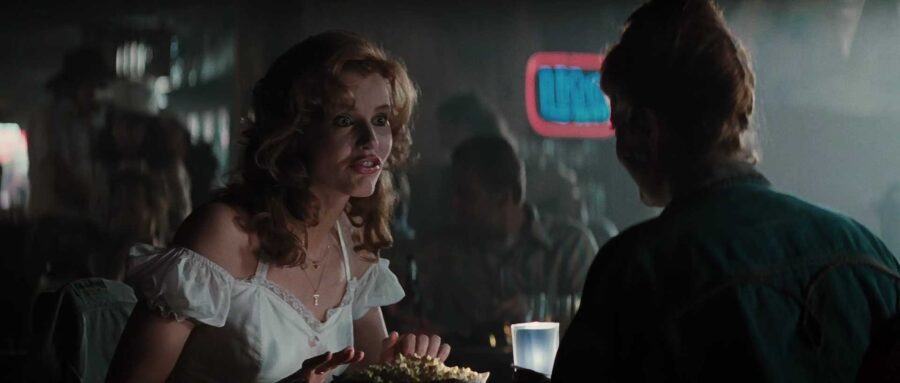
Screenplay: Callie Khouri
Here’s an excerpt:
We’re gonna get out of town… let our hair down.
– Thelma
Explanation: The strongest assonance here is the repeated /aʊ/ vowel (as in out): out, town, down. That repeated vowel works like a chant. It keeps pushing the idea of escape and release forward on the same sound, which fits a line meant to feel unstoppable when performed.
Assonance Examples in Poetry and Literature
Below are examples chosen for what you hear: clear vowel-sound repetition. Reminder: assonance is about pronunciation, not letters.
Poetry examples (classic/public domain)
- William Shakespeare, The Tempest: “Full fathom five thy father lies”
Assonance: the /aɪ/ sound repeats (as in my): five / thy / lies. - William Blake, The Tyger: “Tyger Tyger, burning bright”
Assonance: the /aɪ/ sound repeats (as in my): Tyger / bright. - Edgar Allan Poe, The Raven: “…midnight dreary… weak and weary”
Assonance (plus rhyme support): dreary / weary share a similar vowel region in many pronunciations, which also supports the rhyme feel.
Literature-style examples (original)
These are original lines built to make the vowel repeat easy to hear.
- The lone road closed slowly.
Assonance: the long “oh” sound repeats (as in go). - He didn’t quit. He kipt winning.
Assonance: the short “i” sound repeats (as in sit).
Assonance Examples in Popular Songs
Below are short lyric snippets for illustration. Read them out loud and listen for the vowel echo.
Backstreet Boys — “I Want It That Way”
You are my fire, the one desire
Assonance: the /aɪ/ vowel in my returns in the “-ire” sound in fire/desire in many pronunciations.
Note: this line also uses end rhyme (fire/desire), so it is a good example of assonance working alongside rhyme.
Rihanna — “Diamonds”
Shine bright like a diamond
Assonance: the /aɪ/ sound repeats in shine / bright / like.
Effect: the repeating vowel helps the line hit like a chant, which fits a chorus hook.
Louis Armstrong — “What a Wonderful World”
I see trees of green, red roses too
Assonance: the long “ee” sound (/iː/) repeats in see / trees / green.
Effect: the sustained vowel slows the phrase down, so it suits a warm, reflective delivery.
The Police — “Every Little Thing She Does Is Magic”
Every little thing she does is magic
Assonance: the /ɪ/ vowel (as in sit) repeats across key beats in little / thing / is. Some pronunciations also bring a light /ɪ/ sound into the second syllable of magic.
Not every word needs to match. Assonance often clusters around the most noticeable beats.
How to spot assonance in any song
This quick routine helps you hear the repeated vowel in a chorus or hook.
- Say the lyric out loud (or sing it).
- Focus on the vowel inside the stressed syllables.
- If the same vowel sound keeps returning across key words, that’s assonance.
Summing Up
Assonance is a literary device where vowel sounds repeat close together to build internal rhythm and steer how a line lands when spoken.
Rhyme usually matches end sounds. Assonance matches vowel sounds inside the line, so it can show up anywhere in a sentence.
In film, you’ll notice assonance most in dialogue and lyrics, where sound patterns make lines easier to remember and easier to perform.
Read Next: Want to dig deeper into screenwriting?
Start with the Screenwriter’s Toolkit on literary devices vs. elements – a deep resource covering every major literary device and element used in writing.
Then explore our collection of practical writing techniques covering dialogue, structure, and pacing.
Or jump into the free screenwriting course to start your first draft today.
You can also head back to the Screenwriting section for more tools, theory, and breakdowns.
